2.2.2(k)-(l) - Intermolecular forces and hydrogen bonding
Molecules can be covalently bonded inside themselves and still attract neighbouring molecules. This lesson builds the three intermolecular-force models you need here: induced dipole-dipole interactions, permanent dipole-dipole interactions and hydrogen bonding. The aim is to name each interaction precisely and explain where the attraction comes from.
Forces between molecules
An intermolecular force is an attraction between neighbouring molecules. It is different from the covalent bond within a molecule.
For example, in hydrogen chloride, HCl, the H-Cl covalent bond is inside each molecule. Attractions between one HCl molecule and a neighbouring HCl molecule are intermolecular forces.
Intermolecular force
An intermolecular force is an attractive force between molecules. It is not the same as a covalent bond within a molecule.
This distinction matters in explanations. When a simple molecular substance melts or boils, the molecules separate from each other more easily. The covalent bonds inside the molecules are not normally broken.
Use "between molecules" for intermolecular forces. Use "within a molecule" for covalent bonds.
The three named models in this lesson are:
- induced dipole-dipole interactions
- permanent dipole-dipole interactions
- hydrogen bonding
Worked reasoning: melting iodine
Iodine, I₂, is a simple molecular substance. Each iodine molecule contains a covalent I-I bond. In solid iodine, many I₂ molecules are attracted to neighbouring I₂ molecules by intermolecular forces.
When iodine melts, the particles gain enough energy to overcome some of the intermolecular forces between I₂ molecules. The I-I covalent bonds inside the I₂ molecules are not broken.
Induced dipole-dipole interactions
Electrons in a molecule are always moving. At one instant, the electron cloud may be slightly uneven, so one end of the molecule is slightly more negative and the other end is slightly more positive. This is a temporary dipole.
That temporary dipole can distort the electron cloud in a neighbouring molecule. The neighbouring molecule then has an induced dipole. Opposite partial charges attract, giving an induced dipole-dipole interaction.
Induced dipole-dipole interaction
An induced dipole-dipole interaction is an intermolecular attraction caused by a temporary dipole inducing a dipole in a neighbouring molecule.
These interactions are often the main intermolecular force between non-polar molecules, such as F₂ or I₂. They can also occur alongside other intermolecular forces in polar molecules.
The same interaction has several acceptable names:
- induced dipole-dipole interaction
- London force
- London dispersion force
- induced dipole-dipole interaction as a type of van der Waals' force
For exam-style precision, use "induced dipole-dipole interaction" when the question is about the model. "London (dispersion) forces" is the common accepted alias.
Worked example: identifying the force in fluorine
Fluorine, F₂, is a non-polar molecule. It has no permanent dipole because the two atoms have the same electronegativity and the molecule is symmetrical.
The electron cloud in an F₂ molecule can still become uneven for an instant. This temporary dipole induces a dipole in a neighbouring F₂ molecule, so F₂ molecules attract each other by induced dipole-dipole interactions.
Permanent dipole-dipole interactions
A molecule has a permanent dipole if it has an overall separation of charge. That means one part of the molecule is always slightly positive and another part is always slightly negative.
In a liquid or solid made of polar molecules, neighbouring molecules can line up so that a delta-positive end of one molecule is close to a delta-negative end of another. The electrostatic attraction between these permanent dipoles is a permanent dipole-dipole interaction.
Permanent dipole-dipole interaction
A permanent dipole-dipole interaction is an intermolecular attraction between the opposite partial charges of neighbouring polar molecules with permanent dipoles.
Permanent dipole-dipole interactions can also be called van der Waals' forces. To avoid ambiguity, name the exact interaction whenever possible.
[DIAGRAM: asset_name: 02 02 02e intermolecular forces and hydrogen bonding diagram 01; asset_slug: 02_02_02e_intermolecular_forces_and_hydrogen_bonding__diagram_01; recommended_method: drawn_chem; description: Two complete temporary/induced dipoles with unlike adjacent charges and two complete HCl molecules permanent dipoles; correct inter/intramolecular line conventions.]
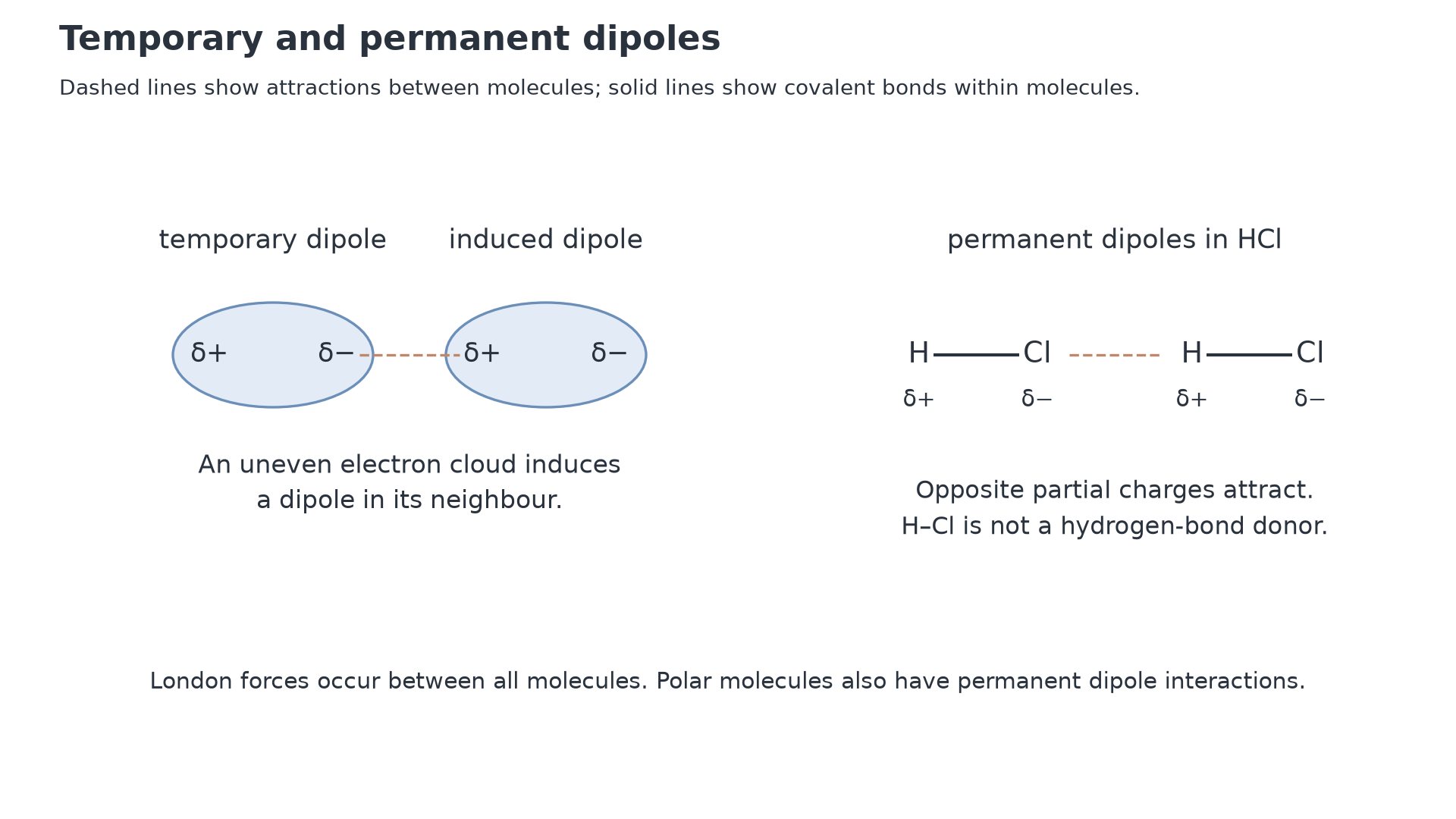
Worked example: hydrogen chloride
Hydrogen chloride, HCl, is polar because chlorine is more electronegative than hydrogen. The H end is delta-positive and the Cl end is delta-negative.
Between neighbouring HCl molecules, the delta-positive H end of one molecule is attracted to the delta-negative Cl end of another molecule. That attraction is a permanent dipole-dipole interaction.
Do not call this hydrogen bonding. HCl has H bonded to Cl, not H bonded to N, O or F.
Hydrogen bonding
Hydrogen bonding is a particular strong intermolecular attraction. In this specification point, it occurs between molecules containing:
- N, O or F with a lone pair
- a hydrogen atom in an -NH, -OH or H-F bond
The H atom in an N-H, O-H or H-F bond is strongly delta-positive because N, O and F are very electronegative. A lone pair on N, O or F in a neighbouring molecule can attract this delta-positive H atom.
Hydrogen bonding
Hydrogen bonding is intermolecular bonding between a lone pair on N, O or F in one molecule and the delta-positive H atom of an -NH, -OH or H-F bond in another molecule.
The lone pair is essential. A hydrogen bond is not the covalent N-H, O-H or H-F bond itself. It is the attraction from that delta-positive H atom to a lone pair on N, O or F in a neighbouring molecule.
[DIAGRAM: asset_name: h432 hydrogen bond; asset_slug: h432_hydrogen_bond; recommended_method: drawn_chem; description: Two water molecules, each two O-H covalent bonds and two lone pairs; straight donor O-H to acceptor O lone-pair dashed H bond; partial charges.]
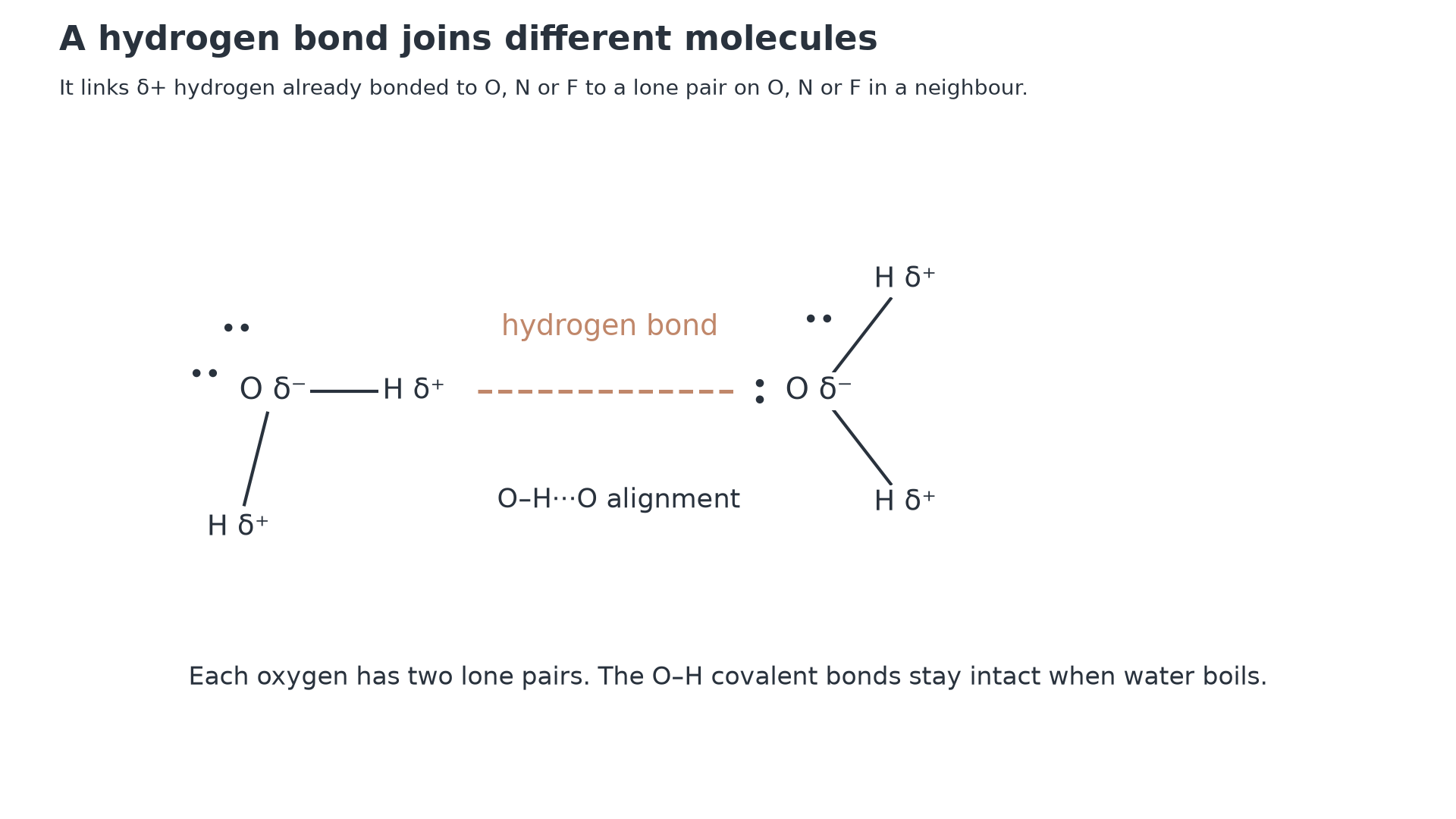
Worked example: water molecules
A water molecule has O-H bonds. Oxygen is very electronegative, so each H atom in an O-H bond is delta-positive. Oxygen also has lone pairs.
Between water molecules, a lone pair on the oxygen atom of one molecule can attract the delta-positive H atom in an O-H bond of another molecule. That intermolecular attraction is a hydrogen bond.
Worked example: why fluoromethane is not enough
Fluoromethane, CH₃F, contains fluorine, but its hydrogens are bonded to carbon, not to fluorine. A CH₃F molecule does not contain an H-F bond, an O-H bond or an N-H bond.
So CH₃F molecules can have permanent dipole-dipole interactions, but they do not form hydrogen bonds with each other.
Choosing the correct interaction name
Build the list of interactions rather than choosing only one.
- All molecules have London/induced dipole-dipole interactions.
- If the molecule has a permanent dipole, also identify permanent dipole-dipole interactions.
- If it has H directly bonded to N, O or F and a neighbouring N, O or F lone pair, identify hydrogen bonding. For these polar hydrogen-bonding molecules, naming hydrogen bonding with London interactions is sufficient unless the question asks for all contributions.
This identifies which interactions are present, not a universal ranking of their strength. London interactions occur between all molecules; polar molecules also have permanent dipole-dipole interactions, and suitable N-H/O-H/H-F donors and lone-pair acceptors can form hydrogen bonds. London interactions can make a large contribution even in polar substances, so do not automatically call the permanent-dipole interaction the strongest.
Worked example: classify three substances
| substance | reasoning | interactions present |
|---|---|---|
| F₂ | non-polar molecule; temporary dipoles can induce neighbouring dipoles | induced dipole-dipole interactions |
| HCl | polar molecule with a permanent dipole; H is not bonded to N, O or F | London and permanent dipole-dipole interactions |
| CH₃OH | contains an O-H bond and oxygen has lone pairs | London interactions and hydrogen bonding |
Worked example: ether compared with methanol
Methoxymethane, CH₃OCH₃, contains oxygen with lone pairs, but it has no O-H bond. Between methoxymethane molecules, there is no delta-positive H atom from an O-H bond for the oxygen lone pair to attract, so there is no hydrogen bonding between its own molecules.
Methanol, CH₃OH, contains an O-H bond and an oxygen lone pair. Methanol molecules can form hydrogen bonds with each other. Methoxymethane can still accept hydrogen bonds from water: a water O–H group supplies the donor and the ether oxygen supplies a lone pair. Always distinguish self hydrogen bonding from hydrogen bonding in a mixture.
Quick recap
- Changes of state normally overcome attractions between molecules, not covalent bonds within them.
- London interactions arise when a temporary dipole induces a dipole in a neighbour; all molecules have them.
- Polar molecules also attract through permanent dipole–dipole interactions.
- Hydrogen bonding needs a suitable N/O/F lone pair and an H directly bonded to N/O/F; distinguish self hydrogen bonding from bonding with water.
- Identify all relevant interactions before comparing their combined effect; there is no universal strongest-force ranking for all substances.