4.2.2(a)-(d) - Haloalkanes and nucleophilic substitution
Haloalkanes are useful because the carbon-halogen bond can be replaced by other groups. In this lesson, the replacement is hydrolysis: a haloalkane forms an alcohol by a substitution reaction. You will learn the reagent conditions, the meaning of nucleophile, the primary haloalkane mechanism, and how the silver nitrate experiment links rate to carbon-halogen bond enthalpy.
Hydrolysis as substitution
A haloalkane has a halogen atom bonded to a saturated carbon atom. A simple way to write one is R-X, where R is an alkyl group and X is a halogen atom such as Cl, Br or I.
In hydrolysis of a haloalkane, the halogen atom is replaced by an OH group. The organic product is an alcohol, and the halogen leaves as a halide ion.
Substitution reaction
A substitution reaction is a reaction in which one atom or group of atoms in a molecule is replaced by another atom or group of atoms.
With aqueous alkali, the reacting nucleophile is hydroxide ion, , from aqueous sodium hydroxide or aqueous potassium hydroxide. The general equation is:
For example, bromoethane forms ethanol:
The usual condition is warming or heating under reflux with aqueous alkali. The word "aqueous" matters here: aqueous alkali supplies hydroxide ions for substitution. This is different from ethanolic alkali conditions used elsewhere for elimination.
Worked example: predicting the hydrolysis product
For , the chlorine atom is on carbon 1. Replacing Cl with OH gives , propan-1-ol. The chloride leaves as .
Do not write or "chlorine" as the leaving product. The C-Cl bond breaks heterolytically so that chloride ion, , is formed.
Nucleophiles and the polar c-x bond
The mechanism depends on two ideas: a nucleophile has an electron pair available, and the carbon-halogen bond is polar.
Nucleophile
A nucleophile is an electron pair donor.
Hydroxide ion is a nucleophile because the oxygen has lone pairs and a negative charge. Water can also act as a nucleophile because oxygen has lone pairs, although water is neutral and usually a weaker nucleophile than .
The C-X bond in a haloalkane is polar because halogens are more electronegative than carbon. The halogen pulls electron density towards itself, so the carbon bonded to the halogen is electron-deficient:
That partial positive charge on carbon makes it a target for an electron pair from a nucleophile. The halogen can leave as a halide ion when the C-X bonding pair moves onto the halogen.
In OCR mechanism answers, the electron pair movement matters: the curly arrow must start from a lone pair or negative charge on the nucleophile, and the C-X bond electrons must move to the halogen.
Worked example: identifying the nucleophile
In the reaction of with aqueous hydroxide, is the nucleophile. It donates an electron pair from oxygen to the carbon bonded to bromine. Bromine is not the nucleophile in this reaction; bromine leaves as .
Primary haloalkane mechanism
OCR requires the nucleophilic substitution mechanism for hydrolysis of primary haloalkanes with aqueous alkali. A primary haloalkane has the halogen bonded to a carbon that is bonded to only one other carbon atom.
When drawing the mechanism, use a full-headed curly arrow from a lone pair or the negative charge on oxygen in to the delta-positive carbon. Start a second full-headed arrow on the C-Br bond itself and end it on Br; do not start this arrow in empty space or on the carbon label. Show the C-Br dipole, the hydroxide charge, and bromide as . The arrows represent electron-pair movement.
[DIAGRAM: asset_name: Primary haloalkane hydrolysis mechanism; asset_slug: 04_02_02a_haloalkane_hydrolysis_and_nucleophilic_substitution__diagram_01; recommended_method: drawn_chem; description: Electron-pair arrows begin at a visible oxygen lone pair and the C-Br bond; C delta positive, Br delta negative; ethanol and bromide products.]
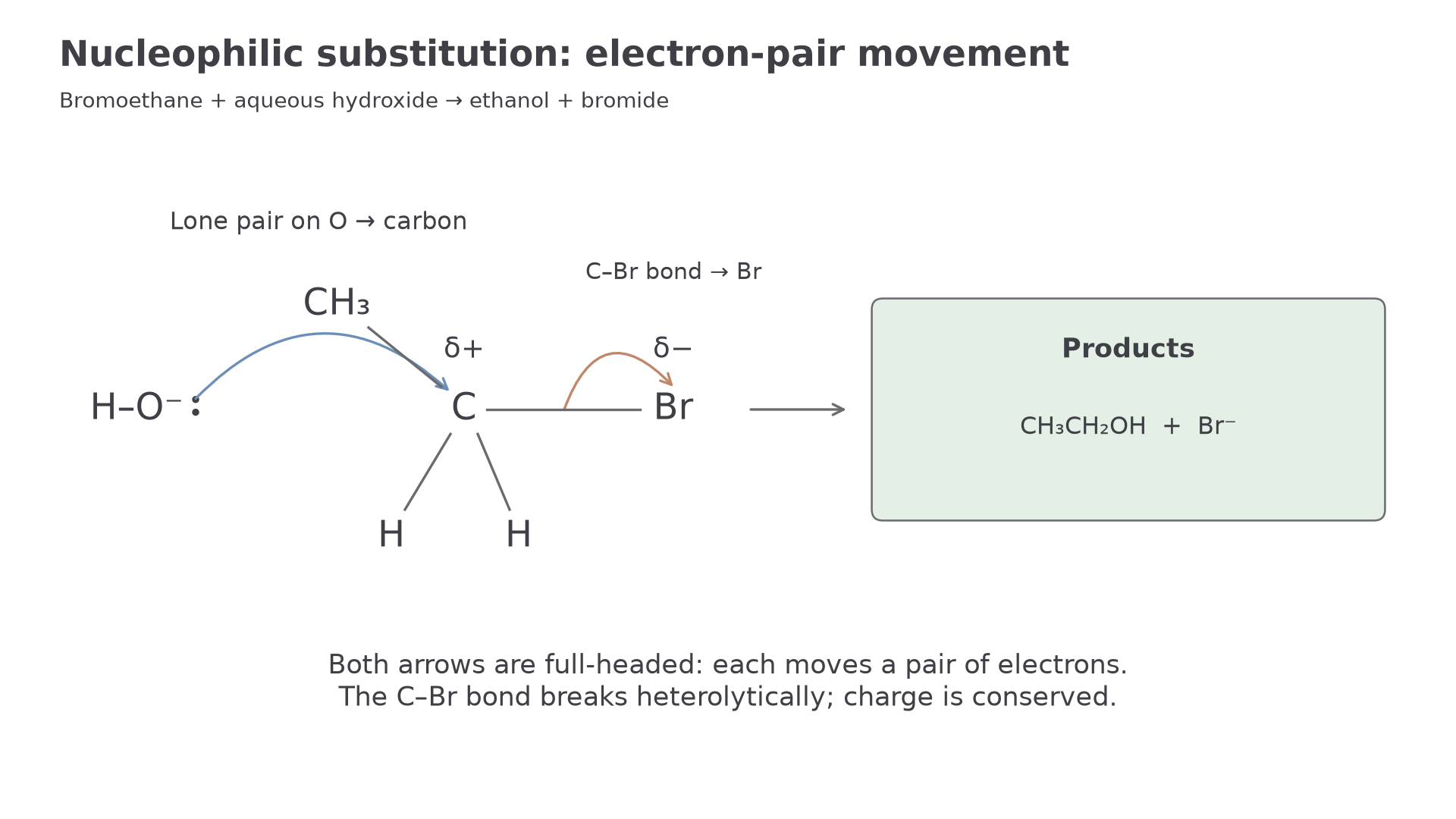
For bromoethane, the mechanism is:
- The oxygen in donates an electron pair to the carbon bonded to bromine.
- At the same time, the C-Br bond breaks and its electron pair moves onto bromine.
- A new C-O bond forms, producing ethanol, and bromide ion is released.
The overall equation is:
This is not a radical mechanism. Curly arrows show movement of electron pairs, not movement of atoms. The bromine atom is not "pushed off" as neutral bromine; it leaves with the bonding pair as .
Worked example: checking a mechanism description
A student writes: "The hydroxide ion attacks the carbon attached to chlorine. The C-Cl bond breaks and chloride ions form."
That is close, but a full mechanism answer needs electron-pair detail: the arrow should start from the lone pair or negative charge on oxygen in and go to the carbon of the C-Cl bond. A second arrow should start from the C-Cl bond and go to chlorine. The C-Cl dipole should show carbon as delta+ and chlorine as delta-.
Silver nitrate rate experiment
Haloalkanes can also be hydrolysed by water in the presence of aqueous silver nitrate and ethanol. This is used to compare experimentally the rates of hydrolysis of different carbon-halogen bonds.
Continue this lesson.
You’re previewing NovaLearn without an account. Create a free account to read the rest.
Create free account