6.2.4 - Carbon-carbon bond formation
Making a new C-C bond is one of the most powerful ideas in organic synthesis because it lets chemists build a larger carbon skeleton from a smaller one. In this lesson, you will use cyanide ions, carbonyl compounds and Friedel-Crafts reactions as OCR's required C-C bond-forming routes. The key skill is not just recalling reagents: it is seeing which carbon atoms become bonded, then choosing the correct mechanism family and follow-up reaction.
Why C-C bonds matter
Many organic reactions change one functional group into another without changing the number of carbon atoms. For example, oxidation can turn an alcohol into an aldehyde or carboxylic acid, but the carbon skeleton normally stays the same.
Carbon-carbon bond formation is different. It increases the carbon skeleton by forming a new bond between two carbon atoms. OCR 6.2.4 focuses on three C-C-forming families:
- cyanide substitution of haloalkanes to form nitriles
- cyanide addition to carbonyl compounds to form hydroxynitriles
- Friedel-Crafts alkylation or acylation of aromatic compounds
The cyanide ion, CN⁻, is especially useful because it contains a carbon atom and a nitrogen atom. In these reactions, the new bond is made using the carbon end of CN⁻, not the nitrogen end. That is why cyanide reactions can extend the chain by one carbon.
Nitrile
A nitrile is an organic compound containing the group, where the carbon of is bonded to the carbon skeleton and is triple-bonded to nitrogen.
Worked example: spotting chain extension
Bromoethane has two carbon atoms: CH₃CH₂Br.
When it reacts with CN⁻, the product is CH₃CH₂CN. The nitrile carbon is counted as part of the longest carbon chain, so the product has three carbon atoms and is propanenitrile.
This is not just "adding nitrogen". It is a C-C bond-forming reaction because the ethyl carbon skeleton is now bonded to the carbon of the group.
Haloalkanes to nitriles
A haloalkane contains a polar C-X bond, where is a halogen. The carbon bonded to the halogen is electron deficient because the halogen is more electronegative than carbon. A cyanide ion can attack this carbon and replace the halogen.
The required OCR condition is cyanide ion in ethanol. In reagent form, write this as ethanolic potassium cyanide or ethanolic sodium cyanide, usually heated under reflux:
or
The general ionic equation is:
Ethanol helps the organic haloalkane mix with the cyanide reagent; water alone dissolves many haloalkanes poorly.
The reaction type is nucleophilic substitution.
Nucleophilic substitution
Nucleophilic substitution is a reaction in which a nucleophile donates an electron pair to an electron-deficient carbon and replaces a leaving group.
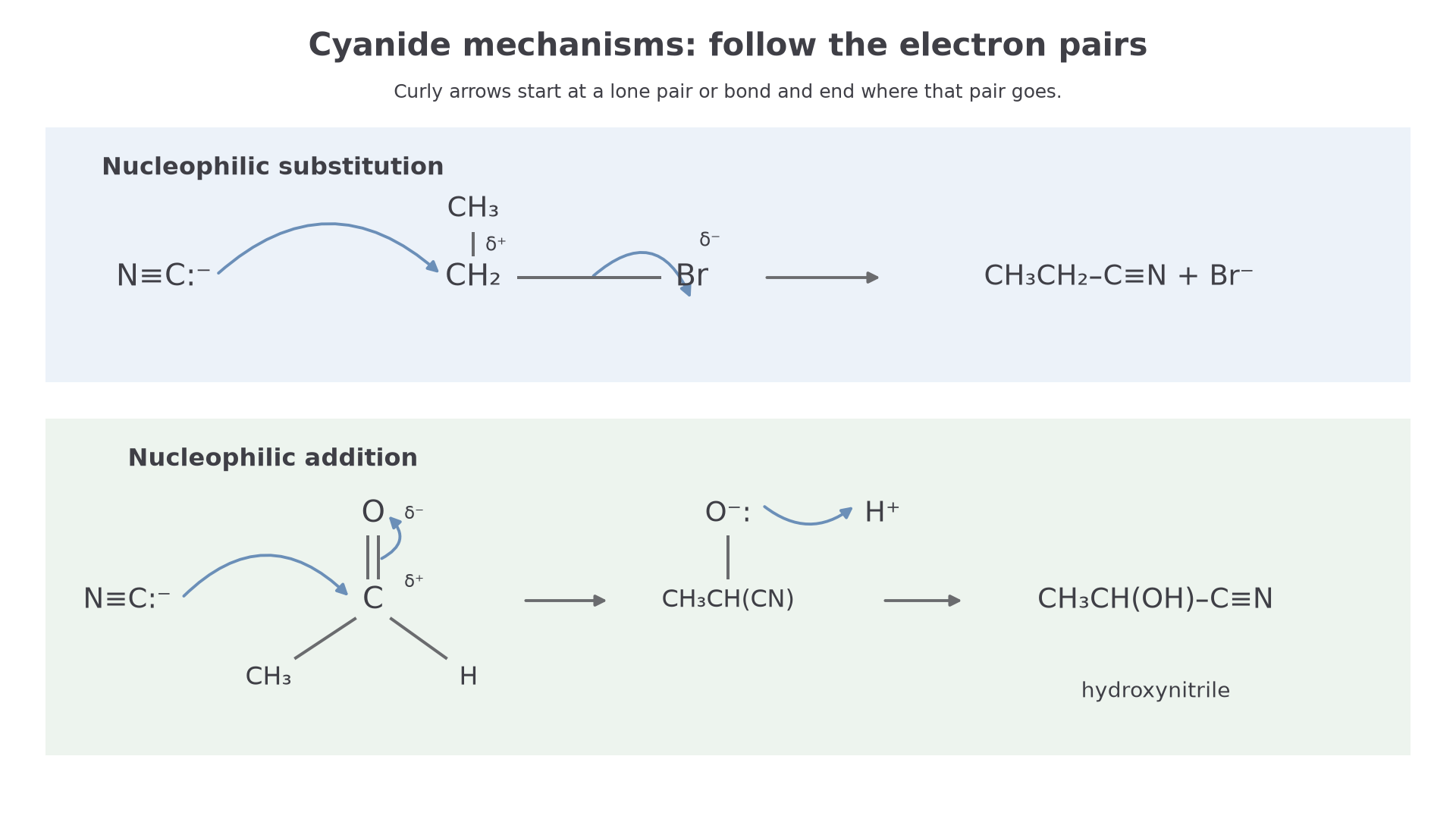
For a primary haloalkane, the mechanism can be described as one concerted step:
- Draw a curly arrow from a lone pair on the carbon of CN⁻ to the carbon bonded to the halogen.
- Draw a second curly arrow from the C–X bond to X as that bond breaks heterolytically.
- The halide ion, X⁻, leaves.
- A nitrile is formed with one more carbon in the chain than the original haloalkane.
Worked example: 1-bromopropane to butanenitrile
Start with CH₃CH₂CH₂Br. Replace by , making sure that attaches through carbon:
[DIAGRAM: asset_name: 6.2.4 - Carbon-carbon bond formation - diagram 02; asset_slug: 06_02_04_carbon_carbon_bond_formation__diagram_02; recommended_method: drawn_chem; description: Electron-pair arrows for cyanide substitution and carbonyl addition, with carbon lone pair, polar bonds, alkoxide and protonation.]
The product is butanenitrile because the carbon is included in the four-carbon chain.
A common exam error is using for this haloalkane step. That is the carbonyl-addition reagent system, not the haloalkane-to-nitrile condition. For haloalkanes, use cyanide in ethanol.
Carbonyls to hydroxynitriles
Aldehydes and ketones contain a polar carbonyl group, C=O. Oxygen is more electronegative than carbon, so the carbonyl carbon is δ⁺ and can be attacked by a nucleophile.
Hydrogen cyanide adds to aldehydes and ketones to form hydroxynitriles. The product has an group and a group attached to the carbon that used to be the carbonyl carbon.
For an aldehyde:
For a ketone:
Use HCN with a cyanide catalyst, or a suitable partially acidified cyanide reagent system that supplies both HCN and CN⁻. In mechanism terms, the reacting nucleophile is CN⁻. The mechanism is nucleophilic addition:
- CN⁻ attacks the δ⁺ carbonyl carbon through the carbon end of cyanide.
- The C=O pi-bond electron pair moves to oxygen, forming an alkoxide intermediate with O⁻.
- Draw a curly arrow from an oxygen lone pair of the alkoxide to H⁺. This protonates the intermediate, forming the group.
Worked example: ethanal to a hydroxynitrile
Ethanal is CH₃CHO. The carbonyl carbon gains , and the oxygen becomes after protonation:
The product is 2-hydroxypropanenitrile. It has three carbon atoms: the original two from ethanal plus the nitrile carbon. This reaction is therefore both nucleophilic addition and C-C bond formation.
For propanone:
The product is 2-hydroxy-2-methylpropanenitrile. Count total carbons as well as tracing the parent chain: cyanide adds one carbon to the skeleton, but a branched substrate does not always increase the longest chain by one.
Haloalkane plus cyanide is nucleophilic substitution. Carbonyl compound plus HCN is nucleophilic addition. The same CN⁻ nucleophile is involved, but the functional group decides the mechanism family.
Continue this lesson.
You’re previewing NovaLearn without an account. Create a free account to read the rest.
Create free account