5.3.1(j) - Transition metal precipitation reactions
Transition-metal ions in solution often give very distinctive test-tube observations. In this lesson you will learn the precipitation reactions of aqueous , , , and with aqueous sodium hydroxide and aqueous ammonia, then the few cases where the precipitate dissolves in excess reagent to form a complex ion. The key exam skill is to link three things cleanly: the observation, the formula of the species formed, and a balanced ionic equation.
The precipitation model
A precipitation reaction occurs when ions in aqueous solution react to form an insoluble solid. In these reactions, the insoluble solid is a metal hydroxide.
Precipitation reaction
A precipitation reaction is a reaction in which two dissolved species form an insoluble solid product, called a precipitate.
For this lesson, an aqueous transition-metal ion may be written in a simple form, such as , or as a metal-aqua complex, such as . OCR accepts either style for precipitation equations, so the lesson will use the simple formula first and then show how it connects to the complexed formula.
With aqueous sodium hydroxide, the reagent supplies hydroxide ions directly:
Hydroxide precipitation pattern
For a 2+ ion:
For a 3+ ion:
Aqueous ammonia is slightly different. Ammonia first acts as a base: it accepts from coordinated water molecules, so the same hydroxide precipitate forms and ammonium ions are produced. For example, copper(II) may be written in the complexed style as:
The simple version, , is still a valid precipitation equation when hydroxide ions are the reagent.
Worked example: balancing an iron(III) precipitation equation
Iron(III) is , so three hydroxide ions are needed to make a neutral solid:
The charges balance because , matching the neutral precipitate.
Dropwise observations
When aqueous sodium hydroxide or aqueous ammonia is added dropwise, the same hydroxide precipitates are formed. The precipitate colour is the observation you usually need to state.
| Aqueous ion | Usual solution colour | Dropwise or observation | Precipitate formula |
|---|---|---|---|
| pale blue | pale blue precipitate | ||
| pale green | dark green / green precipitate | ||
| yellow / orange-brown | orange-brown precipitate | ||
| very pale pink | very pale/off-white to pale brown precipitate | ||
| pale purple, often green in solution | dark grey-green / green precipitate |
[DIAGRAM: asset_name: Lesson 5.3.1j: Transition metal precipitation reactions - diagram 01; asset_slug: 05_03_01e_transition_metal_precipitation_reactions__diagram_01; recommended_method: drawn_chem; description: 16:9 table summarising the five ions, dropwise hydroxide/ammonia precipitates, and the OCR-limited excess sodium hydroxide and ammonia outcomes.]
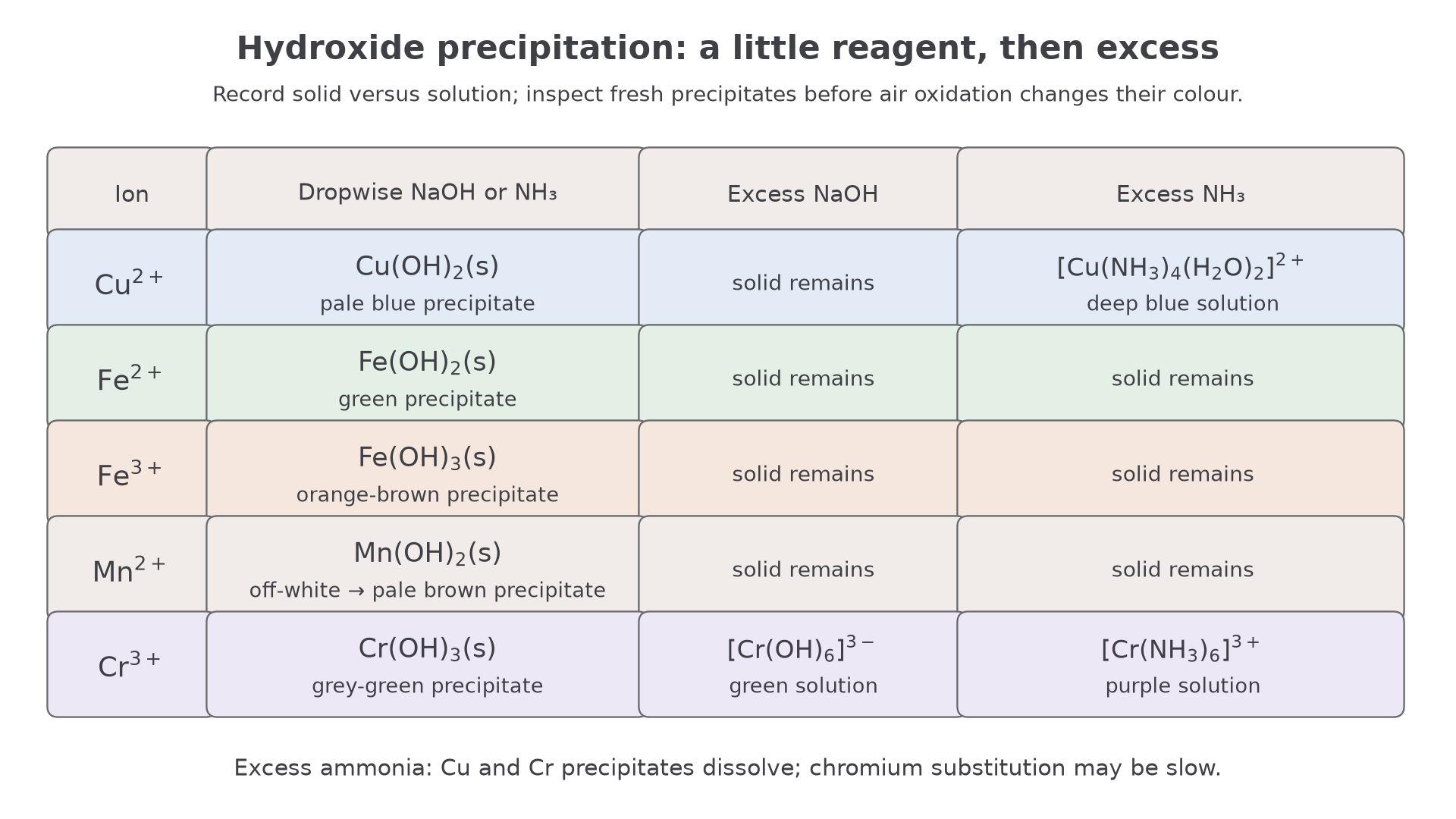
The colour words do not have to be poetic. They have to be chemically precise enough for marking: pale blue precipitate, green precipitate, orange-brown precipitate, pale brown precipitate, and grey-green precipitate are the high-value answers.
Worked example: identifying a metal ion from a dropwise test
A solution gives a pale brown precipitate with dropwise aqueous sodium hydroxide. From the table, a pale brown hydroxide precipitate in this set points to .
The ionic equation is:
The observation and equation support the same conclusion: manganese(II) ions were present.
Excess sodium hydroxide
After the dropwise precipitate forms, the next question is whether it reacts further in excess sodium hydroxide.
For this OCR set, there is only one excess- exception:
With excess aqueous sodium hydroxide, only reacts further. It dissolves to form the dark green complex ion .
The equation is:
The other four hydroxide precipitates do not dissolve in excess sodium hydroxide in this specification point:
| Precipitate | In excess |
|---|---|
| no further reaction | |
| no further reaction | |
| no further reaction | |
| no further reaction | |
| dissolves to dark green |
Continue this lesson.
You’re previewing NovaLearn without an account. Create a free account to read the rest.
Create free account