5.3.1(h)-(i) - Ligand substitution and haemoglobin
Ligand substitution is one reason transition-metal chemistry is so visually distinctive: a new ligand can replace an old ligand around a metal ion, forming a new complex with a different colour. In this lesson you will learn the specific copper(II) and chromium(III) substitutions required by OCR, then apply the same idea to iron in haemoglobin, where oxygen and carbon monoxide act as ligands.
Ligand substitution as exchange
A ligand substitution reaction happens when one or more ligands in a complex are replaced by different ligands. The metal ion stays at the centre of the complex, but the atoms or ions bonded to it change.
Ligand substitution
Ligand substitution is a reaction in which one or more ligands bonded to a central metal ion are replaced by different ligands.
For this OCR lesson, always write the reacting metal ions as complex ions. For copper(II), use the hexaaquacopper(II) ion:
For chromium(III), use the hexaaquachromium(III) ion:
The square brackets show the whole complex ion. The charge outside the brackets is the overall charge of the complex. Water and ammonia ligands are neutral; chloride ligands each have a 1- charge. That is why replacing neutral water ligands by chloride ions can change the overall charge of the complex.
The colour change is evidence that a different complex has formed. You do not need a detailed explanation of d-orbital splitting here; the high-value OCR skill is to link each reagent to the correct complex formula, equation and colour.
[DIAGRAM: asset_name: Lesson 5.3.1h-i: Ligand substitution and haemoglobin - diagram 01; asset_slug: 05_03_01d_ligand_substitution_and_haemoglobin__diagram_01; recommended_method: drawn_chem; description: Reaction map showing the OCR ligand substitutions from [Cu(H2O)6]2+ and [Cr(H2O)6]3+, with incoming ligands, products and required solution colours.]
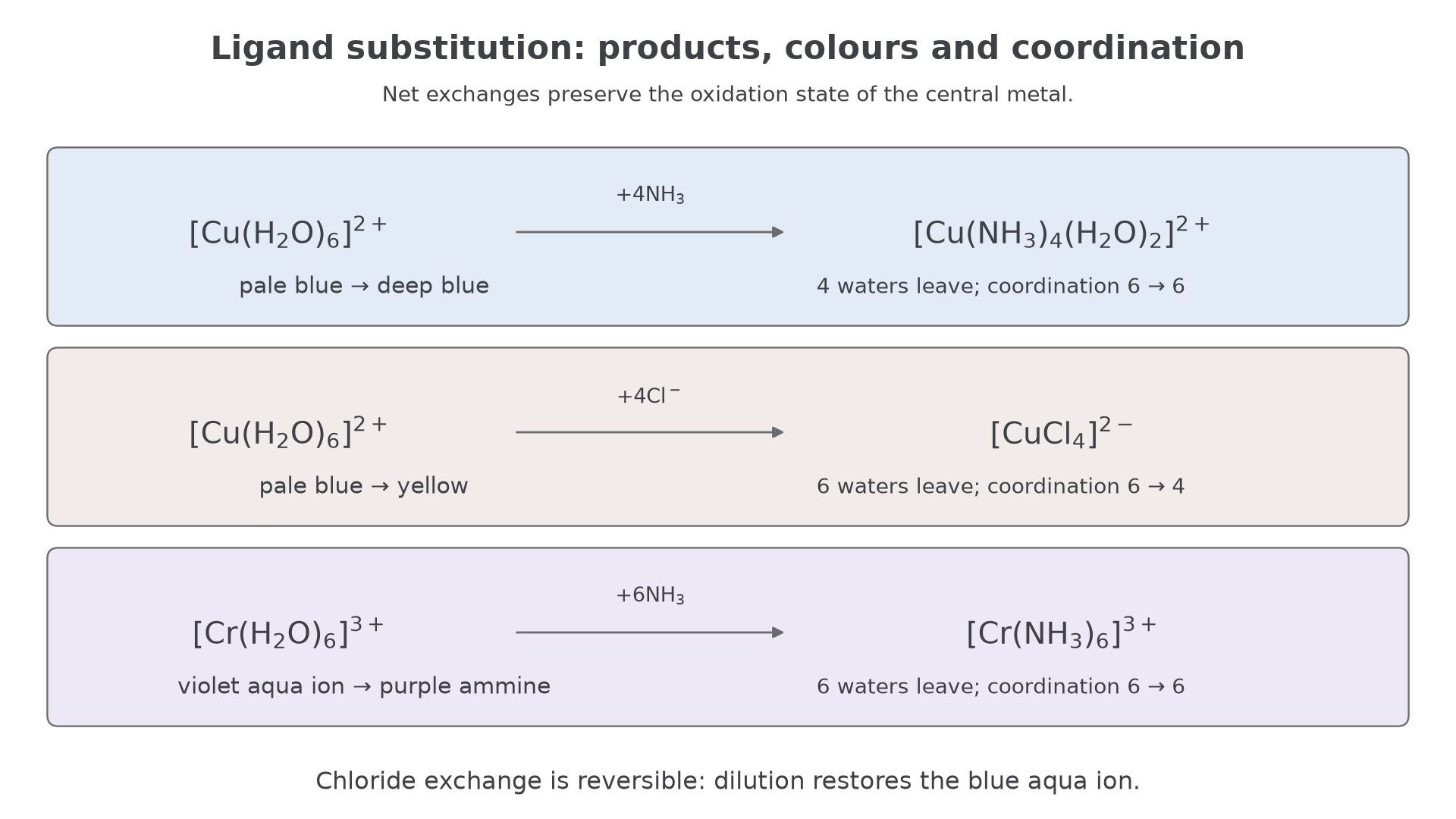
At the bond level, incoming donor atoms use lone pairs to form metal–ligand coordinate bonds while bonds to leaving ligands are broken. A substitution equation gives the net exchange, not a claim that all bonds change simultaneously. For these reactions the metal oxidation state remains unchanged. Changing the charge of the whole complex by replacing neutral water with an anion is not, by itself, redox.
Copper(II) ligand substitutions
The starting complex for both required copper reactions is the pale blue hexaaquacopper(II) ion:
With excess ammonia, four water ligands are replaced by four ammonia ligands:
The solution becomes deep blue. OCR mark schemes also accept descriptions such as dark blue or royal blue for this complex.
With concentrated chloride ions, such as from concentrated hydrochloric acid, four chloride ligands replace all six water ligands, changing the coordination number from six to four to form the tetrachlorocuprate(II) ion:
The solution becomes yellow. In a test tube, the mixture is sometimes described as yellow-green because blue hexaaquacopper(II) ions may still be present, but "yellow solution" is the clean OCR answer for the product complex.
Worked example: write the equation for substitution of water ligands in by ammonia.
Start from the complex ion:
The product specified by OCR is:
Four ammonia ligands have entered, and four water ligands have left. and are both neutral, so the complex charge remains 2+.
Final equation:
The pale blue hydroxide solid and deep blue dissolved complex are different products. The next lesson explains the precipitation stage and its equations.
Reversibility, shape and dilution
The chloride substitution is an equilibrium:
High chloride concentration favours the yellow tetrachloro complex. Adding water dilutes chloride ions and shifts the equilibrium towards the blue hexaaqua complex. Green can be an intermediate mixture of the blue and yellow species; it is not evidence of a new copper oxidation state. Water is the solvent, so do not describe dilution simply as a large change in the concentration of pure water.
The aqua ion is six-coordinate and octahedral; the tetrachloro ion is four-coordinate and tetrahedral. The larger chloride ligands favour lower coordination in this example. With ammonia, four waters are replaced but two remain, so six donor bonds and the octahedral arrangement are retained. Size is a useful comparison here, not a universal rule that predicts every complex's shape.
Adding ammonia dropwise first produces a hydroxide precipitate by acid–base reaction. Excess ammonia allows the dissolved ammine complex to form. Distinguish this two-stage observation from the net aqua-to-ammine substitution equation above.
Continue this lesson.
You’re previewing NovaLearn without an account. Create a free account to read the rest.
Create free account