3.2.1(g) - Hess' law and enthalpy cycles
Some enthalpy changes are awkward or impossible to measure directly, but they can still be calculated from other enthalpy changes. This lesson teaches the cycle method: compare a direct route with an indirect route, keep the same start and finish, and use signs and coefficients carefully. You do not need to memorise a formal definition of Hess' law here; the assessed skill is constructing and using cycles.
Cycles and routes
An enthalpy change is linked to the initial and final chemical states. If two routes start with the same substances and finish with the same substances, conservation of energy means the total enthalpy change for the two routes must match.
In cycle calculations, the direct route is usually the reaction you want:
The indirect route uses enthalpy changes that are easier to measure or already known, such as enthalpy changes of combustion or formation. Your job is to write an equation that makes the two route totals equal.
Three sign rules make most cycle work safer:
- If you follow an arrow in its shown direction, use the enthalpy value with its given sign.
- If you go against an arrow, reverse the sign.
- If the equation uses two or three moles of a substance, multiply that substance's enthalpy value by two or three.
The units for these enthalpy changes are normally:
That means "per mole of reaction as written" or "per mole of the substance specified" in the data table. If the chemical equation is doubled, the enthalpy change is doubled too.
A Hess cycle is not a memory test for a sentence. It is an accounting method: same start, same finish, route totals equal.
State symbols belong to the energy accounting: changing liquid water to steam changes the final state and therefore the enthalpy. Keep negative data in brackets, use the stoichiometric multiplier before adding a route, and report the sign and unit for the equation as written.
Combustion cycles
Use a combustion cycle when the data table gives enthalpy changes of combustion, . In a combustion cycle, both the reactants and the products are burned completely to the same combustion products. For compounds containing carbon and hydrogen, those products are usually carbon dioxide and water.
The top line is the reaction you want:
The bottom line is the same final combustion-products mixture reached from both sides. Because both routes end at the same bottom mixture:
Reaction enthalpy from combustion enthalpies
This formula is useful, but the cycle is the real safeguard. It reminds you why combustion data use "reactants minus products", and it stops you losing a minus sign.
Worked example: hydrogenation from combustion data
Calculate the enthalpy change for:
Use these enthalpy changes of combustion:
| substance | / kJ mol⁻¹ |
|---|---|
| -1411 | |
| -286 | |
| -1560 |
The combustion route from the reactants is:
The combustion route from the product is:
Using the cycle:
The negative sign means the reaction as written is exothermic.
[DIAGRAM: asset_name: 03_02_01d_hess_law_and_enthalpy_cycles__diagram_01; asset_slug: 03_02_01d_hess_law_and_enthalpy_cycles__diagram_01; recommended_method: drawn_chem; description: Balanced hydrogenation combustion cycle showing both sides plus 3.5 oxygen reaching the same 2 carbon dioxide and 3 water, with directed arrows.]
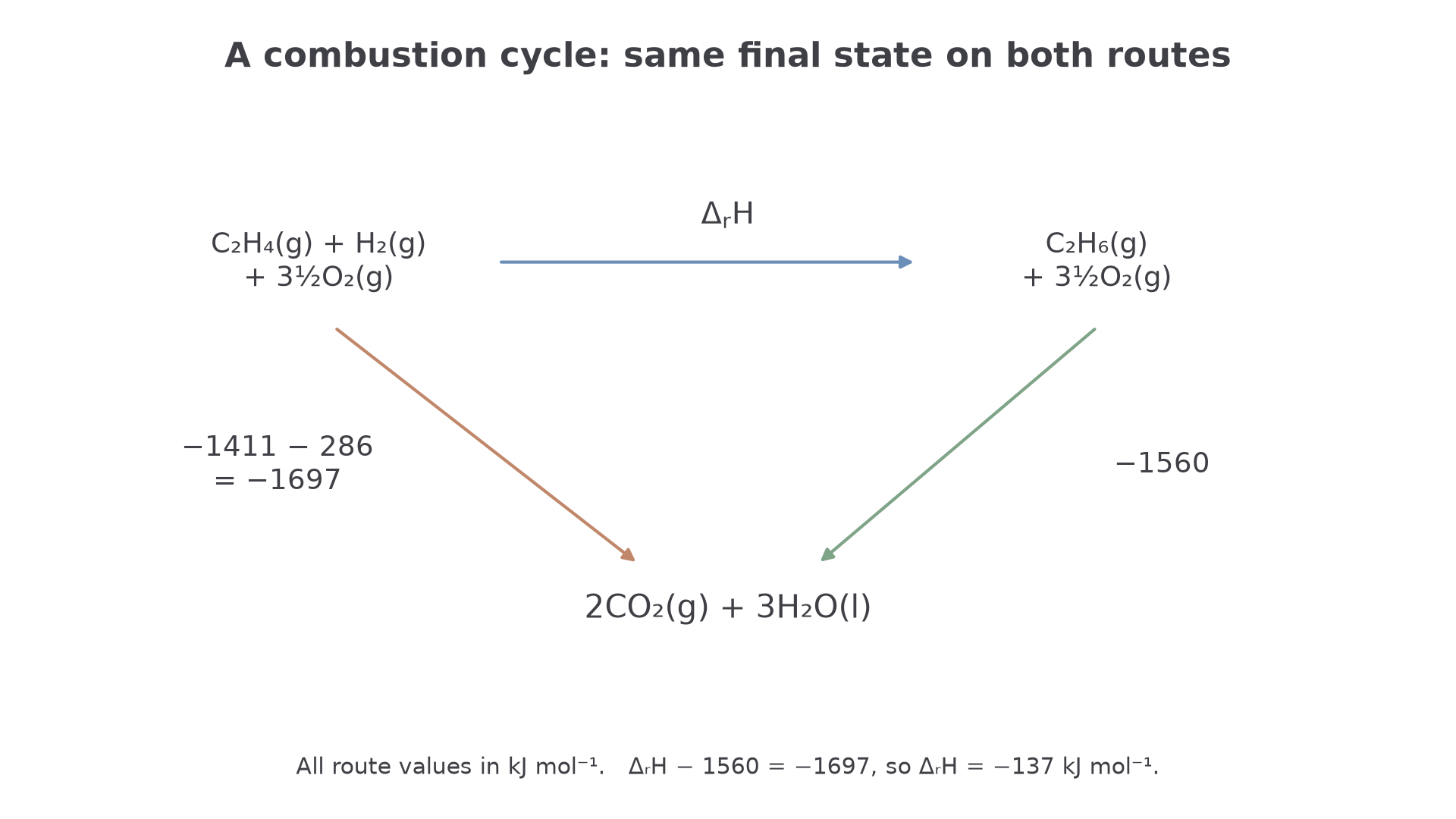
When drawing this cycle, include enough oxygen on each route. The reactant mixture and the product each use to reach . The cycle must conserve atoms as well as energy. A cycle layout is not an enthalpy scale: an upward arrow need not represent a positive value.
Continue this lesson.
You’re previewing NovaLearn without an account. Create a free account to read the rest.
Create free account