2.2.2(i)-(j) - Electronegativity, bond polarity and dipoles
Electronegativity explains why a covalent bond can have a slightly negative end and a slightly positive end. In this lesson, you will learn how to interpret Pauling electronegativity values, how a polar bond forms, and why molecular shape decides whether a molecule has an overall dipole.
Electronegativity and Pauling values
Electronegativity is about attraction inside a covalent bond. When two atoms share a pair of electrons, the atom with the higher electronegativity attracts the bonding electrons more strongly.
Electronegativity
Electronegativity is the ability of an atom to attract the bonding electrons in a covalent bond.
The Pauling scale gives electronegativity as a relative number with no unit. A higher Pauling value means a stronger attraction for the bonding pair. You do not need to memorise a full table of values, but you must be able to interpret values when they are given.
Electronegativity increases towards fluorine in the periodic table. Fluorine has the highest electronegativity, so a bond to fluorine often has a strongly polarised bonding pair.
Worked example: interpreting Pauling values
A question gives these Pauling electronegativity values:
| atom | H | C | O | F |
|---|---|---|---|---|
| electronegativity | 2.1 | 2.5 | 3.5 | 4.0 |
In an O-H bond, oxygen has the higher value, so oxygen attracts the bonding electrons more strongly than hydrogen. In a C-F bond, fluorine has the higher value, so fluorine attracts the bonding electrons more strongly than carbon.
The size of the difference also matters. The C-F difference is:
The C-H difference is:
The C-F bond is therefore much more polar than the C-H bond.
Using electronegativity to predict bond type
Electronegativity helps predict the type of bonding between two atoms. Treat it as a model, not as a sharp rule with a magic cut-off.
If two bonded atoms have the same or very similar electronegativities, the bonding electrons are shared almost equally. This is non-polar covalent bonding, as in Cl-Cl.
If the atoms have different electronegativities but are still sharing electrons, the bond is polar covalent. The bonding pair is drawn closer to the more electronegative atom, as in H-Cl or C-O.
If the difference in electronegativity is very large, electron transfer becomes more likely and the bonding is usually described as ionic. For example, sodium and chlorine have very different tendencies to attract electrons, so sodium chloride is treated as ionic.
Use electronegativity to make a reasoned prediction: similar values suggest non-polar covalent bonding; different values in a covalent molecule suggest a polar covalent bond; very large differences often suggest ionic bonding.
Worked example: predicting the most polar bond
A question gives these values:
| atom | H | Cl | Br |
|---|---|---|---|
| electronegativity | 2.1 | 3.0 | 2.8 |
Compare H-Cl and H-Br:
H-Cl is predicted to be the more polar bond because it has the larger electronegativity difference.
Polar bonds and permanent dipoles
When covalently bonded atoms have different electronegativities, the bonding electrons are not shared equally. The more electronegative atom gains more electron density and becomes partially negative. The less electronegative atom becomes partially positive.
These are partial charges, written as delta negative and delta positive: δ⁻ and δ⁺. They are not full ionic charges.
Polar bond
A polar bond is a covalent bond in which the bonding electrons are attracted more strongly by one atom, causing a permanent separation of partial charge across the bond.
A polar bond has a bond dipole. The dipole points towards the more electronegative atom, because that end is partially negative.
For hydrogen chloride, chlorine is more electronegative than hydrogen:
The H-Cl molecule has a permanent dipole because its polar bond gives one end of the molecule a permanent partial positive charge and the other end a permanent partial negative charge.
Worked example: assigning partial charges
In a C-F bond, fluorine has a higher electronegativity than carbon. The bonding electrons are pulled closer to fluorine. Therefore:
The fluorine end is δ⁻ and the carbon end is δ⁺.
Polar molecules and overall dipoles
A molecule can contain polar bonds without being a polar molecule. To decide whether the whole molecule is polar, you must consider both:
- whether the molecule contains polar bonds
- whether the directions of the bond dipoles cancel because of the molecular shape
Polar molecule
A polar molecule has an overall dipole because its bond dipoles do not cancel due to their direction and molecular shape.
[DIAGRAM: asset_name: h432 bond dipoles; asset_slug: h432_bond_dipoles; recommended_method: drawn_chem; description: Linear CO2 has equal opposite chemical dipole arrows; bent H2O partial charges and nonzero resultant toward oxygen.]
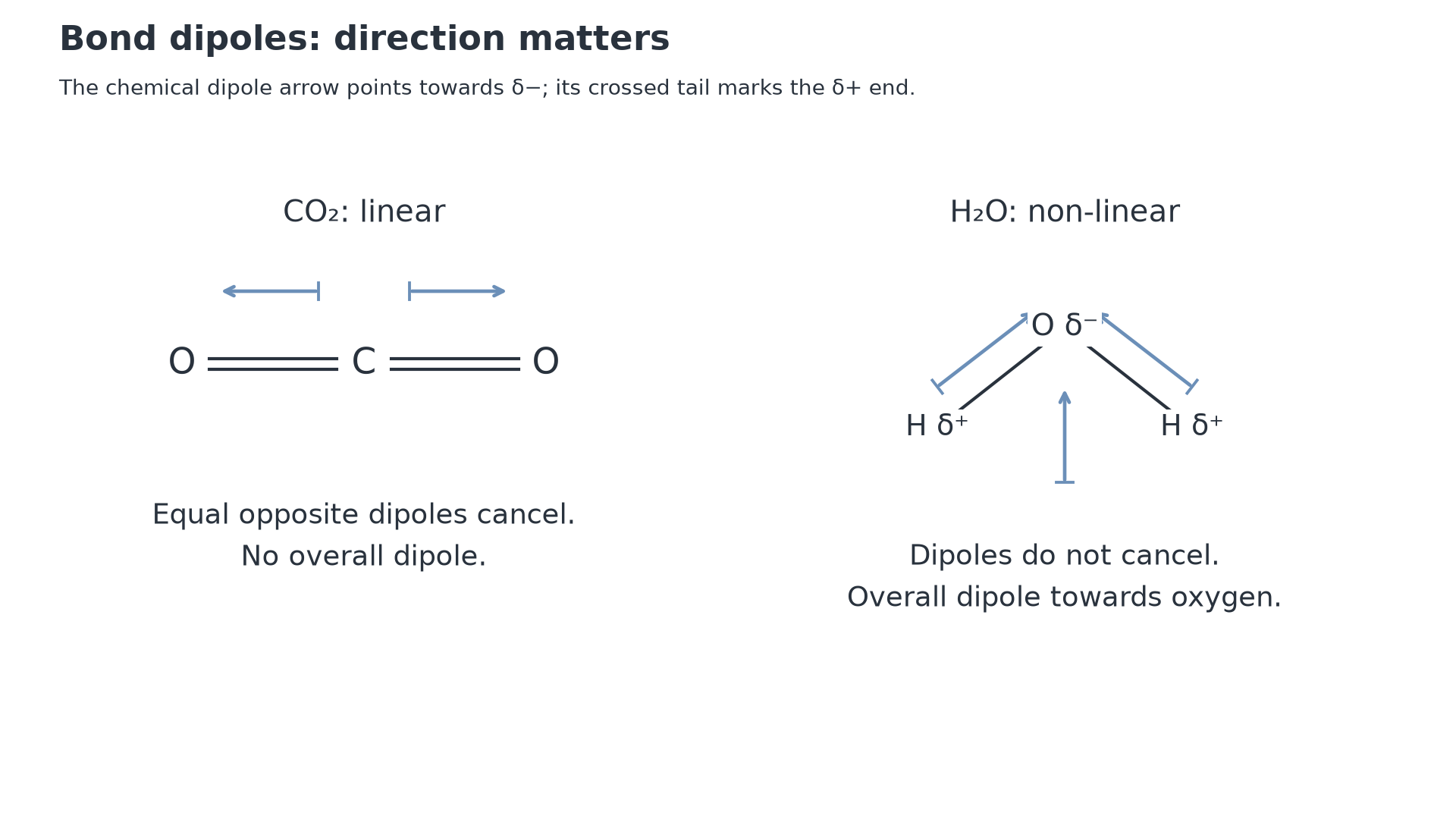
Carbon dioxide and water show the difference clearly.
In CO₂, each C=O bond is polar because oxygen is more electronegative than carbon. However, CO₂ is linear. The two equal C=O dipoles point in opposite directions, so the dipoles cancel. CO₂ has no overall dipole and is non-polar.
In H₂O, each O-H bond is polar because oxygen is more electronegative than hydrogen. Water is bent, so the two O-H bond dipoles do not point in exactly opposite directions. The dipoles do not cancel, so H₂O has an overall dipole and is polar.
The exam distinction is precise: dipoles cancel. Do not write that "polar bonds cancel" or "charges cancel". The bonds are still polar; it is their dipole effects that cancel in a symmetrical molecule.
Worked example: CF₄
Fluorine is more electronegative than carbon, so each C-F bond in CF₄ is polar:
CF₄ is tetrahedral and symmetrical. The four C-F bond dipoles are arranged evenly around the carbon atom, so their effects cancel. CF₄ has no overall dipole, so it is a non-polar molecule despite containing polar bonds.
Worked decision: when the outer atoms differ
Shape alone does not guarantee cancellation. CCl₄ and CH₃Cl are both tetrahedral. In CCl₄ the four equal C–Cl dipoles cancel. In CH₃Cl the different C–H and C–Cl bond dipoles do not balance, so the molecule is polar. Bent SO₂ also has an overall dipole: oxygen attracts the bonding electrons more strongly than sulfur and the two S–O dipoles do not cancel.
Use the decision in order: establish each bond’s polarity, sketch the bond directions, then ask whether equal and opposite effects balance. Do not jump from the word symmetrical straight to non-polar without checking which atoms and bond dipoles are present.
Quick recap
- Electronegativity measures attraction for the bonding electrons; Pauling values are relative and have no unit.
- A larger electronegativity difference usually means a more polar covalent bond; it is not a universal sharp boundary between bond types.
- The more electronegative end is δ⁻ and the other end is δ⁺.
- A molecular dipole depends on the directions and magnitudes of all the bond dipoles. Equal dipoles can cancel; polar bonds do not disappear.
- Use the actual geometry: a molecule can have symmetry, as water does, and still have a non-zero resultant dipole.