3.2.1(f) - Average bond enthalpies
Average bond enthalpies let chemists estimate the enthalpy change of a reaction by looking at covalent bonds broken and covalent bonds made. This lesson teaches the exact energy account used in OCR-style questions: bond breaking absorbs energy, bond making releases energy, and the overall enthalpy change depends on the difference between the two totals.
What average bond enthalpy means
A covalent bond is a region of attraction between nuclei and a shared pair of electrons. To break that attraction, energy must be supplied. Average bond enthalpy measures this energy for a particular type of covalent bond, such as C-H, O-H or H-H.
Average bond enthalpy
For this lesson, average bond enthalpy means the mean enthalpy change for breaking 1 mol of a specified type of bond in gaseous molecules, averaged over different molecular environments.
Three details matter in that explanation.
- It is about breaking bonds, not making bonds.
- It is for 1 mol of bonds, not necessarily 1 mol of molecules.
- It applies to gaseous molecules.
For example, a value of +436 kJ mol⁻¹ for the H-H bond means:
is needed to break 1 mol of H-H bonds in gaseous hydrogen molecules:
The unit kJ mol⁻¹ means kilojoules per mole of bonds broken. Bond enthalpy values are normally written as positive values because bond breaking requires energy.
Average bond enthalpy is also a useful measure of covalent bond strength. A larger average bond enthalpy means more energy is needed to break that bond, so the bond is stronger. However, it is an average: an actual C-H bond in one molecule may not have exactly the same enthalpy as a C-H bond in another molecule.
Average bond enthalpy values are positive because they describe bond breaking in gaseous molecules.
Breaking and making bonds
A chemical reaction involves rearranging atoms. To do that, some bonds in the reactants must be broken and some new bonds in the products must be made.
Bond breaking and bond making have opposite energy signs:
- breaking bonds is endothermic, so it has a positive enthalpy contribution
- making bonds is exothermic, so it has a negative enthalpy contribution
The overall reaction is exothermic if bond making releases more energy than bond breaking absorbs. It is endothermic if bond breaking absorbs more energy than bond making releases.
Average bond enthalpy calculation
This formula works because the tabulated bond enthalpy values are positive values for breaking bonds. We subtract the bonds made because forming those bonds releases energy.
Misconception contrast
Do not say "an exothermic reaction breaks bonds and releases energy." Breaking bonds always needs energy. In an exothermic reaction, the energy released by making new bonds is greater than the energy absorbed to break the original bonds.
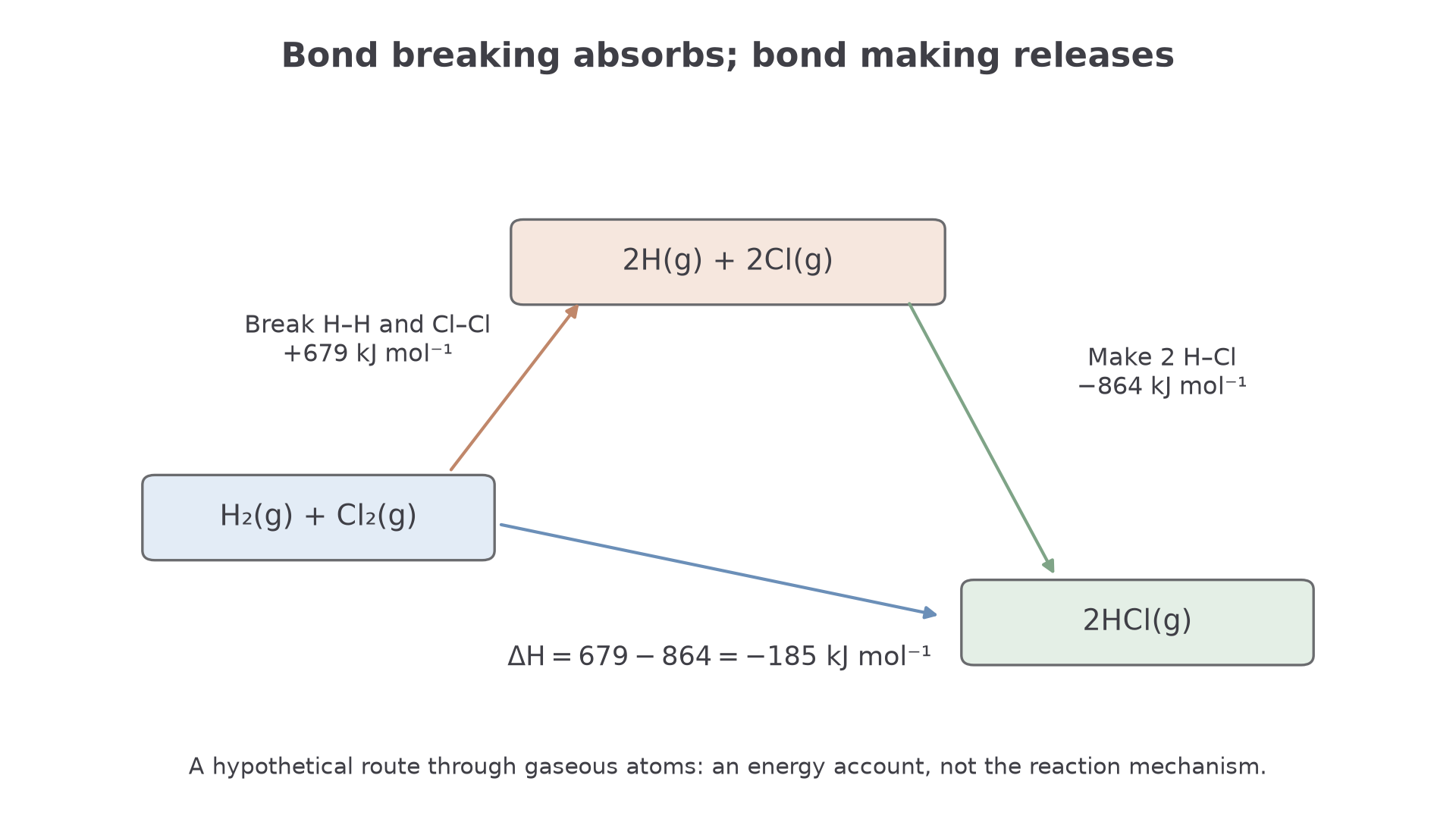
[DIAGRAM: asset_name: 03_02_01c_average_bond_enthalpies__diagram_01; asset_slug: 03_02_01c_average_bond_enthalpies__diagram_01; recommended_method: drawn_chem; description: Hydrogen plus chlorine through separated gaseous atoms to two hydrogen chloride molecules: 679 kJ absorbed and 864 kJ released, net minus 185 kJ.]
Calculating enthalpy changes
Average bond enthalpy calculations begin with a balanced equation and a set of provided bond enthalpy values. The safest method is:
- Count the bonds broken in the reactants.
- Count the bonds made in the products.
- Multiply each bond enthalpy by the number of that bond.
- Use = bonds broken - bonds made.
- Include the sign and unit, usually kJ mol⁻¹.
Worked example: methane and chlorine
Chloromethane can form in the gas phase:
Use these average bond enthalpies:
| Bond | Average bond enthalpy / kJ mol⁻¹ |
|---|---|
| C-H | 413 |
| Cl-Cl | 243 |
| C-Cl | 346 |
| H-Cl | 432 |
Only the bonds that change need to be counted. One C-H bond and one Cl-Cl bond are broken. One C-Cl bond and one H-Cl bond are made.
Energy absorbed to break bonds:
Energy released when bonds form:
Now subtract:
The reaction is exothermic because the value is negative. More energy is released when C-Cl and H-Cl bonds form than is absorbed when C-H and Cl-Cl bonds break.
Counting all bonds also works
Continue this lesson.
You’re previewing NovaLearn without an account. Create a free account to read the rest.
Create free account