5.3.1(f)-(g) - Transition metal stereoisomerism and cisplatin
Transition metal complexes can have the same atoms bonded in the same order but arranged differently in 3-D space. In this lesson you will learn the two OCR-required types of stereoisomerism in complexes: cis-trans isomerism and optical isomerism. You will then use cis-platin as the key application, linking its square planar shape to DNA binding and chemotherapy.
Complex stereoisomers
A complex contains a central metal ion or metal atom with ligands bonded to it. In this lesson, the important point is not a new type of bond; it is the 3-D arrangement of ligands around the metal.
Stereoisomers
Stereoisomers have the same structural formula but a different arrangement of atoms or groups in space. Structural isomers instead have a different bonding pattern/connectivity.
For a complex, "same structural formula" means the same metal, the same ligands and the same bonds from ligands to the metal. The difference is where those ligands sit around the metal centre.
OCR expects you to communicate this with diagrams as well as words. That means you should be comfortable with:
- square planar complexes, where four ligands lie at the corners of a square around the metal
- octahedral complexes, where six ligand donor atoms surround the metal in a 3-D arrangement
- bidentate ligands, which bond to the metal through two donor atoms
- multidentate ligands, which bond through more than one donor atom; bidentate ligands are the two-donor case
- symmetry, especially whether a mirror image can be rotated to match the original
Worked reasoning: why this is stereoisomerism, not structural isomerism.
Two forms of can both have platinum bonded to two ligands and two ligands. If one form has the two ligands next to each other and the other has them opposite each other, the bonding pattern is unchanged. The difference is spatial arrangement, so the pair are stereoisomers.
Cis-trans platinum complexes
For a square planar drawing, place at the centre and four donor atoms in one plane, with adjacent bonds at 90 degrees and opposite bonds at 180 degrees. Draw both isomers explicitly: put the identical chloride ligands adjacent for cis and opposite for trans. Rotate the whole drawing only when checking whether two drawings represent the same arrangement.
is the OCR example for cis-trans isomerism in a transition metal complex. Platinum is in the +2 oxidation state and the complex is square planar: the four ligands lie in one plane around the (II) centre.
Cis-Trans Isomerism In Complexes
Cis-trans isomerism occurs when the same ligands can be arranged next to each other or opposite each other around a metal centre. In a square planar complex, cis means adjacent positions and trans means opposite positions.
[DIAGRAM: asset_name: Lesson 5.3.1f-g: Transition metal stereoisomerism and cisplatin - diagram 01; asset_slug: 05_03_01c_transition_metal_stereoisomerism_and_cisplatin__diagram_01; recommended_method: drawn_chem; description: 16:9 deterministic square planar diagram comparing cis-platin and the trans Pt(NH3)2Cl2 isomer, showing adjacent and opposite ligand positions around Pt(II).]
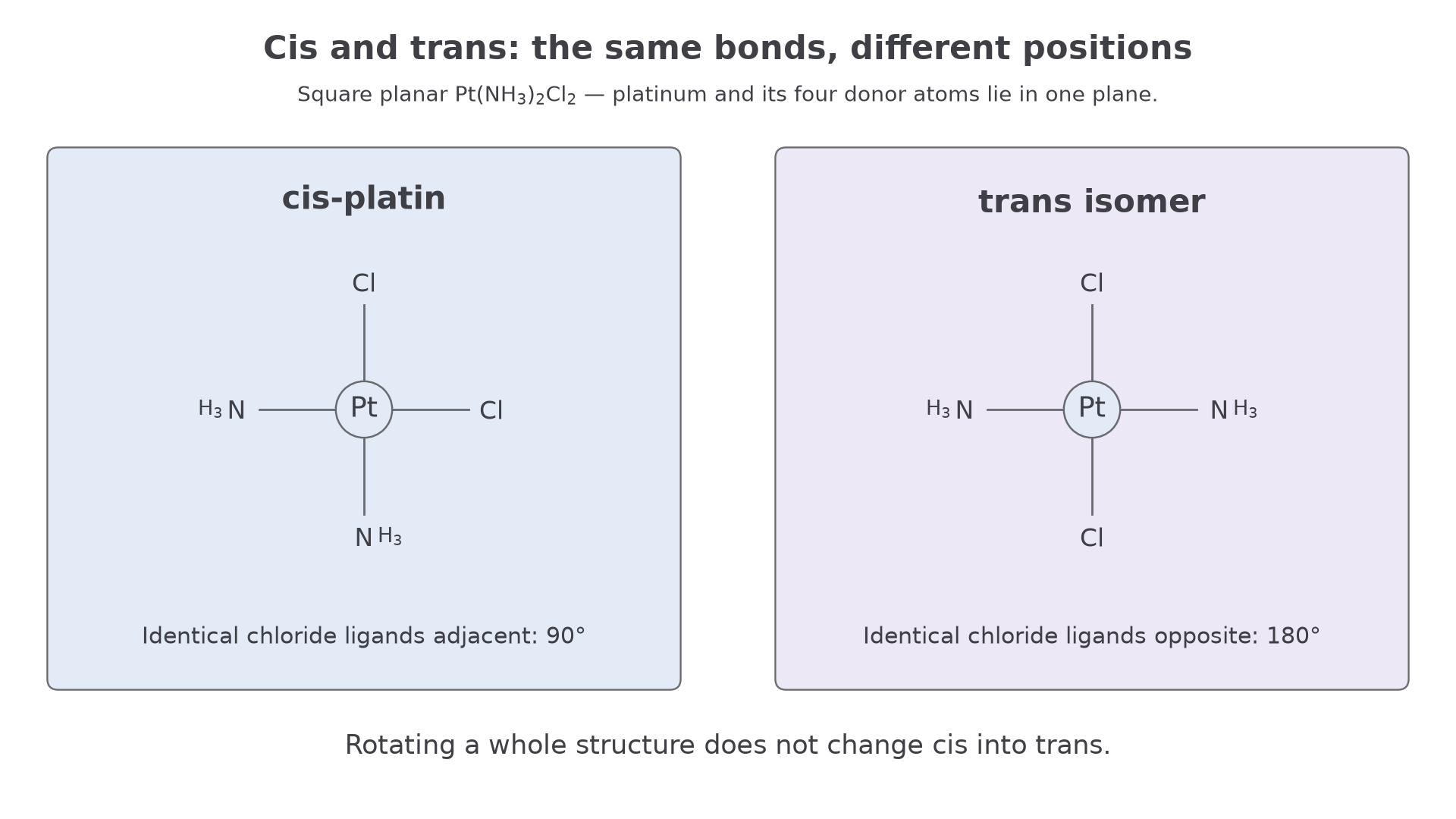
In cis-platin, the two chloride ligands are adjacent. The two ligands are also adjacent. In the trans isomer, the two chloride ligands are opposite each other, and the two ligands are opposite each other.
For these complexes, compare identical ligands around the metal centre: cis means adjacent and trans means opposite. Alkene Cahn–Ingold–Prelog priority rules are not needed. OCR also accepts geometric isomerism (and E/Z as a label in this context); the actual ligand arrangement must still be chemically correct:
- adjacent identical ligands: cis
- opposite identical ligands: trans
Worked example: identify the isomer from a text description.
A square planar complex has above and to the right of . Those positions are next to each other at 90 degrees, so this is the cis isomer. The same complex formula with one above and the other below would be the trans isomer.
The same adjacent/opposite test applies to octahedral : cis chlorides are apart and trans chlorides are apart. In contrast, square planar has only one chloride; moving it to another corner just rotates the same arrangement. Not every complex has a cis–trans pair.
Optical isomerism with bidentate ligands
For the usual octahedral sketch, draw four metal-donor bonds in the plane, one solid wedge towards the viewer and one hashed wedge away. Show six donor atoms. Join the two nitrogen donor atoms belonging to each en ligand with a loop representing its carbon chain; do not draw just one metal bond to the middle of an en ligand. A reflected drawing is an optical partner only if no rotation superimposes the donor bonds and ligand connections. The diagram below uses this wedge-and-hash convention and explicitly connects the two nitrogen donors through each carbon chain.
The counting and spatial method also applies to an introduced multidentate ligand: represent every donor bond, keep the links within each ligand together, and compare the whole complex with its mirror image. Multidentate coordination alone does not guarantee optical isomerism; the complete arrangement must be chiral.
Continue this lesson.
You’re previewing NovaLearn without an account. Create a free account to read the rest.
Create free account