3.2.3(e) - Industrial equilibrium compromises
Industrial equilibrium chemistry is not just about predicting which side of an equilibrium is favoured. In a chemical plant, the conditions must also give a useful reaction rate, be safe to operate, and make economic sense. In this lesson, the Haber process is the main example of how chemists balance those competing demands.
The industrial decision
A reversible reaction can have conditions that look ideal from an equilibrium point of view but are poor in industry. If a low temperature gives a high equilibrium yield but the reaction takes days to reach equilibrium, the plant is not making enough product per hour. If a very high pressure gives more product but needs extremely expensive pressure vessels, the extra yield may not pay for the extra cost and safety risk.
Industrial compromise
An industrial compromise is the choice of operating conditions that balances equilibrium position, reaction rate, safety and economics to give the best practical production process.
For the Haber process, ammonia is made from nitrogen and hydrogen:
Haber equilibrium
The forward reaction is exothermic and the number of gas molecules decreases from 4 mol of gas on the left to 2 mol of gas on the right. Those two facts control the equilibrium arguments. The rate arguments come from collision frequency, activation energy and how quickly the reaction reaches equilibrium.
The key exam habit is to keep two questions separate:
- Where is the equilibrium position? This controls the equilibrium yield.
- How fast is equilibrium reached? This controls useful output per unit time.
The chemical industry is not trying to choose the condition that maximises one factor. It is trying to choose conditions that give enough product fast enough, safely enough and cheaply enough.
Worked example: comparing production per hour
Two proposed batch processes use the same reactor size. Their stated cycle times include charging, reaction and product separation.
| Proposal | Ammonia collected per batch / mol | Complete cycle time / min |
|---|---|---|
| A | 70 | 60 |
| B | 60 | 20 |
A collects more ammonia per batch, but its output is 70 mol h⁻¹. B completes three cycles each hour, so its output is 3 × 60 = 180 mol h⁻¹. B therefore has the greater output per hour despite collecting less per batch. This does not by itself make B the best choice: compare heating/compression costs and safety as well. The data are illustrative, not operating figures to memorise.
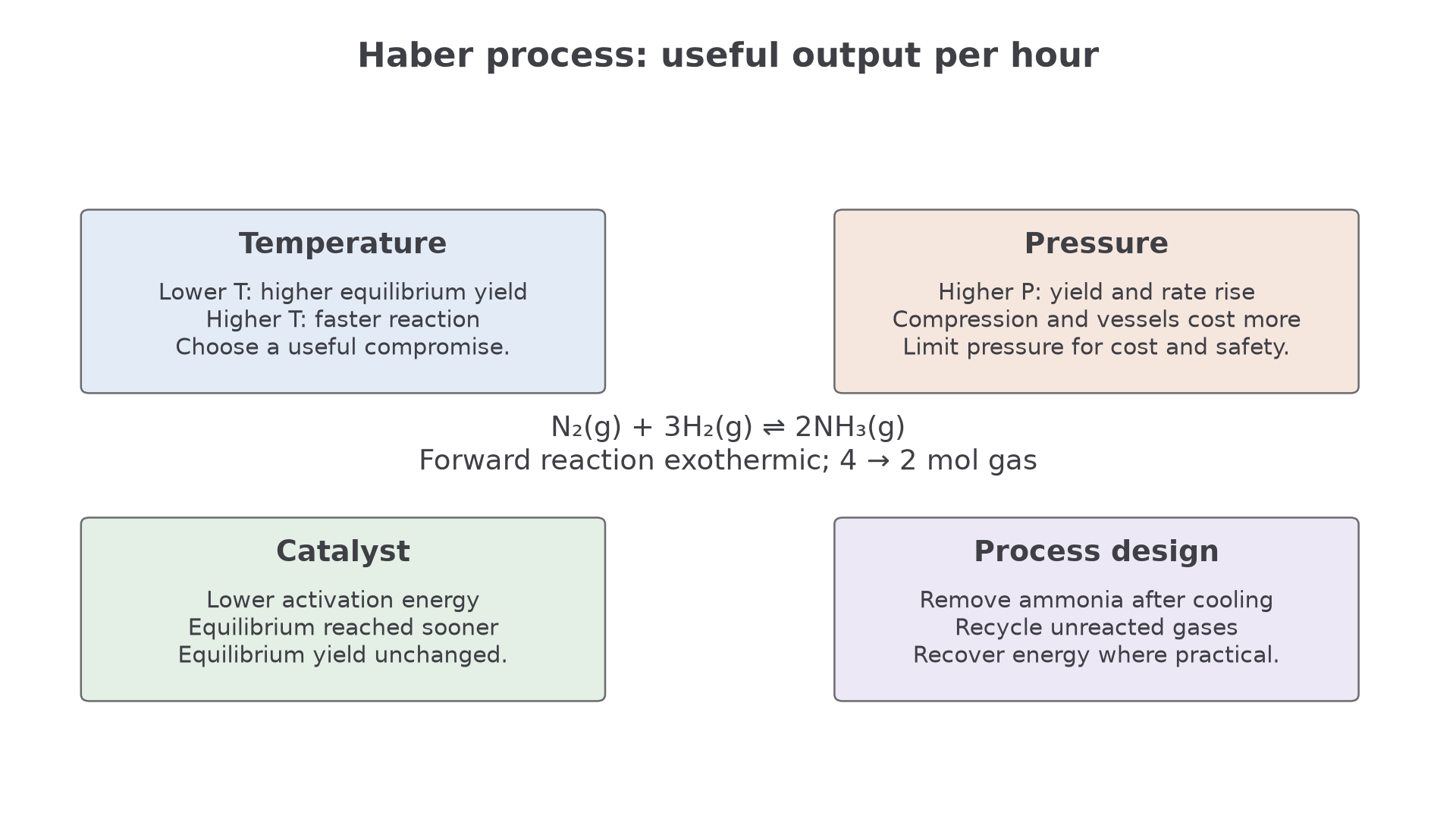
[DIAGRAM: asset_name: 03_02_03b_industrial_equilibrium_compromises__diagram_01; asset_slug: 03_02_03b_industrial_equilibrium_compromises__diagram_01; recommended_method: drawn_chem; description: Haber compromise map with balanced equation, temperature yield-rate tradeoff, pressure cost and catalyst effect.]
Temperature compromise
For the Haber process, the forward reaction is exothermic. Lowering the temperature favours the exothermic direction, so the equilibrium position shifts towards ammonia. If equilibrium yield were the only concern, a low temperature would look attractive.
The problem is rate. At a lower temperature, molecules have less kinetic energy, so fewer collisions have energy at least equal to the activation energy. The reaction reaches equilibrium more slowly. An industrial plant needs ammonia to be produced in a reasonable time, not merely in a high proportion after an impractically long wait.
Worked reasoning:
- The forward reaction, N₂ + 3H₂ → 2NH₃, is exothermic.
- Decreasing temperature favours the exothermic direction.
- Therefore a lower temperature increases the equilibrium yield of ammonia.
- But decreasing temperature also decreases rate.
- So industry uses a moderate high temperature: high enough for a useful rate, but not so high that the ammonia equilibrium yield becomes too low.
Teaching sources often quote about 400-450 °C for the Haber process. The exact number is less important than the reason: it is a compromise between equilibrium yield and rate.
For an exothermic industrial equilibrium, lower temperature usually improves equilibrium yield, but higher temperature usually improves rate. The chosen temperature has to balance both.
Continue this lesson.
You’re previewing NovaLearn without an account. Create a free account to read the rest.
Create free account