5.3.1(k)-(l) - Transition metal redox and unfamiliar reactions
Transition metal ions often change colour when their oxidation state or ligand environment changes. In this lesson you will learn the OCR-required redox interconversions for iron, chromium and copper, then use half-equations and oxidation numbers to interpret unfamiliar reactions without relying on memorised full equations.
Reading redox colour changes
For this specification point, a colour change is evidence, not the explanation by itself. The explanation comes from the oxidation-state change at the metal ion and the reagent conditions that make the electron transfer happen.
The three required systems are:
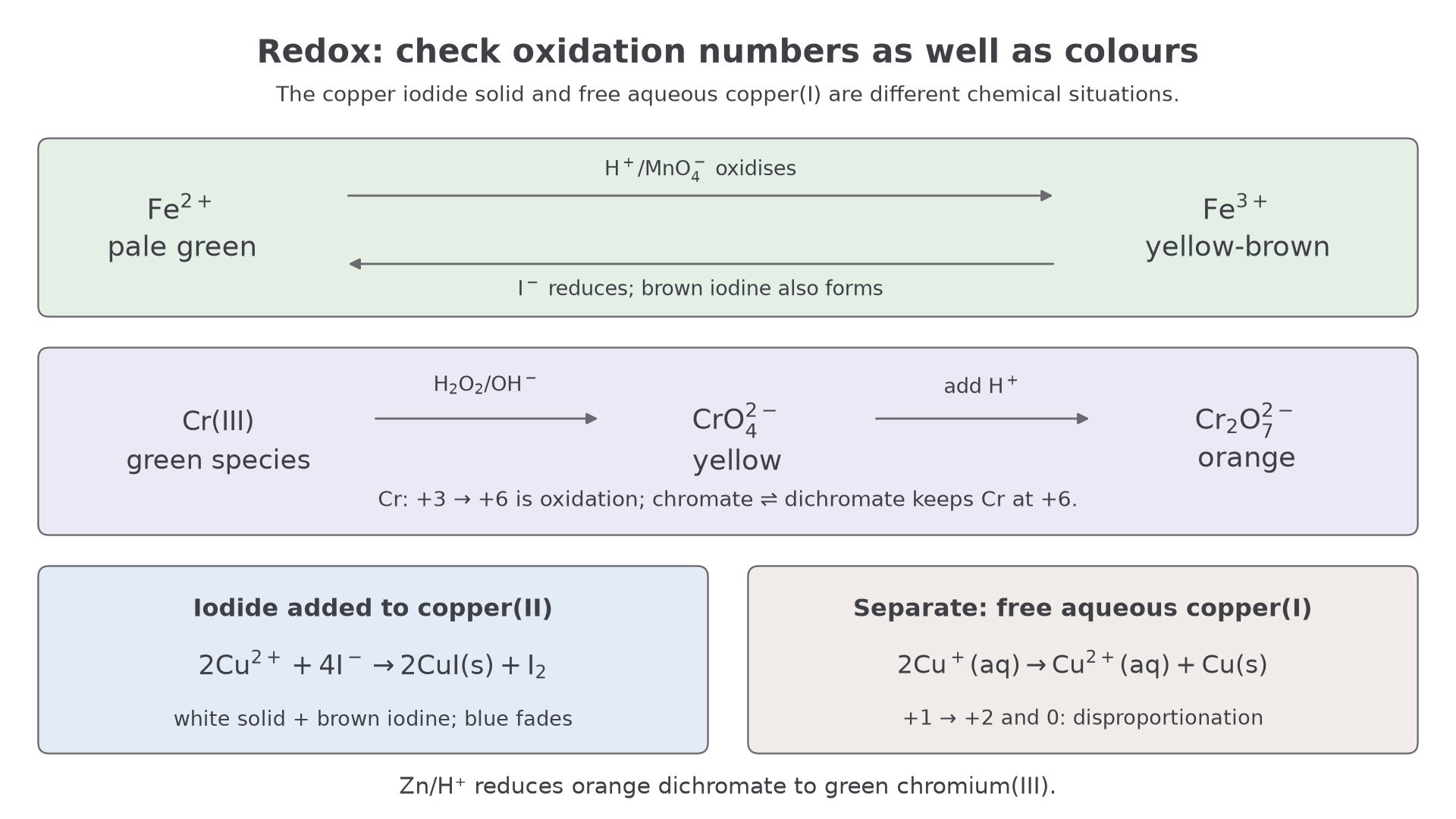
- and : pale green is oxidised to yellow/orange-brown ; can be reduced back to .
- and : green can be oxidised to chromium(VI), seen through yellow chromate(VI) in alkaline solution and orange dichromate(VI) in acid; orange dichromate(VI) can be reduced to green .
- , and : blue can be reduced to copper(I), often trapped as white copper(I) iodide; aqueous readily disproportionates to and copper metal.
Disproportionation
Disproportionation is a redox reaction in which the same element in one oxidation state is both oxidised and reduced. For aqueous copper(I), some becomes and some becomes .
A reliable exam method is:
- Identify the transition-metal species before and after the change.
- Assign oxidation numbers to the metal.
- Decide whether the metal has been oxidised or reduced.
- Use the reagent and conditions to choose or construct the matching half-equation.
- Link the colour or precipitate to the species formed.
Worked reasoning: if a green chromium(III) solution is treated with alkaline hydrogen peroxide and then acidified, chromium changes from +3 to +6. The metal has been oxidised. The observed route is green chromium(III) to yellow chromate(VI), then orange dichromate(VI) after acidification.
[DIAGRAM: asset_name: Iron and chromium redox routes, copper iodide precipitation and separate aqueous copper(I) disproportionation; asset_slug: 05_03_01f_transition_metal_redox_and_unfamiliar_reactions__diagram_01; recommended_method: drawn_chem; description: Iron and chromium redox routes, copper iodide precipitation and separate aqueous copper(I) disproportionation]
Iron interconversions
Iron is the cleanest redox pair in this lesson because the metal changes by one oxidation state:
Iron(II) to iron(III)
Losing an electron is oxidation, so is the reducing agent when it becomes . The usual colour change for the iron ion is pale green to yellow/orange-brown.
OCR names acidified manganate(VII), , as an oxidising reagent for . In a titration with acidified manganate(VII), the endpoint is the first permanent pale pink colour from a tiny excess of ; that endpoint colour is not the colour of .
The reverse interconversion uses iodide ions as the reducing agent:
Reduction of iron(III) by iodide
Worked example: decide the roles in .
Iron changes from +3 to +2, so iron is reduced. Iodide changes from -1 in to 0 in , so iodide is oxidised and acts as the reducing agent. The iodine produced can give a brown colour, so the visible observation may be affected by iodine as well as the iron ions.
Chromium interconversions
The required chromium system connects chromium(III), , with dichromate(VI), . The oxidation-state change is large: chromium goes from +3 to +6 when it is oxidised.
OCR names hydrogen peroxide in alkaline solution, , as the oxidising conditions for . In practice, the first chromium(VI) species seen in alkaline solution is yellow chromate(VI), . Acidifying the solution shifts chromium(VI) into orange dichromate(VI), .
The reduction half-equation for acidified dichromate(VI) is a key construction tool:
Acidified dichromate(VI) reduction
You do not need to memorise full overall equations here, but you should be able to interpret one from half-equations. For reduction by zinc in acid:
The dichromate(VI) half-equation needs 6 electrons, so multiply the zinc half-equation by 3 and cancel electrons:
The observation is orange to green because chromium(VI) is reduced to chromium(III). Zinc is oxidised from 0 to +2.
The yellow-to-orange stage on acidification is not redox: chromium stays +6.
In alkaline solution the starting chromium(III) is represented more precisely by its hydroxo complex. A balanced oxidation half-equation is:
Combine twice this equation with three times . Cancelling electrons and hydroxide gives:
Check six chromium electrons are lost overall, and total charge is on both sides. Peroxide is reduced and is the oxidising agent. This construction explains the alkaline conditions rather than pretending free remains the dominant species in strong alkali.
Continue this lesson.
You’re previewing NovaLearn without an account. Create a free account to read the rest.
Create free account