5.2.3(d)-(e) - Redox titrations
Redox titrations use electron transfer to find an unknown amount or concentration. The practical skill is not just "do a titration"; it is choosing the right endpoint signal, using the redox equation for the mole ratio, and processing experimental results without losing the link between the chemistry and the numbers. OCR focuses especially on /, /, and unfamiliar systems where the equation is supplied.
What redox titrations measure
In a redox titration, one reacting species is oxidised and another is reduced. A measured volume of one solution is placed in a conical flask, and a standard solution is delivered from a burette until the reaction is just complete.
Redox titration
A redox titration is a titration in which the reacting substances transfer electrons, so the endpoint is linked to completion of an oxidation-reduction reaction.
The equivalence point is the chemical point where the reacting amounts are exactly in the mole ratio from the balanced redox equation. The endpoint is the observed colour change used to judge that the equivalence point has just been reached. These are close, but not identical, so practical technique matters.
The two named OCR systems in this lesson are:
- with acidified , where is oxidised to and is reduced to .
- with , where iodine is reduced to iodide and thiosulfate is oxidised to tetrathionate.
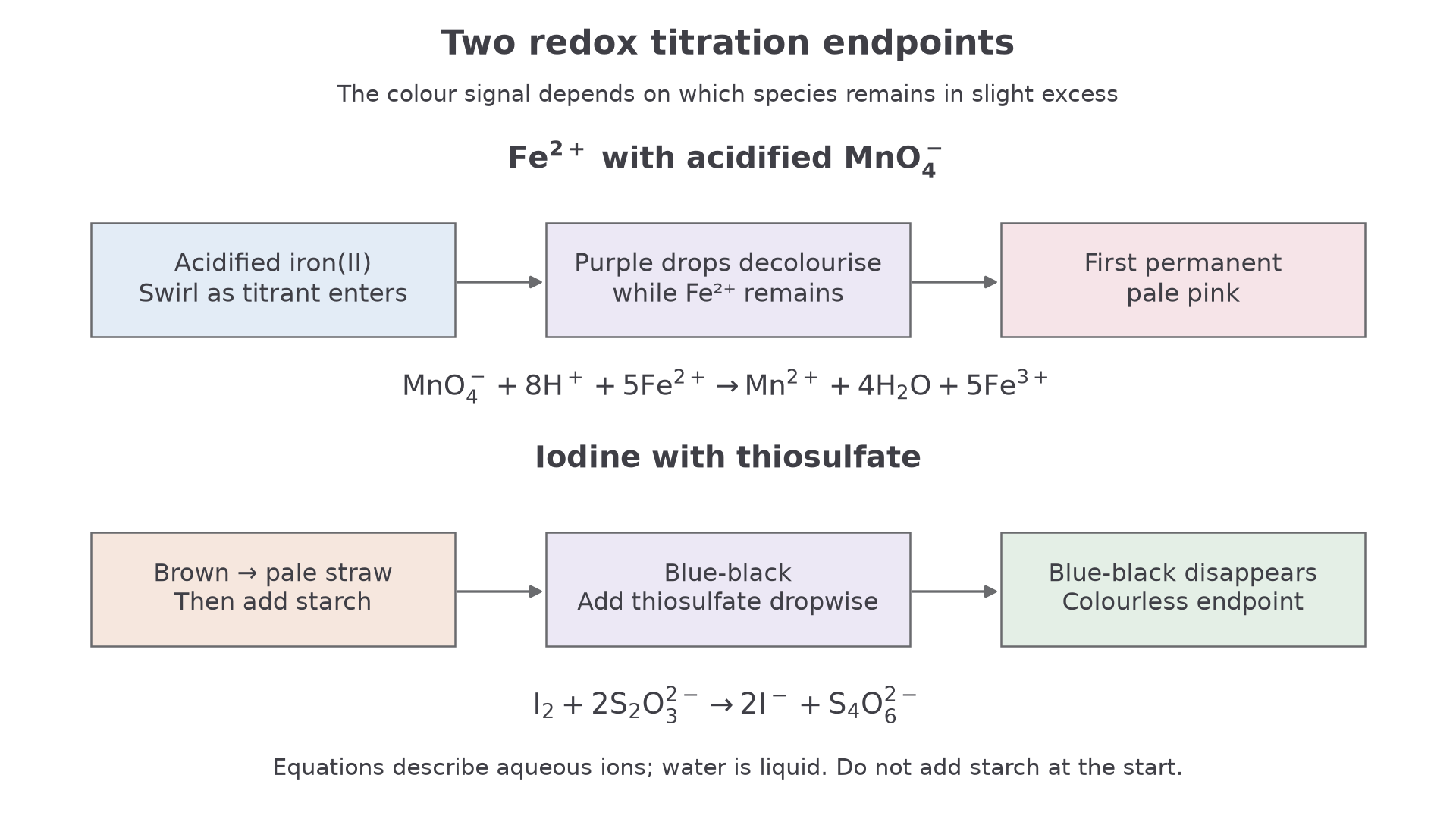
[DIAGRAM: asset_name: Lesson 5.2.3d-e: Redox titrations - diagram 01; asset_slug: 05_02_03b_redox_titrations__diagram_01; recommended_method: drawn_chem; description: Endpoint signal flow for Fe2+/MnO4- and I2/S2O3^2- redox titrations, including colour sequence, indicator timing and core ionic equations.]
Manganate(VII) with iron(II)
Potassium manganate(VII), , contains ions. In acidic solution, is a strong oxidising agent and is reduced to .
Manganate(VII) reduction in acid
Iron(II) ions are reducing agents:
Multiplying the iron(II) half-equation by 5 and adding gives:
The practical sequence is usually:
- Pipette a known volume of solution into a conical flask.
- Add excess dilute sulfuric acid.
- Fill the burette with standard .
- Titrate while swirling until the first permanent pale pink colour remains.
No separate indicator is needed because manganate(VII) is self-indicating. While is present, each drop of purple is reduced to very pale and the colour disappears. Once all has reacted, the next tiny excess of leaves a permanent pale pink colour.
The acid must provide enough for to reduce to . If the mixture is not acidic enough, brown can form and the stoichiometry is no longer the clean 1:5 ratio. Dilute sulfuric acid is used because it provides without adding an ion that is easily oxidised by manganate(VII) under these conditions.
Iodine with thiosulfate
Sodium thiosulfate, , reduces iodine to iodide ions. Thiosulfate ions are oxidised to tetrathionate ions.
Iodine-thiosulfate titration equation
This equation gives the key mole ratio:
The endpoint is handled differently from the manganate(VII) titration. Iodine is brown/yellow in solution. As thiosulfate is added, iodine is reduced to colourless iodide, so the brown colour fades. When the mixture becomes pale straw coloured, add starch. The starch forms a blue-black colour with the remaining iodine. Continue adding thiosulfate dropwise until the blue-black colour just disappears.
Starch is added near the endpoint, not at the beginning. If it is added too early, the iodine-starch colour can be slow to disappear and the endpoint is harder to judge accurately.
Worked example: 25.00 of iodine solution is titrated with 0.100 sodium thiosulfate. The mean titre is 22.60 . Calculate the concentration of iodine.
First find moles of thiosulfate:
From the equation, 2 react with 1 :
This was in 25.00 :
Structured calculations
Keep unrounded calculator values through mole-ratio and dilution steps, then round the final answer appropriately. Premature rounding can change the last reported digit.
Redox titration calculations use the same amount-of-substance tools as acid-base titrations, but the mole ratio often comes from half-equations rather than a simple neutralisation equation.
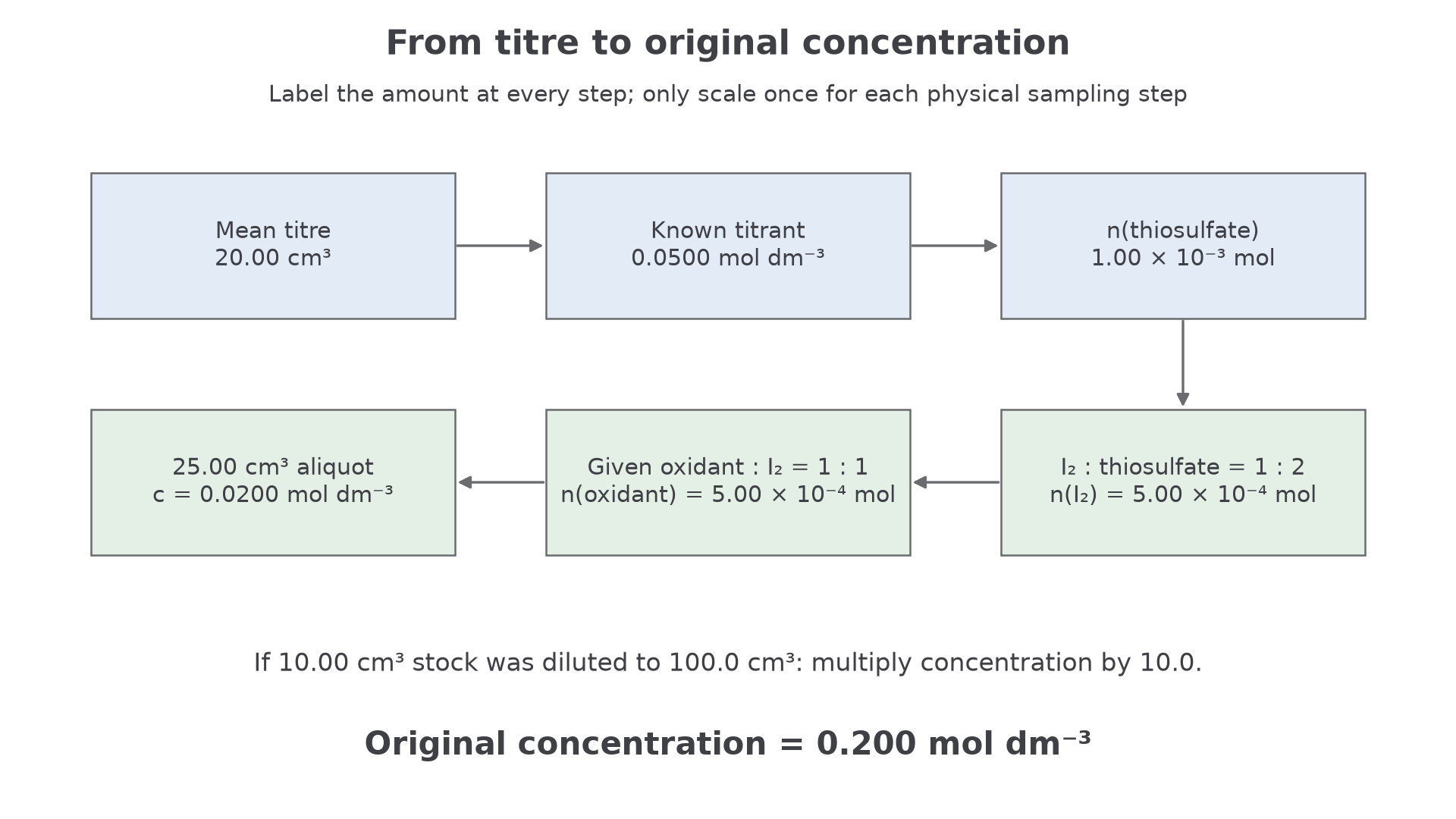
[DIAGRAM: asset_name: Lesson 5.2.3d-e: Redox titrations - diagram 02; asset_slug: 05_02_03b_redox_titrations__diagram_02; recommended_method: drawn_chem; description: Flow diagram for processing redox titration calculations from concordant mean titre through n = cV, redox mole ratio, aliquot scaling and final units/significant figures.]
A reliable route is:
- Select the concordant titres and calculate a mean, excluding any rough titre or clear anomaly.
- Convert the mean titre from to .
- Use for the solution of known concentration.
- Use the balanced redox equation to convert to moles of the unknown species.
- Divide by the aliquot volume, or scale up if the aliquot came from a larger volumetric flask.
- Give appropriate units and significant figures.
Worked example: 25.00 of is acidified and titrated with 0.0200 . The mean titre is 18.40 . Calculate the concentration of .
Equation:
Moles of used:
Use the 1:5 ratio:
This was in 25.00 :
OCR-style questions often include a titre table. Record burette readings to two decimal places, normally ending in 0 or 5. A titre is a difference between two readings, so a burette titre carries uncertainty from both the initial and final reading.
A mean titre and its uncertainty
Suppose the rough titre is , followed by , and . The last three agree within ; exclude the rough and use their unrounded mean in calculations (report ). Use the concordance criterion specified by the method; a common school criterion is within .
Continue this lesson.
You’re previewing NovaLearn without an account. Create a free account to read the rest.
Create free account