6.2.5(b)-(c) - Multistage organic synthesis
Multistage organic synthesis is the skill of planning a route from one organic compound to another. In this lesson, you will learn how to read molecules with several functional groups, predict which reactions are possible, and build routes using transformations from across the OCR specification. The emphasis is not on memorising one giant scheme, but on choosing sensible intermediates and matching each step to the correct reagent and condition.
Read the functional groups
A molecule with several functional groups has several possible reaction sites. In synthesis questions, the first task is to identify each functional group separately before deciding which one should react.
Functional group
A functional group is a group of atoms responsible for the characteristic reactions of a compound.
For this Module 6 synthesis point, you should be comfortable recognising the Module 4 groups and the later Module 6 groups.
| Feature in a molecule | Functional group or class | Useful prediction |
|---|---|---|
| alkene | Addition reactions; decolourises bromine water. | |
| , where is , or | haloalkane | Nucleophilic substitution; can form alcohols, amines or nitriles using the right nucleophile. |
| on an aliphatic carbon | alcohol | Hydrogen bonding; primary/secondary alcohols can be oxidised; alcohols can eliminate water or form haloalkanes. |
| directly on a benzene ring | phenol | Weak acidity; activated aromatic ring; does not behave as an aliphatic alcohol. |
| aldehyde | Oxidises to a carboxylic acid; reduces to a primary alcohol; undergoes nucleophilic addition. | |
| within a chain | ketone | Reduces to a secondary alcohol; undergoes nucleophilic addition; does not oxidise like an aldehyde under OCR conditions. |
| carboxylic acid | Acidic; reacts with carbonates, alkalis and alcohols; can form acyl chlorides. | |
| ester | Can be hydrolysed; formed from carboxylic acids or acid derivatives and alcohols. | |
| acyl chloride | Reactive acid derivative; forms esters, carboxylic acids and primary/secondary amides. | |
| -NH₂ or substituted amine group | amine | Basic because the nitrogen lone pair accepts a proton; forms salts with dilute inorganic acids. |
| -CONH₂ or | amide | Acid derivative; can appear in polyamides and hydrolysis products. |
| nitrile | Extends the carbon chain by one carbon; can be reduced to an amine or hydrolysed to a carboxylic acid. | |
| -NO₂ on an aromatic ring | nitroarene | Reduces to an aromatic amine with tin/concentrated HCl, followed by alkaline work-up. |
| benzene ring | arene | Undergoes electrophilic substitution rather than addition under normal OCR aromatic conditions. |
Worked example: identify the functional groups in H₂NCH(CH₂OH)COOH.
This molecule contains an amine group, -NH₂, a primary alcohol group, -CH₂OH, and a carboxylic acid group, . The amine can accept a proton from dilute acid to form a salt. The carboxylic acid can react with carbonate ions to produce carbon dioxide. The primary alcohol can be oxidised under suitable conditions, but a synthesis answer must make clear that this is the alcohol group reacting, not the carboxylic acid group.
The main property prediction is also functional-group based. Alcohol, amine and carboxylic acid groups can all form hydrogen bonds with water, so a small molecule containing several of these groups is likely to be relatively soluble in water. That is a prediction from bonding and functional groups, not from the molecule name alone.
Build the route map
In a synthesis route, a functional-group transformation is one stage that changes one functional group into another. A multistage route connects several transformations through real organic intermediates.
Use the map as a thinking tool, then write the route in words. The examiner does not need every reaction you know; they need the steps that take the starting compound to the target.
[DIAGRAM: asset_name: 6.2.5b-c - Multistage organic synthesis - diagram 01; asset_slug: 06_02_05b_multistage_organic_synthesis__diagram_01; recommended_method: drawn_chem; description: Three connected synthetic routes with real intermediates: chain extension, acyl derivatives and aromatic amide formation.]
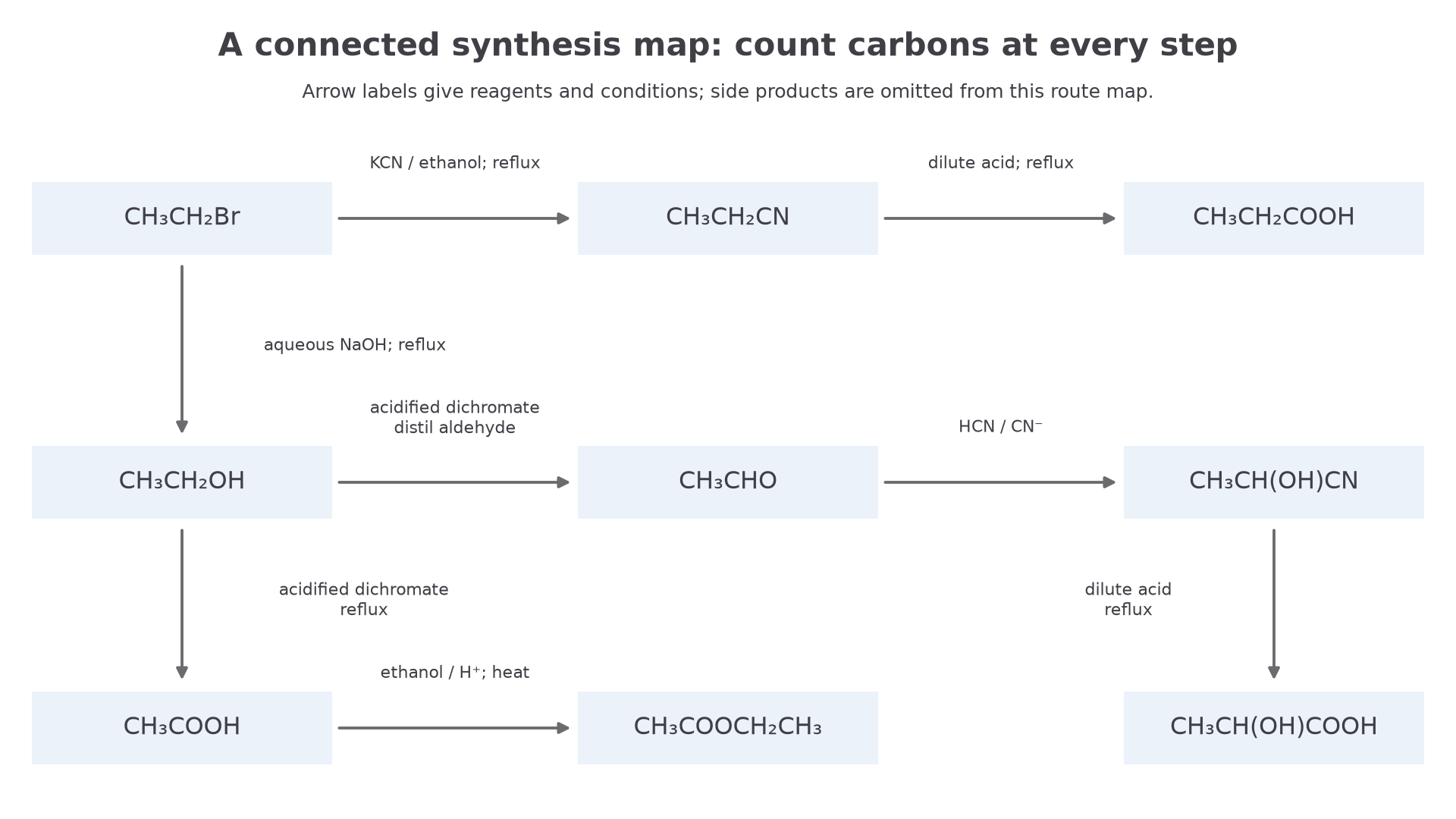
Core OCR transformations include:
| Transformation | Reagent or condition to remember |
|---|---|
| alkane to haloalkane | Cl₂ or Br₂, UV light; free-radical substitution can give mixtures |
| alkene to dihaloalkane | Br₂; electrophilic addition |
| alkene to alkane | with a suitable catalyst such as Ni |
| alkene to haloalkane | hydrogen halide, such as |
| alkene to alcohol | steam with an acid catalyst such as H₃PO₄ |
| alcohol to alkene | acid catalyst such as H₃PO₄ or H₂SO₄, heat |
| alcohol to haloalkane | halide ions in acid, such as NaBr/H₂SO₄ |
| haloalkane to alcohol | aqueous alkali, heat |
| haloalkane to nitrile | CN⁻ in ethanol |
| haloalkane to amine | excess ethanolic ammonia |
| primary alcohol to aldehyde | acidified dichromate(VI), distil the aldehyde as it forms |
| primary alcohol to carboxylic acid | acidified dichromate(VI), heat under reflux |
| secondary alcohol to ketone | acidified dichromate(VI) |
| aldehyde to carboxylic acid | acidified dichromate(VI), Cr₂O₇²⁻/H⁺ |
| aldehyde or ketone to alcohol | NaBH₄ |
| aldehyde or ketone to hydroxynitrile | , made from NaCN(aq)/H⁺(aq) |
| nitrile to amine | reduction, for example |
| nitrile to carboxylic acid | acid hydrolysis, reflux |
| carboxylic acid to ester | alcohol and concentrated H₂SO₄, heat |
| ester to carboxylic acid and alcohol | hot aqueous acid, reflux |
| ester to carboxylate salt and alcohol | hot aqueous alkali, reflux |
| carboxylic acid to acyl chloride | SOCl₂ |
| acyl chloride to ester | alcohol or phenol |
| acyl chloride to amide | ammonia or an amine |
| amide to acid and ammonium salt | aqueous acid, heat under reflux |
| amide to carboxylate and amine | aqueous alkali, heat under reflux |
| benzene to halobenzene | Cl₂ or Br₂ with a suitable halogen carrier, such as AlCl₃ or FeBr₃ |
| phenol to tribromophenol | excess bromine water; no halogen carrier needed |
| benzene to nitrobenzene | concentrated HNO₃ with concentrated H₂SO₄ |
| nitroarene to aromatic amine | tin and concentrated , then |
| arene to alkylbenzene or acylbenzene | Friedel-Crafts reaction using a haloalkane or acyl chloride with a halogen carrier |
Worked overall yield. A 1:1:1 two-stage synthesis starts with 0.100 mol of A. At 80% yield, stage 1 gives 0.0800 mol B. If stage 2 is 75%, it gives 0.0600 mol C: overall yield is 0.80 × 0.75 × 100 = 60%, not the average 77.5%. Check reaction ratios before multiplying stage yields.
OCR may supply extra information in a question. Treat supplied information as a temporary new arrow on the map. For example, suppose a question states that a primary amide RCONH₂ can be dehydrated to RCN using reagent Z. Starting with ethanoic acid, form CH₃COCl using SOCl₂, then CH₃CONH₂ using excess NH₃, then apply supplied Z to make CH₃CN. The last step removes water and does not add carbon. The supplied rule extends the route without making Z a memorised syllabus reagent. Do not import unrelated reactions such as Grignard or Wittig chemistry unless the question gives you the needed reaction.
Plan a route
A strong synthesis answer follows a simple sequence.
Continue this lesson.
You’re previewing NovaLearn without an account. Create a free account to read the rest.
Create free account