4.2.2(e) - Organohalogens and ozone depletion
Some organohalogen compounds are useful because they are chemically stable, but that stability can let them survive long enough to reach the upper atmosphere. In this lesson you will learn how ultraviolet radiation makes radicals from CFCs, how those radicals catalyse ozone breakdown, and why scientific evidence led to restrictions on CFC use.
Ozone, CFCs and the problem
Ozone, , is a form of oxygen found in the upper atmosphere. The Earth's protective ozone layer absorbs much of the ultraviolet radiation from the Sun before it reaches the surface. If less ozone is present, more harmful ultraviolet radiation can pass through.
CFCs are chlorofluorocarbons. They are organohalogen compounds because they contain carbon atoms bonded to halogen atoms, especially chlorine and fluorine. A common example is dichlorodifluoromethane, .
The awkward part is that the original benefits of CFCs are connected to the later environmental problem:
| Property of CFCs | Why it was useful | Why it became risky |
|---|---|---|
| chemically stable | did not react easily during use | persisted long enough to reach the upper atmosphere |
| low toxicity | safer than some older refrigerants | could be released without an obvious immediate hazard |
| non-flammable | useful in aerosols and refrigeration | encouraged widespread use |
At ground level, CFCs are not very reactive. In the upper atmosphere, however, they meet higher-energy UV radiation. That UV radiation can break a carbon-halogen bond in a CFC and produce radicals.
Radical
A radical is a species with an unpaired electron. In equations, the unpaired electron is shown by a dot, for example or .
Worked reasoning: why useful stability can become an atmospheric problem
is stable enough not to react much in the lower atmosphere. Air mixing can therefore carry it upwards over time. In the upper atmosphere, higher-energy UV radiation can break a C-Cl bond, producing chlorine radicals. The problem is not that CFCs are violently reactive at ground level; it is that they survive until they reach conditions where radical chemistry can begin.
UV forms halogen radicals
UV radiation can provide enough energy to break a covalent bond in a CFC. The important bond-breaking model here is homolytic fission: one electron from the bond pair goes to each product species. That gives radicals on both sides of the broken bond.
Homolytic Fission
Homolytic fission is the breaking of a covalent bond so that one electron from the bond pair goes to each atom or product species, forming radicals.
For dichlorodifluoromethane, one C-Cl bond can break:
[DIAGRAM: asset_name: UV homolysis of a CFC; asset_slug: 04_02_02b_organohalogens_and_ozone_depletion__diagram_01; recommended_method: drawn_chem; description: C-Cl bond homolysis produces two radical fragments, with one electron from the bond on each fragment.]
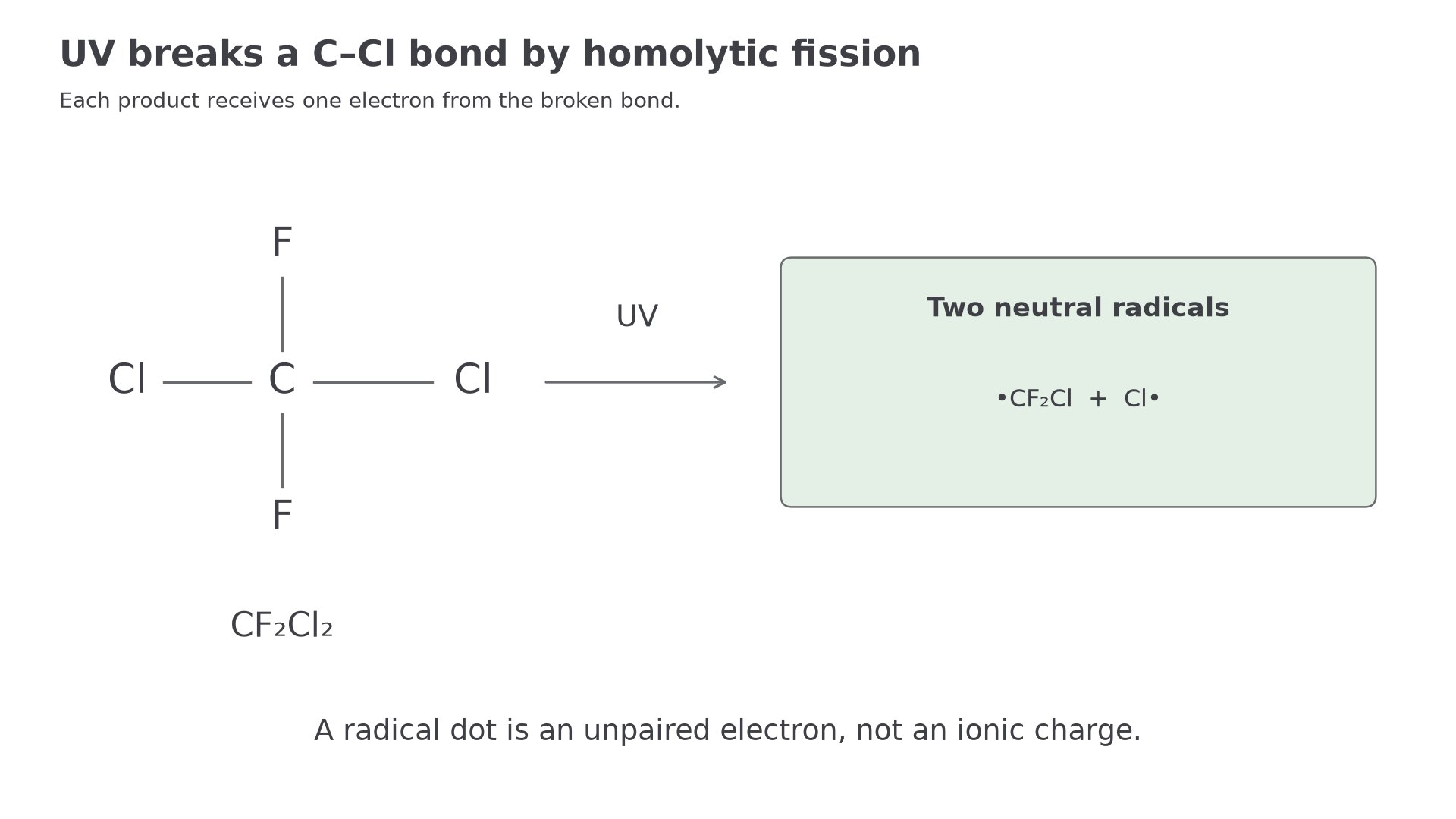
The chlorine radical, , is the species that starts the ozone-breakdown cycle. The other product, , is also a radical because the carbon-containing fragment has an unpaired electron.
Worked example: writing a radical production equation
Suppose UV radiation breaks one C-Cl bond in .
- Start with the CFC formula: .
- Remove one chlorine atom as a chlorine radical, .
- The remaining carbon-containing fragment has one fewer chlorine atom and is also a radical: .
Notice that this is not an ionic equation. The dot means an unpaired electron, not a positive or negative charge.
Chlorine radical ozone breakdown
Once a chlorine radical has formed, it can react with ozone. The two required steps are:
In the first step, the chlorine radical reacts with ozone, , forming chlorine monoxide radical, , and oxygen, . In the second step, the chlorine radical is regenerated when reacts with an oxygen atom, O.
[DIAGRAM: asset_name: Catalytic ozone cycles; asset_slug: 04_02_02b_organohalogens_and_ozone_depletion__diagram_02; recommended_method: drawn_chem; description: Balanced chlorine and nitrogen monoxide radical cycles showing regenerated catalyst and the overall O3 plus O to 2O2 reaction.]
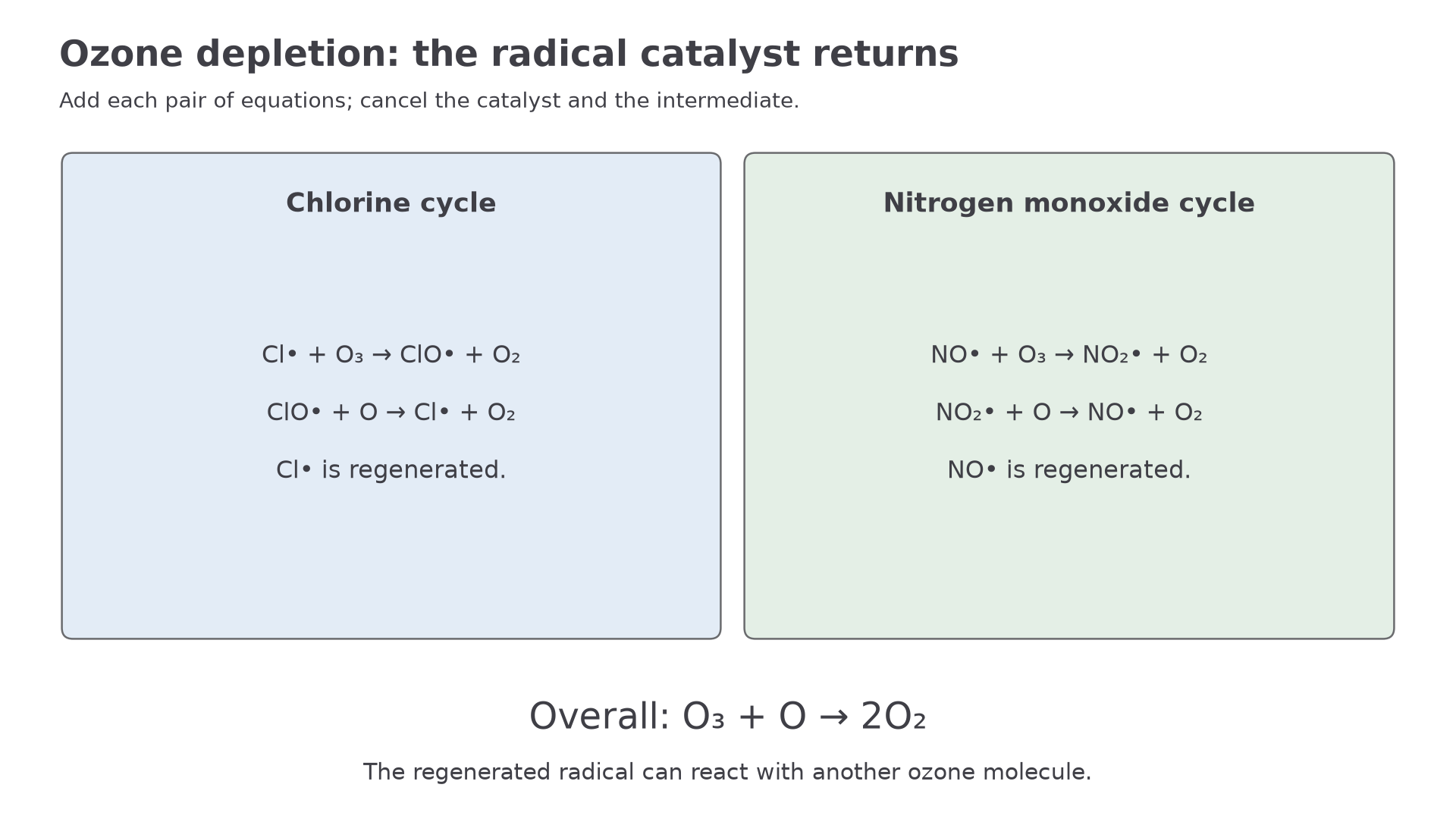
That regeneration is the key. A catalyst is used in one step and remade in a later step, so it can take part again. Here, is a radical catalyst for the breakdown of ozone.
If the two steps are added together, the radical species cancel:
Continue this lesson.
You’re previewing NovaLearn without an account. Create a free account to read the rest.
Create free account