6.3.1(c) - Organic functional group tests
Organic functional group tests turn small-scale observations into evidence. In this lesson, you will learn the exact OCR test-tube tests for identifying key organic functional groups in an unknown compound. The main skill is not just remembering colours: it is linking reagent, observation and inference without overclaiming from a single result.
Evidence before identity
A qualitative test is a small-scale experiment that produces an observation. The observation is then used as evidence for a functional group. In OCR questions, you often see a table of results and have to explain what each result shows.
The safe habit is:
- name the reagent or condition;
- state the observation;
- state the functional-group inference;
- combine it with other results before naming a structure.
[DIAGRAM: asset_name: 6.3.1c - Organic functional group tests - diagram 01; asset_slug: 06_03_01b_organic_functional_group_tests__diagram_01; recommended_method: drawn_chem; description: Separate fresh samples: test reagents and observations with colour swatches and qualified chemical inferences.]
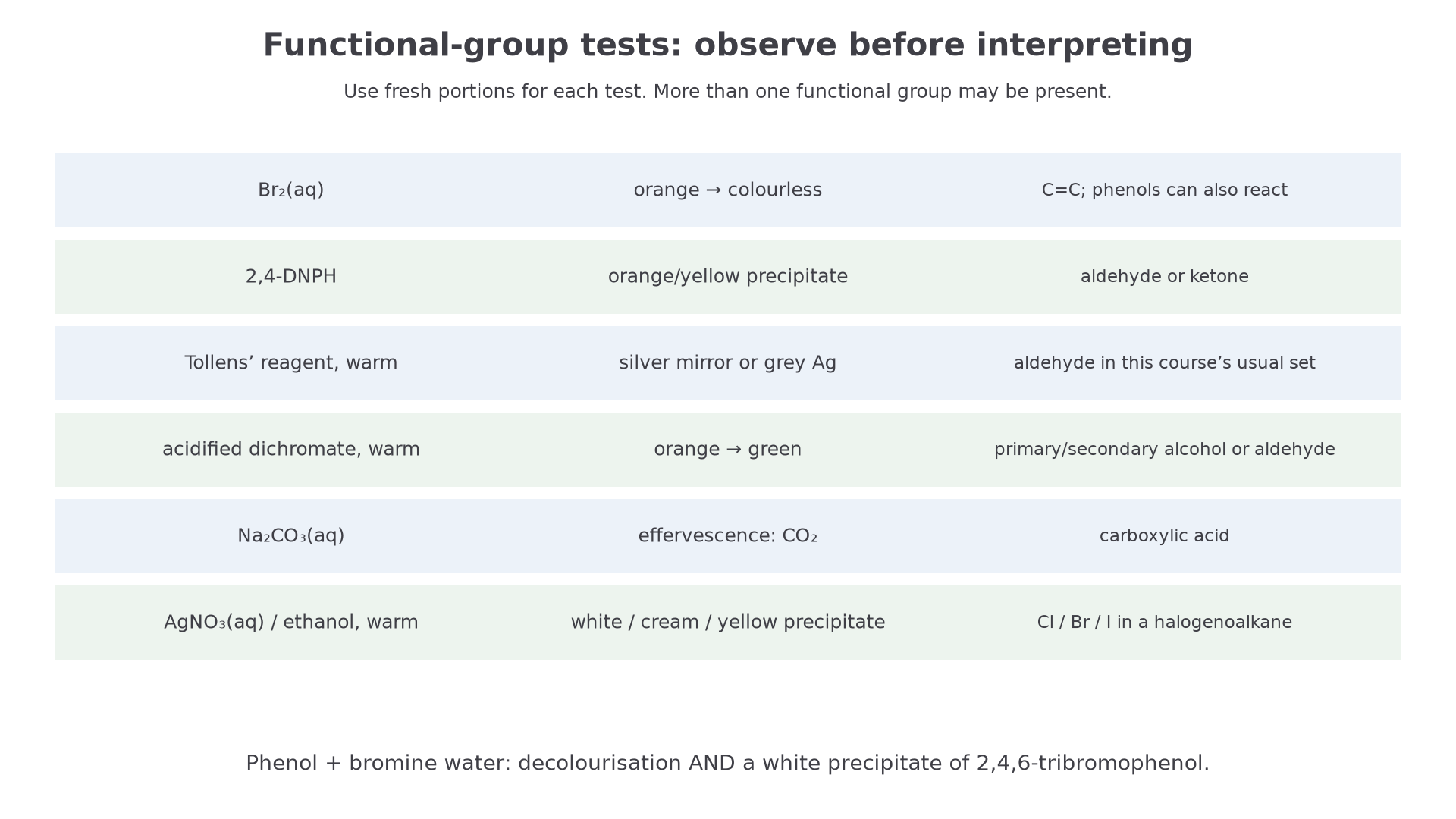
For this lesson, the required tests are:
| Functional group or class tested | Reagent and condition | Positive observation | Inference |
|---|---|---|---|
| alkene, | bromine water / bromine | orange or brown colour is decolourised | carbon-carbon double bond present |
| haloalkane, | aqueous silver nitrate in ethanol, warmed if needed | silver halide precipitate: white, cream or yellow | haloalkane has hydrolysed to release halide ions |
| phenol | sodium hydroxide and carbonate on separate fresh samples | neutralises/reacts with NaOH; no effervescence with carbonate | weakly acidic phenol possible; not a carboxylic acid |
| aldehyde or ketone carbonyl | 2,4-DNP / 2,4-DNPH / Brady's reagent | yellow, orange or red precipitate | aldehyde or ketone carbonyl present |
| aldehyde | Tollens' reagent, warmed gently | silver mirror or grey/black silver precipitate | aldehyde present |
| primary or secondary alcohol, or aldehyde | acidified dichromate(VI), warmed or refluxed | orange to green | oxidisable group present: primary alcohol, secondary alcohol or aldehyde |
| carboxylic acid | carbonate solution | effervescence from carbon dioxide | carboxylic acid present |
Worked example: reading evidence rather than guessing
An unknown gives a yellow precipitate with 2,4-DNP and a silver mirror with Tollens' reagent. The first test shows an aldehyde or ketone carbonyl group. The Tollens' result then narrows this to an aldehyde. The conclusion is not just "carbonyl"; the combined evidence supports aldehyde.
Unsaturation, halogens and acidity
Three tests in this lesson are best treated as quick screens: bromine for unsaturation, silver nitrate in ethanol for haloalkanes, and carbonate for acidity.
Alkenes with bromine
Alkenes contain a carbon-carbon double bond. Bromine is orange-brown in aqueous solution. When it reacts across a bond, the bromine colour disappears.
For ethene, the addition reaction can be represented as:
In an unknown analysis question at A level, the required observation is that bromine water is decolourised. This result is not uniquely specific to alkenes: phenols can also decolourise bromine (often with a white precipitate), and aldehydes can reduce bromine water. Use the candidate list and other tests; do not infer C=C from decolourisation alone in an unrestricted unknown.
Haloalkanes with aqueous silver nitrate in ethanol
A haloalkane contains a carbon-halogen bond, . In this qualitative test, ethanol helps the organic haloalkane mix with the aqueous reagent. Water hydrolyses the haloalkane slowly, releasing halide ions, and silver ions form an insoluble silver halide precipitate:
The precipitate colour depends on the halide ion released:
| Halide ion | Silver halide | Observation |
|---|---|---|
| Cl⁻ | white precipitate | |
| Br⁻ | cream precipitate | |
| yellow precipitate |
For a controlled comparison of primary chloro-, bromo- and iodoalkanes with the same carbon chain, keep concentrations, volumes and water-bath temperature equal. Start timing on mixing. The iodoalkane precipitate normally appears first because C–I has the lowest bond enthalpy, then bromoalkane, then chloroalkane. Bond breaking, not C–X polarity alone, controls this trend.
For this lesson, the purpose is identification of the haloalkane functional group. Do not turn the answer into a rate comparison unless the question specifically gives times or asks about hydrolysis rate.
Phenols and carboxylic acids with sodium hydroxide and carbonate
Phenols are weakly acidic. They react with sodium hydroxide in a neutralisation reaction to form a phenoxide salt, such as sodium phenoxide. This is evidence for weak acidity, but it is not enough on its own to call the compound a carboxylic acid.
Phenols are not acidic enough to react with carbonate ions. So a phenol gives no effervescence with carbonate solution.
Carboxylic acids do react with carbonate ions. The observation is effervescence because carbon dioxide is produced:
This contrast is important. Phenol evidence is weak acidity shown by neutralisation with sodium hydroxide, together with no bubbles with carbonate. Bubbles with carbonate support carboxylic acid rather than phenol.
If the candidates are phenol and ethanol, bromine water provides another distinction: phenol decolourises it and forms a white precipitate of 2,4,6-tribromophenol, whereas ethanol gives no visible change under these test conditions. A test result must be interpreted against the stated candidates; it is not a universal proof of identity.
Worked example: phenol or carboxylic acid
Two unknowns are tested with sodium hydroxide and sodium carbonate solution. A gives effervescence with carbonate. B reacts with sodium hydroxide but gives no effervescence with carbonate.
A is identified as a carboxylic acid from the carbonate result. B is consistent with a phenol: it behaves as a weak acid with sodium hydroxide but is not acidic enough to release carbon dioxide from carbonate.
Carbonyl and aldehyde tests
The two carbonyl tests form a sequence. 2,4-DNP detects aldehydes or ketones. Tollens' reagent then distinguishes aldehydes from ketones.
Carbonyl compound in this test
In this OCR test, a carbonyl compound means an aldehyde or a ketone. Do not infer carboxylic acid or ester from a positive 2,4-DNP result in this lesson.
2,4-DNP detects aldehydes and ketones
2,4-dinitrophenylhydrazine is often written as 2,4-DNP or 2,4-DNPH and may be called Brady's reagent. Add it to a small sample of the unknown. A positive result is a yellow, orange or red precipitate. This shows that an aldehyde or ketone carbonyl group is present.
This test does not distinguish an aldehyde from a ketone. It also does not identify a specific compound from the precipitate colour alone.
Tollens' reagent detects aldehydes
Tollens' reagent is ammoniacal silver nitrate. Warm the sample gently with Tollens' reagent. A positive result is a silver mirror on the inside of the test tube, or a grey/black precipitate of silver.
The redox idea is:
- the aldehyde is oxidised to a carboxylate in the alkaline Tollens' mixture; an acid is obtained only after acidification;
- silver ions are reduced to silver metal, .
Ketones do not give this positive result under the conditions of the Tollens' test. So if 2,4-DNP is positive but Tollens' reagent gives no visible change, the carbonyl compound is a ketone.
Worked example: aldehyde or ketone
An unknown gives an orange precipitate with 2,4-DNP. It gives no visible change with Tollens' reagent.
Continue this lesson.
You’re previewing NovaLearn without an account. Create a free account to read the rest.
Create free account