6.1.2(a)-(c) - Carbonyl reactions and nucleophilic addition
Carbonyl compounds contain the C=O group, and that polar double bond controls their reactions. In this lesson, you will learn why aldehydes and ketones are attacked by nucleophiles, how aldehydes are oxidised, and how or adds to carbonyl compounds. The mechanism details matter because OCR mark schemes reward correct electron-pair movement, dipoles, charges and reagents.
The carbonyl reaction site
An aldehyde has the carbonyl group at the end of a carbon chain, so it contains the group . A ketone has the carbonyl carbon bonded to two carbon groups, so it contains .
The carbonyl group is reactive because oxygen is more electronegative than carbon. The C=O bond is polar:
The carbonyl carbon is electron deficient, so it can be attacked by a nucleophile.
Nucleophile
A nucleophile is an electron pair donor.
In a nucleophilic addition reaction of a carbonyl compound, a nucleophile donates an electron pair to the carbonyl carbon. The C=O pi bond opens up, the oxygen becomes negatively charged in an intermediate, and then the intermediate is protonated to make a neutral product.
This is addition, not substitution: the carbonyl C=O double bond is converted into single bonds, and no leaving group is expelled from the carbonyl compound.
Worked reasoning: why attack happens at carbon
For ethanal, , the oxygen pulls electron density away from the carbonyl carbon. A negative or electron-rich species is attracted to the carbon, not to the oxygen. In a curly-arrow mechanism, the arrow from the nucleophile must point to the carbonyl carbon, while the C=O electron pair moves to oxygen.
Oxidising aldehydes
OCR requires the oxidation of aldehydes using acidified dichromate(VI) ions:
In practical reagent terms, this is usually written as:
An aldehyde is oxidised to a carboxylic acid. In organic redox equations, OCR expects to represent oxygen from an oxidising agent.
Aldehyde oxidation
For ethanal:
The observation with acidified potassium dichromate(VI) is orange to green because dichromate(VI) ions are reduced to chromium(III) ions. A ketone does not undergo this oxidation under these conditions.
PAG7 is the practical link: use small-scale organic qualitative-analysis apparatus, warm safely if needed, and record the colour change clearly. Acidified dichromate(VI) is hazardous, so this is not a casual "add lots and see" test; the teaching point is controlled reagent use and accurate observation.
Worked example: writing an oxidation equation
Propanal is . The aldehyde group becomes , so the product is propanoic acid:
Do not write an alcohol product here. Aldehyde oxidation moves the molecule to a carboxylic acid.
Aldehydes have a hydrogen attached to the carbonyl carbon; oxidation replaces this effectively with OH while retaining the carbon skeleton. Ketones have carbon groups on both sides, so the corresponding oxidation would require C–C bond cleavage and does not occur in this test. Use a small sample and warm in a water bath, with the same reagent quantity and warming time for comparison samples; compare with a reagent blank before recording orange-to-green as a positive result.
reduction to alcohols
Sodium borohydride, , reduces aldehydes and ketones to alcohols. In the equation, OCR organic redox notation uses for hydrogen from a reducing agent.
For an aldehyde:
An aldehyde forms a primary alcohol because the carbonyl carbon is bonded to only one carbon group.
For a ketone:
A ketone forms a secondary alcohol because the carbonyl carbon is bonded to two carbon groups.
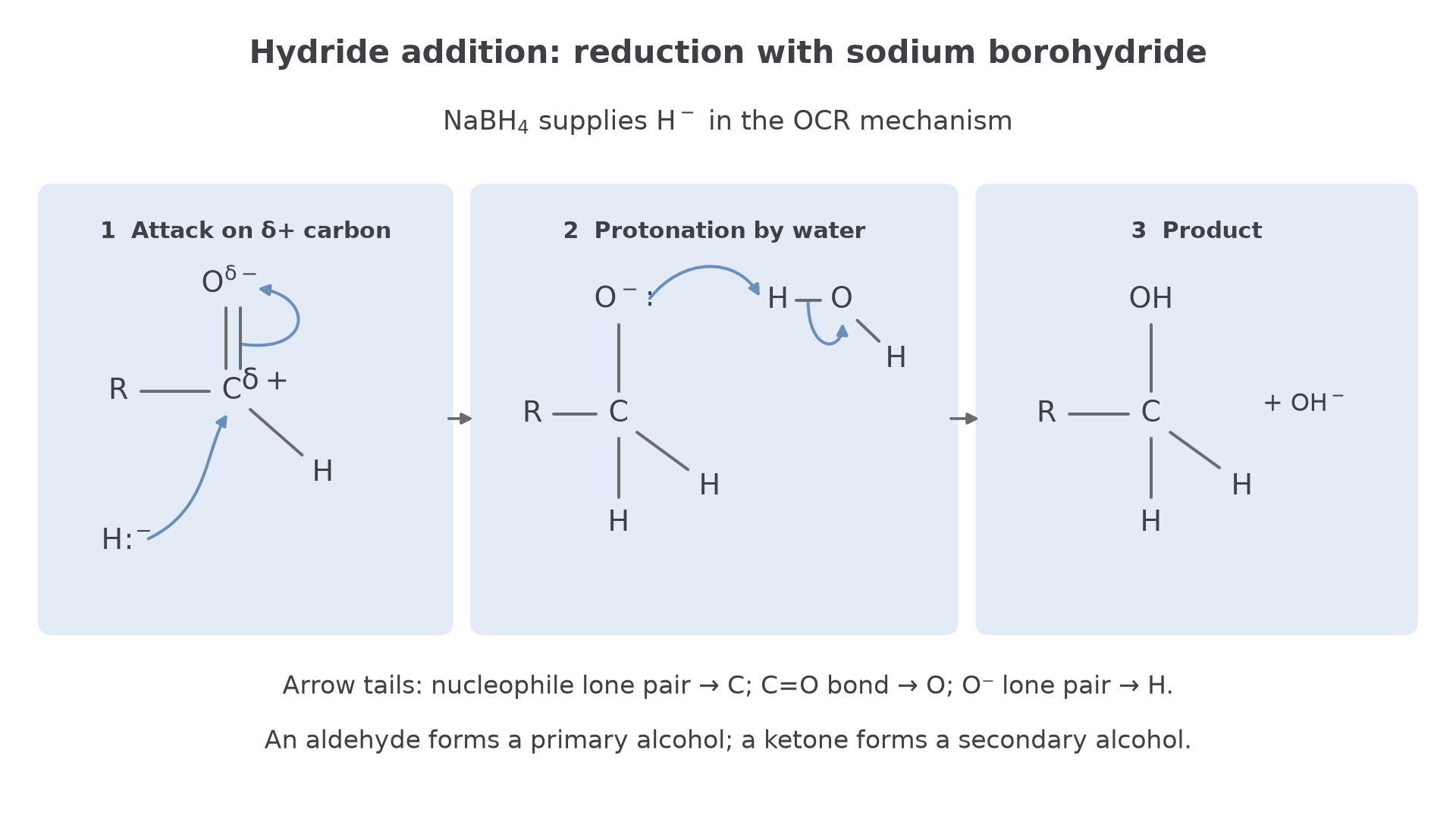
OCR allows the mechanism to be simplified by treating the nucleophile as hydride, .
The two stages are:
- donates an electron pair to the delta+ carbonyl carbon while the C=O pi electron pair moves to oxygen, giving a single C-O bond and an alkoxide intermediate.
- The negatively charged oxygen is protonated by water to form the alcohol.
Worked example: reducing ethanal
Ethanal is an aldehyde, so it forms a primary alcohol:
The product is ethanol. The mechanism explanation is not "hydrogen gas adds"; the simplified nucleophile is hydride, , from , followed by protonation from water.
In the usual OCR reaction conditions, sodium borohydride selectively reduces aldehyde/ketone C=O, leaving an isolated C=C or a carboxylic acid group unchanged. For example, forms . Check each carbon's four bonds rather than replacing every oxygen-containing group.
Methanal is the special end-of-series aldehyde: it gives methanol. The familiar primary-alcohol pattern applies to aldehydes with a carbon group attached to CHO.
[DIAGRAM: asset_name: 6.1.2a-c - Carbonyl reactions and nucleophilic addition - diagram 01; asset_slug: 06_01_02a_carbonyl_reactions_and_nucleophilic_addition__diagram_01; recommended_method: drawn_chem; description: Hydride attack with dipoles, lone pair, O-minus intermediate and water protonation.]
Continue this lesson.
You’re previewing NovaLearn without an account. Create a free account to read the rest.
Create free account