6.1.1(k)-(l) - Directing effects in aromatic synthesis
A substituted benzene ring does not usually react as if every position is equally likely. In this lesson, you will learn how , and groups direct the position of a new electrophilic substitution, and why this matters when chemists plan an aromatic synthesis route.
Position language on a substituted ring
In a monosubstituted aromatic compound, the group already attached to the ring is treated as being on carbon 1. The next electrophile can replace a hydrogen at carbon 2, 3 or 4 relative to that existing group.
The older words are useful, but OCR normally uses numbers:
- position 2 is also called ortho
- position 3 is also called meta
- position 4 is also called para
There is an important symmetry point. On a monosubstituted benzene ring, carbon 2 and carbon 6 are equivalent because the ring can be numbered the other way round. Carbon 3 and carbon 5 are also equivalent. So a "2-substituted" product and a "6-substituted" drawing are the same product, not two different products.
[DIAGRAM: asset_name: Lesson 6.1.1k-l: Directing effects in aromatic synthesis - diagram 01; asset_slug: 06_01_01d_directing_effects_in_aromatic_synthesis__diagram_01; recommended_method: drawn_chem; description: position map showing a monosubstituted benzene ring with OH/NH2 as 2- and 4-directing groups and NO2 as a 3-directing group, including equivalent 2/6 and 3/5 positions.]
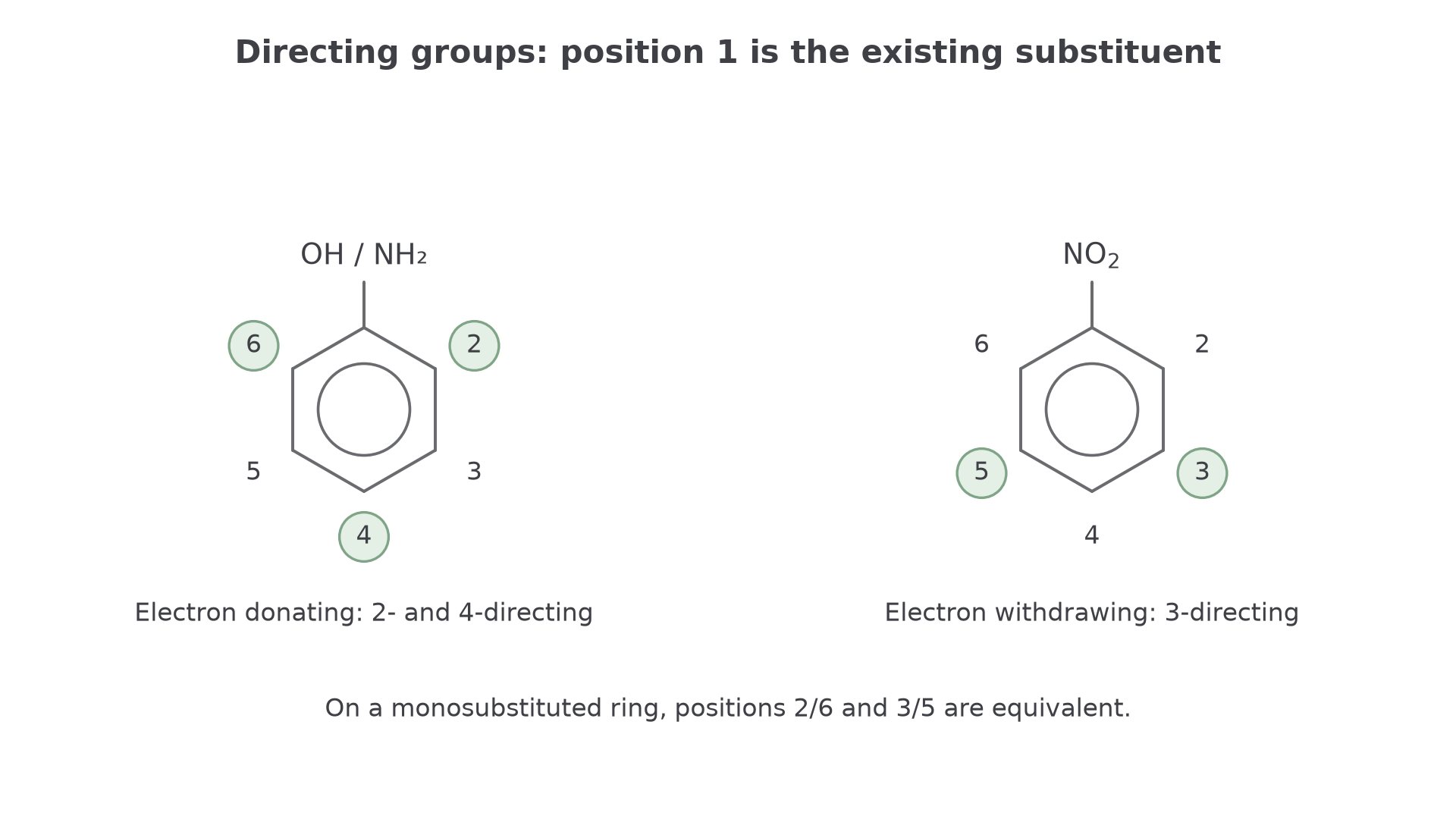
Directing effect
A directing effect is the way a group already attached to an aromatic ring influences the position at which the next electrophilic substitution occurs.
Worked example: phenol is . If a single new nitro group enters at position 2, the product is 2-nitrophenol. If it enters at position 4, the product is 4-nitrophenol. A drawing with the nitro group at position 6 is still 2-nitrophenol after renumbering the ring.
Electron-donating groups direct to 2 and 4
OCR requires two electron-donating groups for this lesson: and . When either group is already attached directly to an aromatic ring, the next electrophilic substitution is directed mainly to the 2- and 4-positions.
For OCR 6.1.1k-l, remember: and are 2- and 4-directing groups.
The electron-pair idea behind this is simple enough for this lesson. The oxygen in or the nitrogen in has a lone pair that can be partially donated into the aromatic pi-system. This increases the electron density in the ring compared with benzene, making the ring more susceptible to electrophilic attack. For product prediction, the assessed consequence is that the new group goes to position 2 or position 4.
Worked example: predict the monosubstitution products when phenylamine, , reacts with an electrophile that adds one chlorine atom to the ring.
- Put at position 1.
- is an electron-donating group.
- Electron-donating directs the new substitution to positions 2 and 4.
- The products are 2-chlorophenylamine and 4-chlorophenylamine.
Do not call 6-chlorophenylamine an extra product here. Position 6 is equivalent to position 2.
Two existing groups
For 4-nitrophenol, label the OH-bearing carbon 1 and the nitro-bearing carbon 4. OH directs a new group to 2/6 because 4 is occupied. Count afresh from the nitro group: its two meta positions are also carbons 2/6 in the original numbering. Both groups therefore favour the same pair of equivalent sites; monobromination gives one distinct main product, 2-bromo-4-nitrophenol.
Once two different groups are present, check the symmetry of the whole structure: positions 2 and 6 need not remain equivalent. A numbering shortcut for a monosubstituted ring cannot automatically be used for a disubstituted ring.
The number of substitutions also depends on the conditions. With excess bromine water, a strongly activated phenylamine ring can substitute at all three available 2-, 4- and 6-positions, giving 2,4,6-tribromophenylamine. A supplied monosubstitution condition is different from unrestricted excess bromine.
Nitro groups direct to 3
OCR requires one electron-withdrawing group for this lesson: . When a nitro group is already attached to an aromatic ring, the next electrophilic substitution is directed to the 3-position.
For OCR 6.1.1k-l, remember: is a 3-directing group.
The nitro group withdraws electron density from the aromatic ring. In OCR answers, the most important use of this fact is the predicted position of the next substitution: the new group enters at position 3 relative to .
Worked example: predict the main monosubstitution product when nitrobenzene undergoes chlorination of the ring.
- Put at position 1.
- is electron-withdrawing.
- is 3-directing.
- The product is 3-chloronitrobenzene.
Position 5 is equivalent to position 3 in a monosubstituted ring, so it is not a separate product.
Continue this lesson.
You’re previewing NovaLearn without an account. Create a free account to read the rest.
Create free account