5.1.3(i)-(m) - Buffer solutions and blood pH
A buffer solution is useful because it keeps the hydrogen ion concentration from changing much when a small amount of acid or base is added. In this lesson, you will learn how an acidic buffer is made, how the conjugate acid-base pair controls pH, how OCR-style buffer calculations use , and how the carbonic acid-hydrogencarbonate system helps maintain blood pH.
What a buffer solution does
A buffer minimises pH changes when small amounts of acid or base are added. It does not keep pH exactly constant, and its capacity is finite: it needs both members of its conjugate pair to remain available.
Buffer solution
A buffer solution is a system that minimises pH changes on addition of small amounts of an acid or a base.
The acidic buffers in this OCR section contain a weak acid and its conjugate base. A convenient general pair is:
Here, is the weak acid and is its conjugate base. For the common ethanoic acid buffer:
The important point is that the mixture contains significant amounts of both forms of the conjugate acid-base pair. The weak acid alone does not provide much , because it only partially dissociates. A buffer needs a reservoir of and a reservoir of .
For this lesson, think "acidic buffer = weak acid plus its conjugate base ".
Making an acidic buffer
OCR specifies two ways to form an acidic buffer.
The first method is to mix a weak acid with a soluble salt of the weak acid. For example:
The salt dissociates fully in water:
The sodium ion is a spectator ion. The buffer action comes from and , not from .
The second method is to react an excess of weak acid with a strong alkali. The strong alkali makes some conjugate base in the same beaker:
If is in excess, some remains after neutralisation and some has been formed. That gives the two species needed for a buffer. If the strong alkali is not limiting and neutralises all the weak acid, there is no reservoir of left, so the solution is not the acid buffer described here.
Worked example:
25.0 of 0.100 is mixed with 10.0 of 0.100 .
The reacts with the same amount of , forming the same amount of .
So after neutralisation:
- left = - =
- formed =
This is a buffer because both and are present.
How the conjugate pair controls pH
An acidic buffer controls pH because each member of the conjugate acid-base pair has a job.
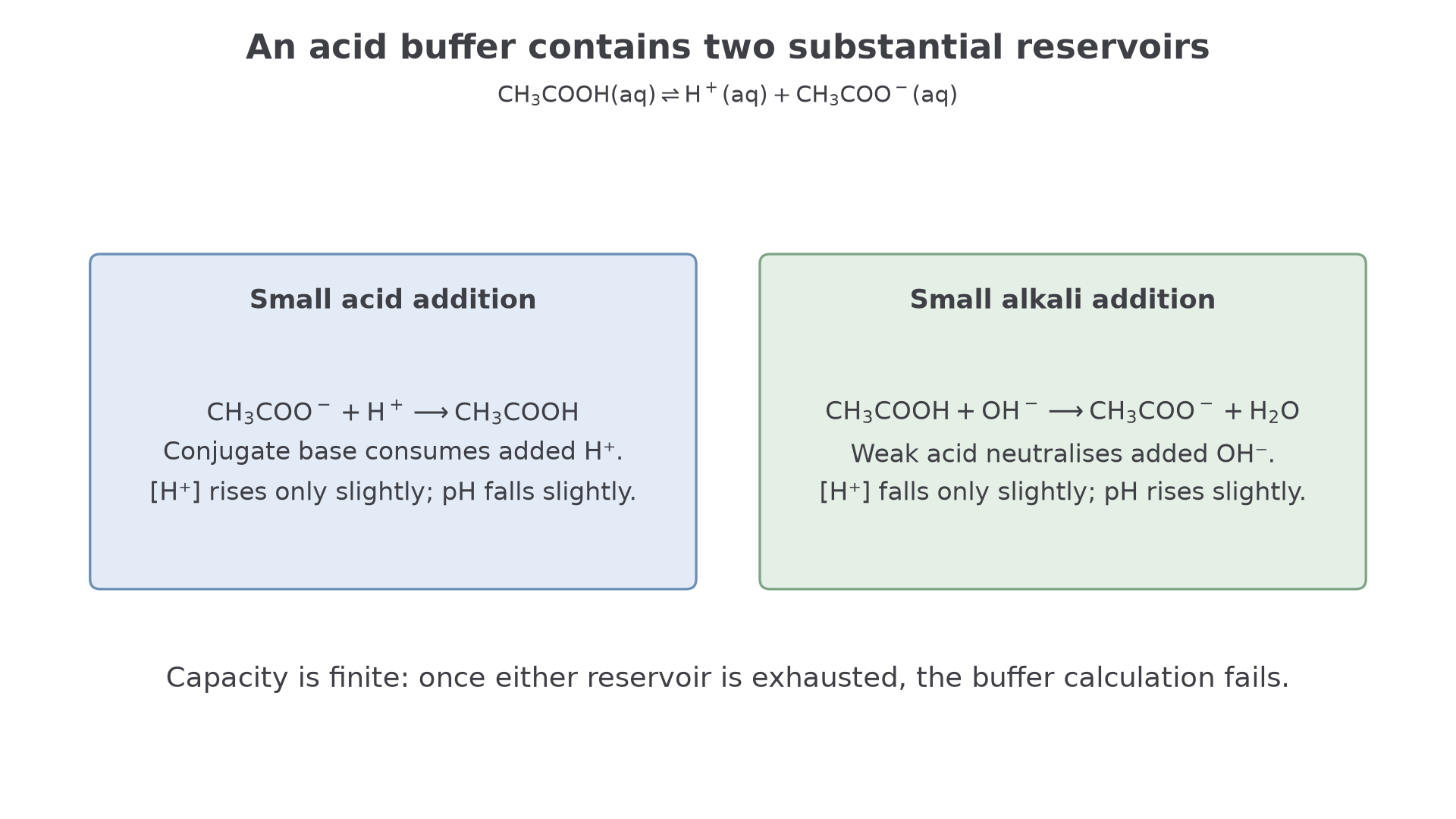
If a small amount of acid is added, the added is mostly removed by the conjugate base:
For the ethanoic acid/ethanoate buffer:
This reduces the increase in , so the pH falls only slightly.
If a small amount of base is added, the added is neutralised by the weak acid:
For the ethanoic acid/ethanoate buffer:
This reduces the decrease in , so the pH rises only slightly.
A common mistake is to say that the equilibrium "stops pH changing". The more accurate OCR idea is that the conjugate pair removes most of the added or , so the pH change is minimised.
The same action can be expressed through . Added acid drives this equilibrium left; removal of by allows more HA to dissociate, shifting it right. Name the equilibrium before describing its shift. The remaining reservoirs are large relative to the small addition, so their ratio changes only a little.
[DIAGRAM: asset_name: Acid buffer response; asset_slug: 05_01_03d_buffer_solutions_and_blood_ph__diagram_01; recommended_method: drawn_chem; description: Ethanoic acid-ethanoate buffer removes added acid or alkali through balanced reactions while pH changes slightly.]
Calculating pH from and the conjugate pair
For a weak acid buffer:
\(K_a\) expression for a weak acid buffer
Rearrange this expression to make the subject:
Then convert to pH:
In OCR buffer calculations, and are the equilibrium concentrations of the conjugate acid-base pair. In practice, the tiny extra dissociation of is usually negligible compared with the much larger amounts of and already present, so the concentrations after mixing are used.
Worked example:
A buffer contains 0.100 and 0.150 . The of is at 25 . Calculate the pH.
Choose the equation:
Substitute:
Now calculate pH:
Continue this lesson.
You’re previewing NovaLearn without an account. Create a free account to read the rest.
Create free account