3.1.3(a)-(d) - Halogen properties and reactivity trends
The halogens chlorine, bromine and iodine show two different kinds of trend. Their boiling points increase down the group because the molecules have stronger London forces, but their redox reactivity decreases because they form 1− ions less easily. In this lesson you will learn how to connect observations, equations, electron transfer and particle-level explanations without drifting into the later halogen topics.
Diatomic Halogen Molecules
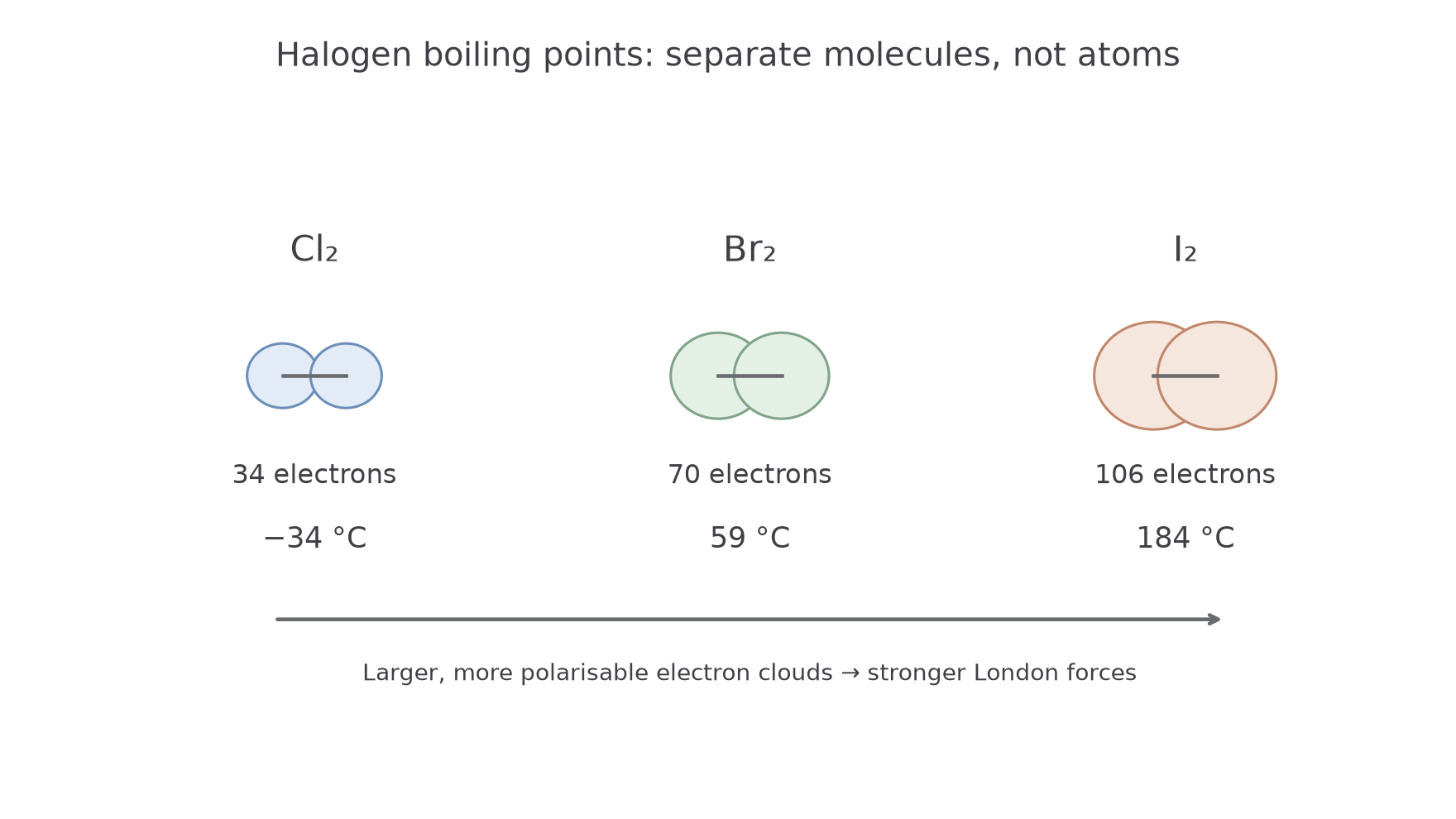
Chlorine, bromine and iodine exist as diatomic molecules: Cl₂, Br₂ and I₂. Each molecule contains two atoms joined by a covalent bond. These are simple molecular substances, so their boiling points depend on the intermolecular forces between the molecules, not on breaking the covalent bond inside each molecule.
London forces
London forces are induced dipole-dipole interactions caused by temporary uneven electron distribution. They act between all molecules, including non-polar molecules such as Cl₂, Br₂ and I₂.
The boiling points increase down Group 17:
| Halogen molecule | Physical state at room temperature | Approximate boiling point |
|---|---|---|
| Cl₂ | gas | -34 °C |
| Br₂ | liquid | 59 °C |
| I₂ | solid | 184 °C |
Down the group, the molecules are larger and contain more electrons. A larger electron cloud is more easily distorted, so temporary induced dipoles are stronger. Stronger London forces mean more energy is needed to separate the molecules, so the boiling point increases from Cl₂ to Br₂ to I₂.
Worked example: explaining the boiling-point trend
Question: Explain why iodine has a higher boiling point than chlorine.
Iodine exists as I₂ molecules and chlorine exists as Cl₂ molecules. I₂ has more electrons and a larger electron cloud than Cl₂. The electron cloud in I₂ is more easily polarised, so the London forces between I₂ molecules are stronger. More energy is needed to overcome these intermolecular forces, so iodine has the higher boiling point.
Notice the careful wording: boiling separates molecules from each other. It does not break the covalent bond inside Cl₂, Br₂ or I₂.
Boiling-point trend down Group 17 is an intermolecular-force trend: larger molecules have stronger London forces and therefore higher boiling points.
[DIAGRAM: asset_slug: 03_01_03a_halogen_properties_and_reactivity_trends__diagram_01; description: Diatomic Cl2/Br2/I2 molecules with electron counts 34/70/106 and boiling points; covalent bonds retained.]
Electron Gain and Redox
A halogen atom has seven electrons in its outer shell. In notation, the outer-shell pattern is s²p⁵, often written more fully as ns²np⁵. This means a halogen atom is one electron short of a full outer shell.
In many redox reactions, a halogen atom gains one electron to form a 1- halide ion:
For the diatomic molecule, two atoms are present, so the reduction half-equation uses two electrons:
The same pattern applies to bromine and iodine:
Oxidising agent
An oxidising agent causes another species to lose electrons. The oxidising agent itself gains electrons and is reduced.
For a halogen molecule, the oxidation number of each halogen atom is 0. In a halide ion, the oxidation number is -1. So when Cl₂ becomes Cl⁻, chlorine has gained electrons and has been reduced from 0 to -1.
Worked example: tracking electron transfer
In this ionic equation:
chlorine changes from oxidation number 0 in Cl₂ to -1 in Cl⁻. Chlorine has gained electrons, so chlorine has been reduced.
Bromide changes from oxidation number -1 in Br⁻ to 0 in Br₂. Bromide ions have lost electrons, so bromide ions have been oxidised.
Overall, chlorine is the oxidising agent because it causes bromide ions to lose electrons.
A common error is to explain halogen reactivity using electron loss or ionisation energy. In this topic, the halogen molecule is reacting by gaining electrons to form halide ions.
Displacement Evidence
The reactivity trend is shown by displacement reactions. A more reactive halogen oxidises the halide ion of a less reactive halogen. The order for this lesson is:
This is also the order of oxidising power.
The three displacement reactions you need are:
| Reaction | Full equation using potassium salts | Ionic equation |
|---|---|---|
| Chlorine displaces bromide | Cl₂(aq) + 2KBr(aq) → 2KCl(aq) + Br₂(aq) | Cl₂(aq) + 2Br⁻(aq) → 2Cl⁻(aq) + Br₂(aq) |
| Chlorine displaces iodide | Cl₂(aq) + 2KI(aq) → 2KCl(aq) + I₂(aq) | Cl₂(aq) + 2I⁻(aq) → 2Cl⁻(aq) + I₂(aq) |
| Bromine displaces iodide | Br₂(aq) + 2KI(aq) → 2KBr(aq) + I₂(aq) | Br₂(aq) + 2I⁻(aq) → 2Br⁻(aq) + I₂(aq) |
Continue this lesson.
You’re previewing NovaLearn without an account. Create a free account to read the rest.
Create free account