3.2.3(f)-(g) - Equilibrium constant Kc
Qualitative equilibrium ideas tell you which way a reversible reaction tends to move. The equilibrium constant, , puts a number on the composition of a homogeneous equilibrium mixture at a fixed temperature. In this lesson you will write expressions, calculate from equilibrium concentrations, and use the size of to estimate whether products or reactants are favoured.
Meaning of
A reversible reaction reaches dynamic equilibrium when the forward and reverse reactions happen at the same rate. At that point, the concentrations of reactants and products stay constant, even though particles are still reacting both ways.
is a number calculated from those equilibrium concentrations. It is useful because it lets chemists compare equilibrium mixtures more precisely than saying "mostly products" or "mostly reactants".
Homogeneous Equilibrium
A homogeneous equilibrium is an equilibrium in which all reacting species are in the same physical phase, such as all gases or all species in solution.
Equilibrium Concentration
An equilibrium concentration is the concentration of a species after the reversible reaction has reached equilibrium. It is shown using square brackets, such as , and is usually measured in .
For a general homogeneous equilibrium:
the expression is:
General \(K_c\) Expression
The products are on the top of the fraction. The reactants are on the bottom. The powers come from the balancing numbers in the chemical equation.
[DIAGRAM: asset_name: Lesson 3.2.3f-g: Equilibrium constant Kc - diagram 01; asset_slug: 03_02_03c_equilibrium_constant_kc__diagram_01; recommended_method: drawn_chem; description: Deterministic expression-builder showing aA + bB <=> cC + dD, products-over-reactants fraction, coefficient powers, and the warning to use equilibrium concentrations only.]
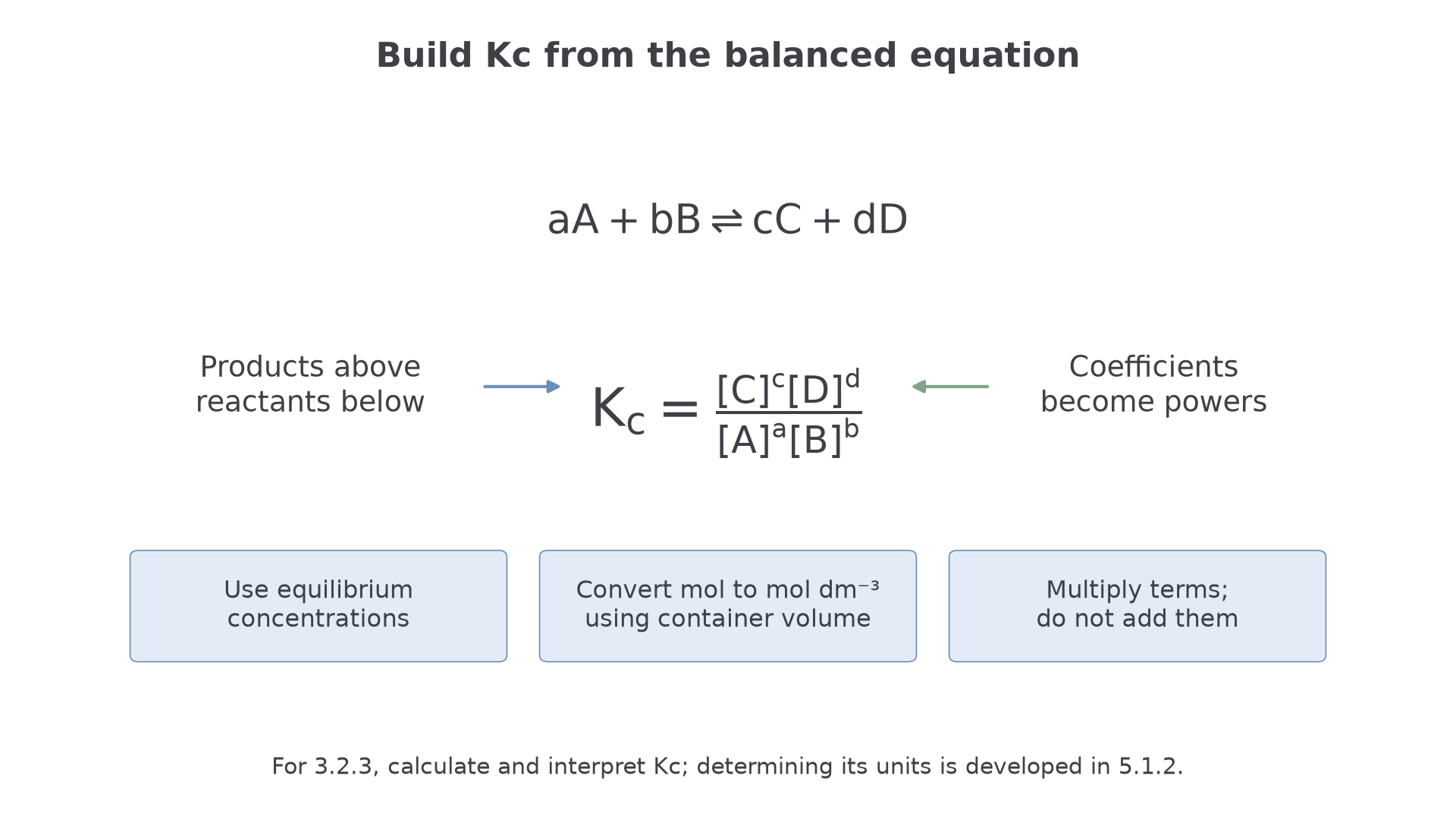
The most important word is equilibrium. A starting concentration tells you what was mixed at the beginning. A calculation needs the concentrations once the mixture has reached equilibrium.
Calculating from Concentrations
Once you have the correct expression, the calculation is substitution. Put each equilibrium concentration into the expression and calculate carefully.
You do not need to work out the units of in this topic (units of equilibrium constants come later, in 5.1.2). Give the value of to an appropriate number of significant figures unless the question tells you otherwise.
Worked example: direct substitution
Hydrogen and iodine react to form hydrogen iodide:
At equilibrium, the concentrations are:
| species | equilibrium concentration / mol dm⁻³ |
|---|---|
| 0.0400 | |
| 0.0300 | |
| 0.240 |
First write the expression:
Now substitute:
So for this reaction at this temperature. The value is much larger than 1, so the equilibrium mixture contains a relatively large amount of product compared with reactants.
Common errors in this kind of calculation:
- using starting concentrations instead of equilibrium concentrations
- putting reactants on the top of the fraction
- forgetting to square a concentration when the coefficient is 2
- rounding too early in the calculation
- adding concentration terms instead of multiplying them
Powers from Coefficients
The powers in a expression are not chosen from the state symbols, the type of molecule or the reaction order. They come from the balanced chemical equation.
For example:
has this expression:
The coefficient 2 in front of becomes the power 2 on . The coefficient 2 in front of becomes the power 2 on . The coefficient 1 in front of is usually not written as a power.
Worked example: using powers
For the same equilibrium, suppose the equilibrium concentrations are:
| species | equilibrium concentration / mol dm⁻³ |
|---|---|
| 0.0200 | |
| 0.0100 | |
| 0.0400 |
Substitute into the expression:
Notice the denominator: . If were not squared, the answer would be completely different.
Continue this lesson.
You’re previewing NovaLearn without an account. Create a free account to read the rest.
Create free account