4.1.3(c)-(d) - Stereoisomerism in alkenes
Some alkenes can exist as two different spatial arrangements even though the atoms are connected in the same order. OCR expects you to recognise when this is possible, use the Cahn-Ingold-Prelog priority rules to decide E or Z, and know when the older cis-trans language is safe. The central habit is simple: check the two groups on each carbon of the C=C, then compare positions across the double bond.
Locked Arrangements Around C=C
A structural formula tells you which atoms are bonded to which. A stereoisomer has the same structural formula as another compound, but a different arrangement of atoms or groups in space.
Stereoisomers
Stereoisomers are compounds with the same structural formula but with a different arrangement in space.
In an alkene, the C=C double bond restricts rotation. If the groups attached to the double bond could rotate freely, one arrangement could turn into the other without breaking the molecule. Around a C=C bond, that free rotation is not possible under ordinary conditions, so different spatial arrangements can be separate stereoisomers.
For E/Z isomerism to be possible at a C=C bond, both conditions must be met:
- There must be restricted rotation about the double bond.
- Each carbon atom of the C=C must be attached to two different groups.
The second condition is local. It does not mean that all four groups around the double bond must be different. But-2-ene, , can show stereoisomerism because each alkene carbon is attached to H and . Prop-1-ene, , cannot show E/Z isomerism because one alkene carbon is attached to two identical H atoms.
[DIAGRAM: asset_name: Lesson 4.1.3c-d: Stereoisomerism in alkenes - diagram 01; asset_slug: 04_01_03b_stereoisomerism_in_alkenes__diagram_01; recommended_method: drawn_chem; description: 16:9 deterministic line diagram showing two locked arrangements of but-2-ene around C=C, with CH3 and H groups labelled, cis/Z and trans/E labels, and a note that the structural formula is the same but spatial arrangement differs.]
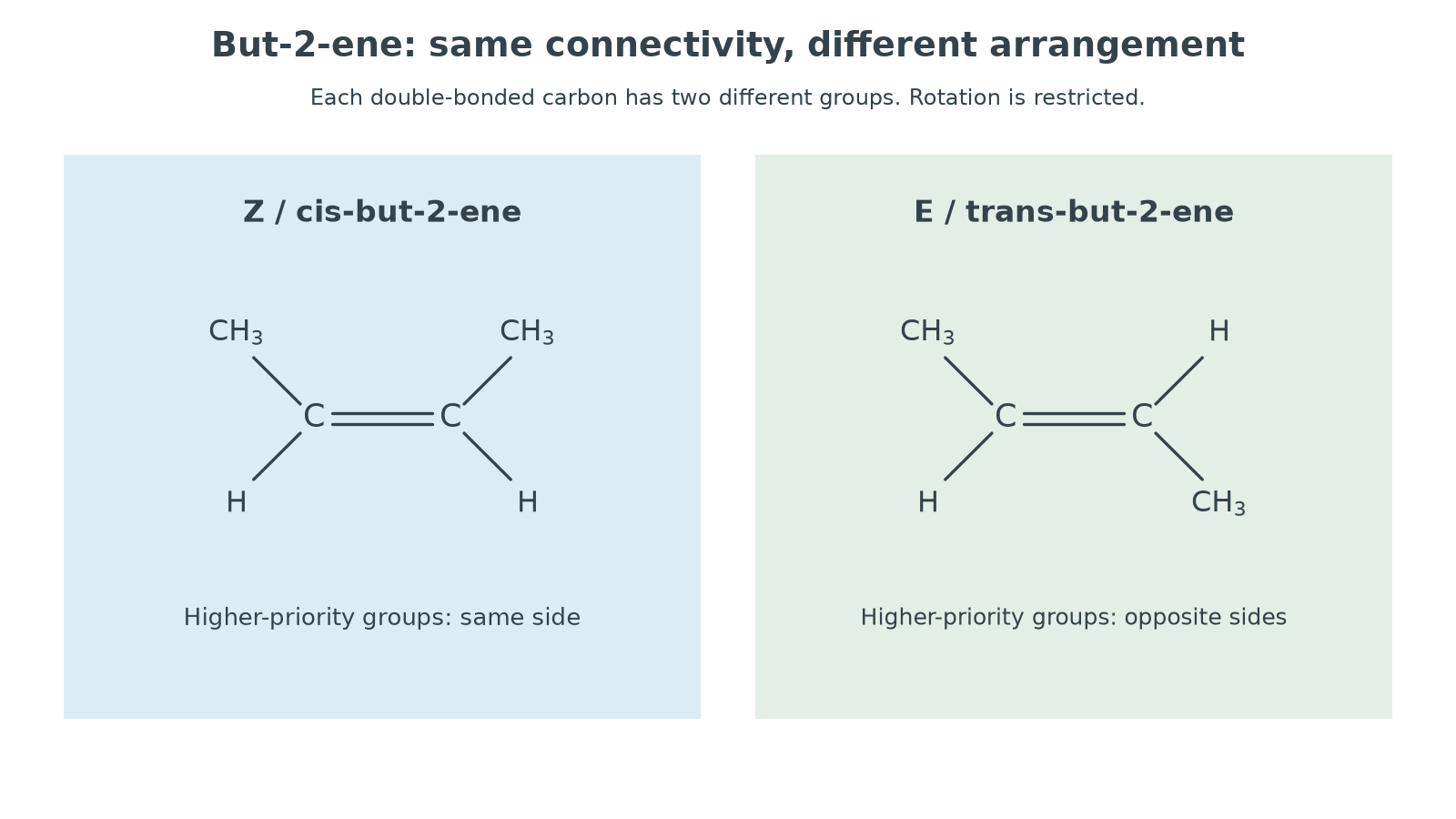
Worked reasoning: does pent-1-ene show E/Z isomerism?
Pent-1-ene is . Look only at the two carbons of the C=C. The first carbon is attached to H and H, so it does not have two different groups. Pent-1-ene does not show E/Z isomerism at that double bond.
Cis-Trans as a Special Case
Cis-trans isomerism is a special case of E/Z isomerism. You can use cis-trans language when a substituent group attached to one carbon atom of the C=C is the same as a substituent group attached to the other carbon atom of the C=C.
Cis-Trans Isomerism
Cis-trans isomerism is a special case of E/Z isomerism in which two of the substituent groups attached to the two carbon atoms of the C=C group are the same. The cis isomer has those same groups on the same side of the double bond; the trans isomer has them on opposite sides.
But-2-ene is the clean example. Each carbon of the C=C has one H and one , so either pair can be compared across the double bond:
- cis-but-2-ene has the two groups on the same side.
- trans-but-2-ene has the two groups on opposite sides.
OCR warns that E is not generally interchangeable with trans, or Z with cis. Having one H on each C=C carbon is a guaranteed case where that shortcut works. Other individual molecules may also have cis = Z and trans = E, but check CIP priorities rather than assuming it. Cis-trans compares an identical pair; E/Z compares the higher-priority group on each carbon.
Worked reasoning: cis or trans?
In but-2-ene, if the two groups are drawn on opposite sides of the C=C bond, the molecule is trans-but-2-ene. The two hydrogens are also on opposite sides, so using either identical pair gives the same cis-trans answer.
CIP Priorities
E/Z naming uses the Cahn-Ingold-Prelog priority rules, usually shortened to CIP rules. The aim is to choose one higher-priority group on each carbon of the C=C, then compare where those two higher-priority groups are.
Use this sequence:
- Look at one carbon atom of the C=C at a time.
- Compare the two atoms directly attached to that alkene carbon.
- The atom with the higher atomic number has higher priority.
- If the directly attached atoms are the same element, list the next attached atoms in decreasing atomic number (excluding the alkene carbon). Compare the lists at the first point of difference; continue outwards only if they still tie.
Do not rank by formula mass, relative molecular mass or the visual size of the group. OCR has repeatedly highlighted that CIP priority is based on atomic number and first point of difference.
Common direct priorities are:
| Comparison | Higher priority | Reason |
|---|---|---|
| Br vs Cl | Br | bromine has the higher atomic number |
| Cl vs C | Cl | chlorine has the higher atomic number |
| C vs H | C | carbon has the higher atomic number |
If both directly attached atoms are carbon, compare what is attached to those carbon atoms next. For example, has higher priority than because the next carbon in is attached to C,H,H, while the carbon in is attached to H,H,H; at the first point of difference, C beats H.
Boundary note: this lesson does not require assigning CIP priorities to double or triple bonds inside R groups. If a substituent contains a more complicated multiple bond, that extra priority treatment is not required here.
Worked example: priority groups in
At the left carbon of the C=C, compare with H. The directly attached atoms are C and H, so has higher priority.
At the right carbon of the C=C, compare Cl with . The directly attached atoms are Cl and C, so Cl has higher priority.
Continue this lesson.
You’re previewing NovaLearn without an account. Create a free account to read the rest.
Create free account