2.2.2(m)-(o) - Water, simple molecular lattices and properties
Water is a small covalent molecule, but its physical properties are not what a simple "small molecule" prediction would suggest. In this lesson you will use hydrogen bonding and simple molecular lattice models to explain why ice floats, why water has relatively high melting and boiling points, and why many simple molecular covalent substances have low melting points, variable solubility and poor electrical conductivity.
Water and hydrogen bonding
In a water molecule, the O-H bonds are polar because oxygen attracts the bonding electrons more strongly than hydrogen. Each hydrogen atom in water is therefore electron-poor, and the oxygen atom has lone pairs that can attract electron-poor hydrogen atoms on neighbouring water molecules.
Hydrogen bonding in water
Hydrogen bonding in water is intermolecular bonding between the partially positive hydrogen atom of one H₂O molecule and a lone pair on the oxygen atom of a neighbouring H₂O molecule.
The key word is intermolecular. The O-H covalent bonds inside each H₂O molecule are strong intramolecular bonds. Hydrogen bonds act between different H₂O molecules and are relatively strong compared with many other intermolecular forces, such as induced dipole-dipole interactions.
Water's relatively high melting point and boiling point follow from this model. To melt ice or boil liquid water, energy is needed to overcome hydrogen bonds between H₂O molecules. The O-H covalent bonds inside the water molecules are not broken during normal melting or boiling.
Worked reasoning: why water boils much higher than expected for a small molecule
Hydrogen sulfide, H₂S, is also a small covalent molecule, but it does not form hydrogen bonds between its molecules. Its strongest intermolecular forces are weaker than the hydrogen bonds between H₂O molecules.
So, for water:
- H₂O molecules form hydrogen bonds with neighbouring H₂O molecules.
- Hydrogen bonds are relatively strong intermolecular forces.
- More energy is needed to overcome these forces.
- Therefore water has a relatively high boiling point for a small covalent molecule.
The explanation is not that the O-H covalent bonds are unusually easy or difficult to break. The explanation is about attractions between molecules.
Why ice is less dense than water
Most substances become denser when they freeze because their particles are held in a more closely packed solid structure. Water is an important exception. Ice is less dense than liquid water, so ice floats.
In ice, hydrogen bonds hold H₂O molecules in a regular open lattice. The molecules are held further apart than they are, on average, in liquid water. In liquid water, some hydrogen bonds are broken and reforming all the time, so the molecules can move closer together.
[DIAGRAM: asset_name: h432 ice density; asset_slug: h432_ice_density; recommended_method: drawn_chem; description: Explicit spacing schematic with six whole-water molecule circles per side; open solid versus denser liquid; dashed links schematic not full crystallographic lattice.]
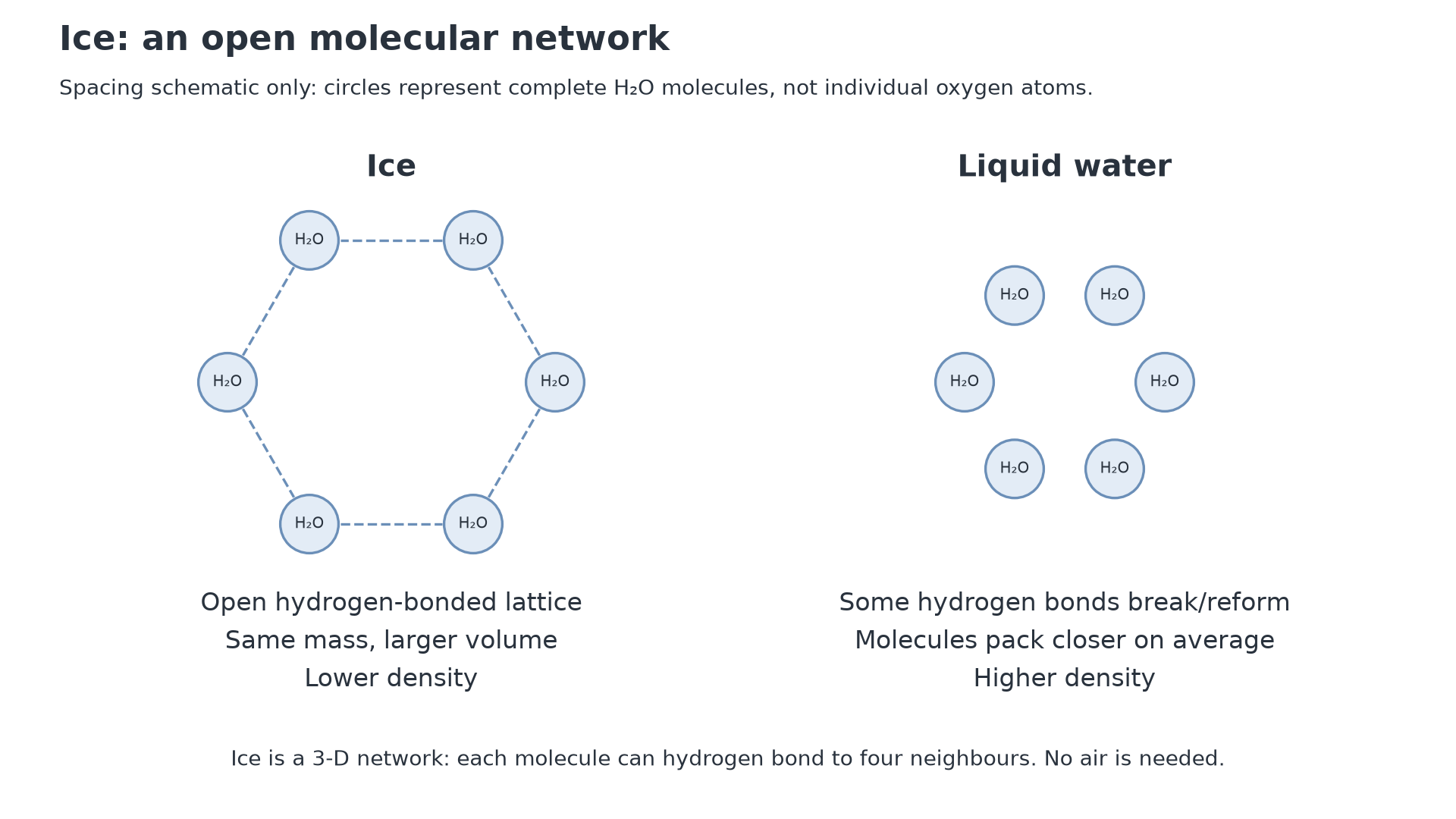
Density is mass per unit volume. If the same number of H₂O molecules occupies a larger volume in ice than in liquid water, the density of ice is lower.
Worked example: connecting density to expansion
For a simple calculation, take the density of liquid water as 1.00 g cm⁻³ and that of ice as 0.920 g cm⁻³. For 92.0 g of each state, use volume = mass ÷ density.
- Liquid water: 92.0 ÷ 1.00 = 92.0 cm³.
- Ice: 92.0 ÷ 0.920 = 100 cm³ (approximately).
The mass and number of molecules have not increased: the same molecules occupy about 8 cm³ more space in the open ice structure. The molecules themselves do not swell, and air is not needed to explain the larger volume.
Worked reasoning: correcting the usual solid-state assumption
A student writes: "Ice should be denser than water because particles in a solid are always closer together."
The assumption is wrong for water:
- In ice, H₂O molecules are linked by hydrogen bonds into an open lattice.
- This open lattice holds the H₂O molecules further apart than in liquid water.
- A fixed mass of ice therefore occupies a larger volume than the same mass of liquid water.
- The density of ice is lower, so ice floats on water.
Do not say the gaps are full of air. The important point is the spacing of H₂O molecules in the hydrogen-bonded lattice.
Simple molecular lattices
A simple molecular lattice is a regular solid structure made from covalently bonded molecules. The molecules themselves are held together internally by covalent bonds, but the molecules are attracted to neighbouring molecules by intermolecular forces.
Simple molecular lattice
A simple molecular lattice is a solid structure containing simple covalent molecules arranged in a lattice, with intermolecular forces between neighbouring molecules.
Ice is a simple molecular lattice made from H₂O molecules. The H₂O molecules contain O-H covalent bonds, and neighbouring H₂O molecules are attracted by hydrogen bonds.
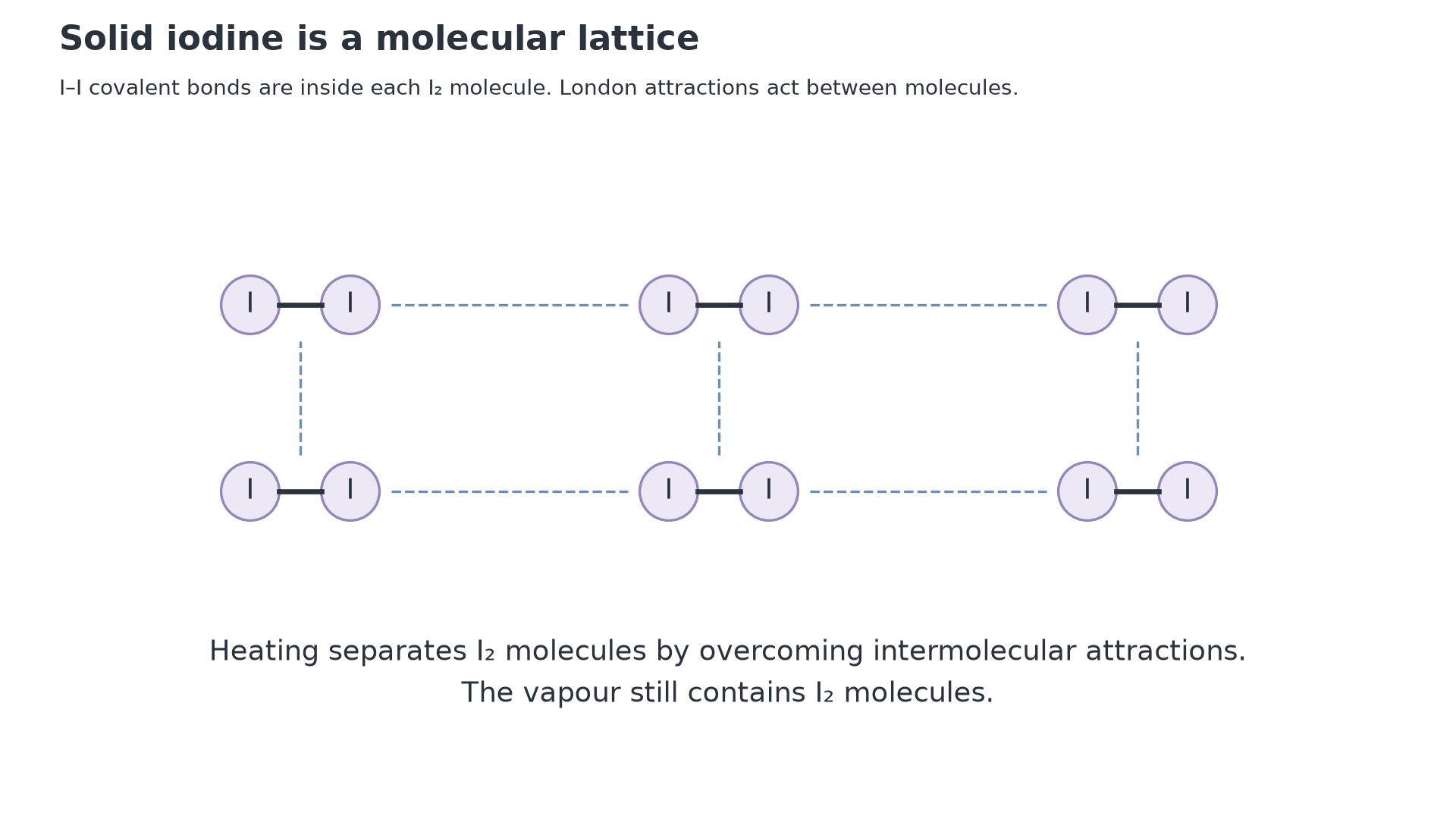
Iodine is another useful example. Solid iodine contains I₂ molecules. Each I₂ molecule has a covalent bond between the two iodine atoms. The separate I₂ molecules are attracted to each other by induced dipole-dipole interactions.
When a simple molecular substance melts or boils, the molecules are separated from each other. The intermolecular forces between molecules are overcome. The covalent bonds inside each molecule usually remain intact.
[DIAGRAM: asset_name: h432 iodine lattice; asset_slug: h432_iodine_lattice; recommended_method: drawn_chem; description: Schematic repeated I2 molecules; solid internal I-I and dashed intermolecular London links; no implied giant covalent structure.]
Worked reasoning: what changes when solid iodine is heated
Solid iodine can form iodine vapour. The particles in the vapour are still I₂ molecules.
The explanation is:
- Solid iodine has a simple molecular lattice of I₂ molecules.
- There are covalent bonds within each I₂ molecule.
- There are induced dipole-dipole interactions between I₂ molecules.
- Heating overcomes the intermolecular forces between I₂ molecules.
- The I-I covalent bonds inside the molecules are not broken in this change of state.
Properties from structure and bonding
For simple molecular covalent compounds, physical properties depend mainly on the intermolecular forces between molecules and on whether there are mobile charged particles.
Melting and boiling points
Simple molecular substances often have low melting and boiling points compared with ionic, metallic or giant covalent substances. This is because only intermolecular forces between molecules need to be overcome during melting or boiling. Covalent bonds inside the molecules are much stronger, but they are not normally broken in a change of state.
The exact melting or boiling point depends on the strength of the intermolecular forces. Hydrogen bonding raises water's melting and boiling points relative to many small molecules. Larger non-polar molecules, such as I₂, can also have stronger induced dipole-dipole interactions than smaller non-polar molecules because their electron clouds are more easily distorted.
Solubility
A simple molecular substance dissolves well only if attractions formed between solute and solvent particles can compensate for attractions that must be disrupted. A molecular substance that can form hydrogen bonds with water may dissolve in water. A non-polar molecular substance, such as iodine, is only slightly soluble in water because it cannot form strong attractions with water molecules.
Many non-polar molecular substances dissolve better in non-polar organic solvents because the intermolecular forces disrupted are replaced by similar intermolecular forces between solute and solvent molecules.
Electrical conductivity
A solution can behave differently from the pure molecular substance. Hydrogen chloride forms ions in water, so hydrochloric acid conducts. This does not mean that liquid HCl contains a giant ionic lattice.
Electrical conduction requires mobile charged particles, such as mobile ions or delocalised electrons. Simple molecular covalent substances are made of neutral molecules. They therefore do not usually conduct electricity as solids or liquids because they lack mobile charged particles.
For simple molecular substances, melting and boiling usually overcome intermolecular forces, solubility depends on the attractions made with the solvent, and electrical conductivity is poor because there are no mobile charged particles.
Worked explanation: predicting properties of a non-polar molecular solid
Substance X is a covalent compound made of small non-polar molecules in a simple molecular lattice. Start with the particles and forces, then predict each property; the reasoning is more useful than memorising a fixed list.
- Melting point: likely low, because only weak induced dipole-dipole interactions between molecules need to be overcome.
- Boiling point: likely low for the same reason, although boiling needs enough energy to separate molecules throughout the liquid.
- Solubility in water: likely low, because X cannot form strong attractions such as hydrogen bonds with water.
- Electrical conductivity: poor, because X is made of neutral molecules and has no mobile ions or delocalised electrons.
Quick recap
- Water’s hydrogen bonds help explain its unusually high melting and boiling points for a small molecule.
- The open hydrogen-bonded lattice in ice holds molecules further apart, giving a larger volume for the same mass and a lower density.
- A simple molecular lattice contains separate covalent molecules attracted by intermolecular forces.
- Changes of state overcome intermolecular forces; solubility depends on interactions with the solvent.
- Pure molecular substances usually lack mobile charge carriers. An aqueous solution can conduct if ions form.