3.1.4 - Inorganic qualitative analysis
Qualitative analysis is about identifying which ions are present from visible test-tube evidence. In this lesson you will learn the exact OCR sequence for carbonate, sulfate and halide ions, plus the test for ammonium ions. The key skill is to connect a reagent and observation to a secure inference, while avoiding false positives.
The evidence sequence
Use a fresh clean portion for each test, following the diagnostic order carbonate, sulfate, then halide. Do not pour sulfate-test mixtures into the silver nitrate test: barium chloride would introduce chloride. Acidify the sulfate portion appropriately to remove carbonate interference, and use dilute nitric acid for the separate halide portion. The ammonium test uses a further fresh portion with aqueous sodium hydroxide.
A qualitative test is only useful if the observation can be linked to one ion. For this lesson, the anions must be tested in this order:
- carbonate
- sulfate
- halide
The order matters because some ions interfere with later tests. Carbonate ions form insoluble barium carbonate with barium ions, so a carbonate could look like a sulfate if you add Ba²⁺(aq) too early. Sulfate ions can form insoluble silver sulfate, so sulfate must be ruled out before a halide test with silver nitrate.
Qualitative Analysis
Qualitative analysis identifies the substances or ions present in a sample. It does not measure how much of each substance is present.
When you record a test, use this chain:
| step | what to write |
|---|---|
| reagent | the chemical added, such as Ba²⁺(aq) or AgNO₃(aq) |
| observation | what you see, such as effervescence or a white precipitate |
| inference | the ion identified, such as SO₄²⁻ |
| equation | the ionic equation, where required |
Worked reasoning: why sequence beats random testing
Suppose an unknown compound contains carbonate ions. If you first add barium ions, you may see a white precipitate:
That white precipitate could be mistaken for sulfate. Testing carbonate first removes that ambiguity because carbonates react with acid to form carbon dioxide.
[DIAGRAM: asset_slug: qualitative_test_portions; description: Three independent anion-test portions in required order; separate warm-NaOH ammonium test; prevents chloride carryover.]
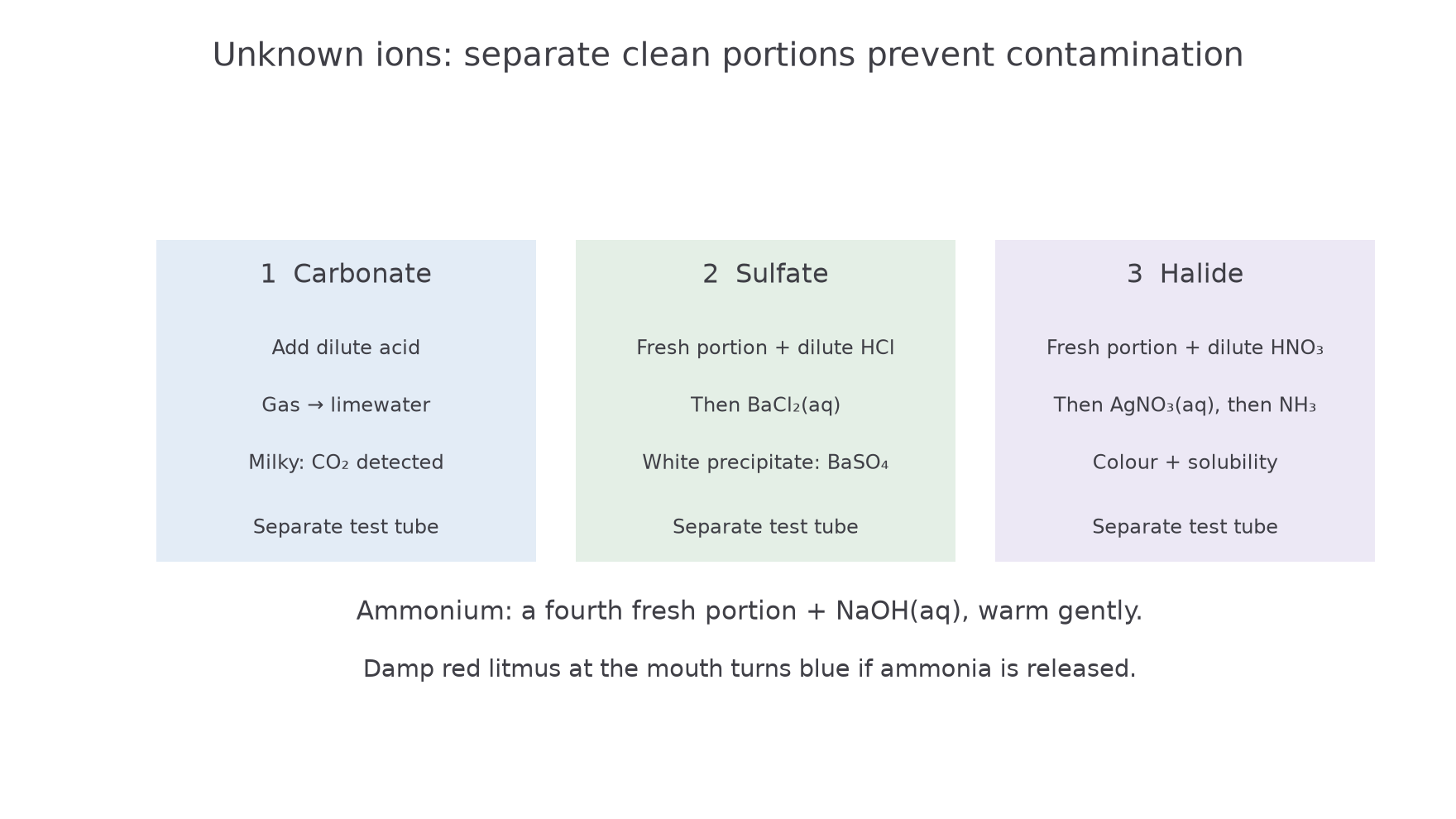
Testing for carbonate ions
Carbonate ions react with aqueous hydrogen ions to form carbon dioxide gas. In the test tube, the first observation is effervescence: bubbles of gas are produced. To confirm the gas as carbon dioxide, pass it through limewater; the limewater turns milky.
Carbonate Ionic Equation
The acid supplies H⁺(aq). The exact acid is less important for the carbonate inference than the fact that hydrogen ions react with carbonate. In a practical sequence, use small quantities on a test-tube scale and record the gas test as well as the bubbling.
Worked example: carbonate evidence
An unknown solid is dissolved in water. Dilute acid is added to a small portion. Bubbles form, and the gas turns limewater milky.
The bubbles show that a gas is formed. The limewater result identifies the gas as carbon dioxide. Because carbonate ions react with acid to form carbon dioxide, the anion present is CO₃²⁻.
A positive carbonate test is effervescence with acid, with carbon dioxide confirmed by limewater turning milky.
Testing for sulfate ions
After carbonate has been ruled out, test for sulfate ions by adding aqueous barium ions. Barium ions form a white precipitate of barium sulfate if sulfate ions are present.
Sulfate Ionic Equation
In school practicals, barium ions are commonly added using barium chloride solution or barium nitrate solution. The core OCR chemistry is the presence of Ba²⁺(aq) and the white BaSO₄(s) precipitate.
The carbonate test comes first because barium carbonate is also insoluble:
If carbonate has not been tested for, a white precipitate with barium ions is not enough evidence for sulfate.
Removing interference from a mixture
A negative carbonate result is useful for a single-anion unknown, but a sample may contain both carbonate and sulfate. Add dilute hydrochloric acid to a separate sulfate-test portion until effervescence stops, then add barium chloride solution. Alternatively use dilute nitric acid followed by barium nitrate. The acid removes carbonate as carbon dioxide, while barium sulfate still forms. Do not use sulfuric acid: it introduces the sulfate being tested. Keep this portion separate from the later halide sample, especially if chloride reagents were used.
Worked example: sulfate evidence
A solution gives no effervescence with acid. A fresh portion is tested with aqueous barium ions and a white precipitate forms.
No effervescence means carbonate is not detected. The white precipitate with Ba²⁺(aq) is therefore evidence for sulfate ions:
Testing for halide ions
Halide ions in this lesson are chloride, bromide and iodide: Cl⁻, Br⁻ and I⁻. Test for them after carbonate and sulfate have been considered.
The usual test is:
- Acidify the solution with dilute nitric acid.
- Add silver nitrate solution.
- Observe the silver halide precipitate.
- If needed, add aqueous ammonia to distinguish similar precipitate colours.
Continue this lesson.
You’re previewing NovaLearn without an account. Create a free account to read the rest.
Create free account