3.2.2(c)-(e) - Catalysts and rate practicals
Catalysts are used because they make reactions faster without being used up in the overall reaction. In this lesson you will learn how to show catalytic behaviour on an enthalpy profile, how to distinguish homogeneous and heterogeneous catalysts, and how rate practicals collect evidence using mass, gas volume and time. The practical thread matters: a catalyst explanation is much stronger when you can connect it to what a rate experiment would actually measure.
The Catalyst Route
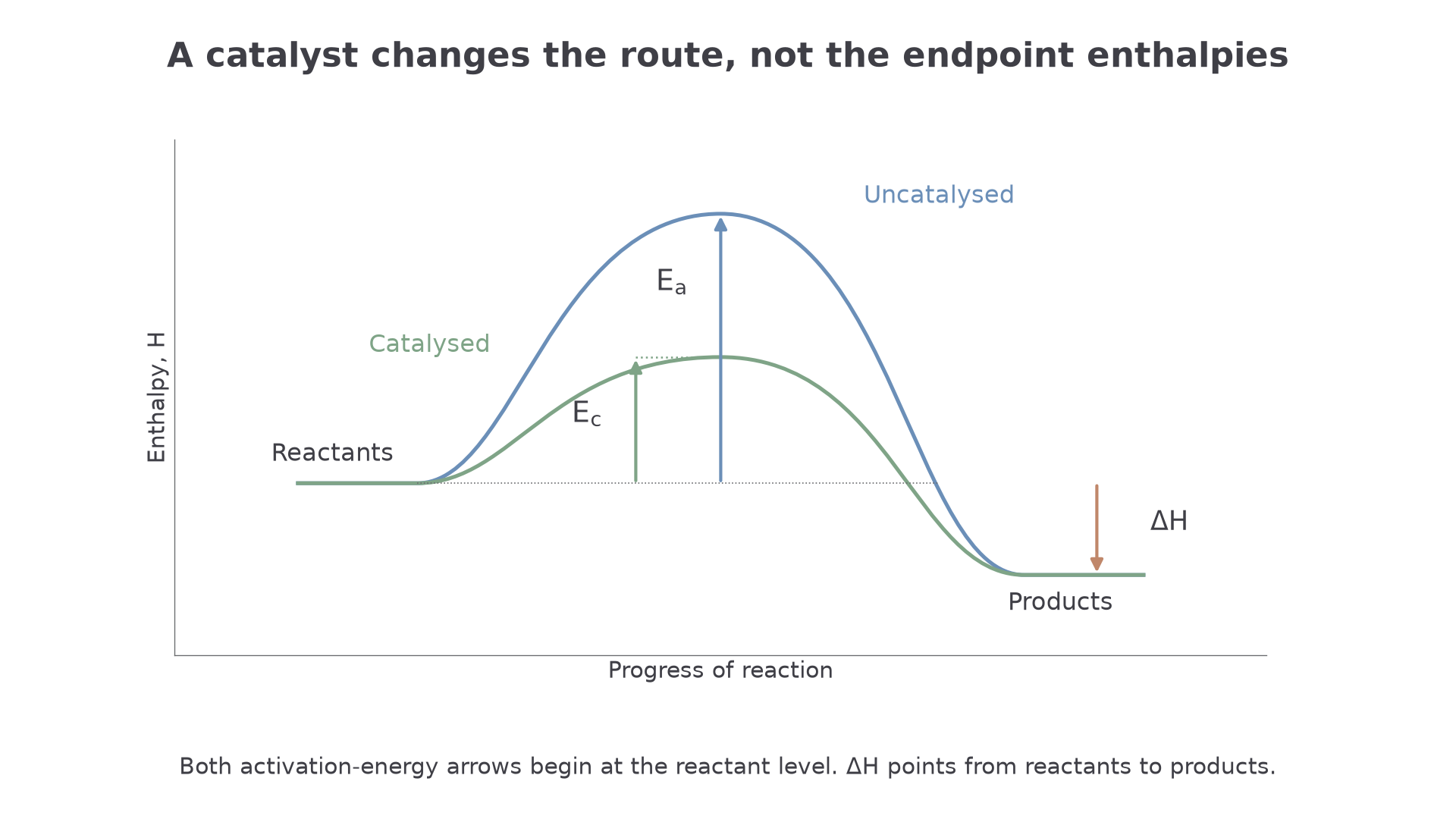
To draw a catalysed energy profile, keep the reactant and product energy levels unchanged. Measure each activation-energy arrow from the reactant level to the actual peak of its pathway; the catalysed peak is lower.
A catalyst increases the rate of a chemical reaction without being used up by the overall reaction. That last phrase is important: the catalyst may take part during a route, but it is regenerated by the end, so it is not a reactant in the overall equation.
Catalyst
A catalyst is a substance that increases the rate of a reaction without being used up in the overall reaction.
Particles still need enough energy for reaction to occur. A catalyst provides a different route for the reaction with a lower activation energy, . At the same temperature, more reacting particles can overcome this lower energy barrier, so the reaction is faster.
On an enthalpy profile diagram:
- the reactant and product enthalpy levels are the same with and without the catalyst;
- the catalysed route has a lower peak, so the catalysed activation energy is lower;
- is unchanged because the overall reactants and products are unchanged.
Worked example: hydrogen peroxide decomposition
Hydrogen peroxide can decompose slowly:
Adding a small amount of manganese(IV) oxide, MnO₂(s), makes the oxygen form much faster. The MnO₂ is a catalyst because it increases the rate and is not used up by the overall reaction. On the enthalpy profile, the catalysed curve would have a lower activation energy than the uncatalysed curve, but the same reactants, products and .
Common traps:
- A catalyst does not add energy to the particles.
- A catalyst does not make more negative or more positive.
- A catalyst does not appear as a consumed reactant in the overall equation.
- Details of the catalytic process are not required for this OCR point.
[DIAGRAM: asset_name: 03_02_02b_catalysts_and_rate_practicals__diagram_01; asset_slug: 03_02_02b_catalysts_and_rate_practicals__diagram_01; recommended_method: drawn_chem; description: Catalysed and uncatalysed profiles share endpoint levels; Ea and Ec start at reactant height and reach their respective peaks; delta H points down.]
Catalyst Phases
Catalysts are classified by phase. In this context, phase means the physical state or physical phase of the catalyst compared with the reacting substances.
Homogeneous catalyst
A homogeneous catalyst is in the same phase as the reactants.
Heterogeneous catalyst
A heterogeneous catalyst is in a different phase from the reactants.
For example, if an acid catalyst and the reacting substances are all aqueous, the catalyst is homogeneous. If a solid catalyst is used with liquid or gaseous reactants, the catalyst is heterogeneous.
Worked reasoning: MnO₂ and hydrogen peroxide
In the decomposition of hydrogen peroxide solution, the catalyst is MnO₂(s) and the reacting hydrogen peroxide is in solution. The catalyst and reacting mixture are in different phases, so MnO₂ is a heterogeneous catalyst in this practical example.
The word "heterogeneous" does not mean "the catalyst is complicated" or "there are several chemicals present". It means the catalyst is in a different phase from the reacting substances.
Economic Importance and Sustainability
Catalysts are economically important because they allow useful reactions to happen fast enough under less demanding conditions. If a catalyst lowers the activation energy, an industrial process may be able to run at a lower temperature while still producing product at a useful rate.
Lower temperatures can reduce the energy required to heat reactors. If that energy would otherwise come from combustion of fossil fuels, using a catalyst can reduce fuel use and therefore reduce CO₂ emissions.
For OCR, the sustainability link is: catalyst lowers activation energy → lower operating temperature can be used → less fossil fuel burned for heating → lower CO₂ emissions.
There is also a tradeoff. Some catalysts are toxic or environmentally harmful if they escape, are handled poorly or are disposed of carelessly. A good evaluation weighs the benefit of lower energy demand and reduced emissions against the risk and cost of catalyst toxicity, recovery and safe disposal.
Worked reasoning: a balanced evaluation
A process using a toxic solid catalyst may still be more sustainable overall if the catalyst is contained, reused for a long time and greatly reduces the heating fuel needed. It would be a weaker answer to say simply "catalysts are sustainable" without mentioning that catalyst toxicity can be a disadvantage.
Continuous Monitoring Methods
For gas collection, connect the reaction flask headspace through an airtight bung and delivery tube to the inlet of a gas syringe. Clamp the syringe barrel horizontally, leaving its plunger free to move, and choose sufficient capacity for the gas expected. Seal the apparatus as the reaction starts, avoid gas leaks, and do not block the outlet or allow reaction liquid into the delivery tube. For mass loss, gas must escape: use an open flask with a loose cotton-wool plug to reduce spraying while letting gas out; do not seal the flask.
Continue this lesson.
You’re previewing NovaLearn without an account. Create a free account to read the rest.
Create free account