6.2.3 - Polyesters, polyamides and condensation polymers
Polyesters and polyamides are condensation polymers: their chains grow when functional groups react together and a small molecule is eliminated. In this lesson, you will learn how ester and amide links form, how those links are hydrolysed in acid or base, and how to work between monomers, repeat units and polymer sections. The emphasis is on unfamiliar structures supplied in the question, not memorising named polymers.
Condensation link model
A monomer is a small molecule that can join with other monomer molecules. A polymer is a large molecule made from many repeating units.
Condensation polymerisation
Condensation polymerisation is the formation of a polymer from monomers with suitable functional groups, with elimination of a small molecule such as water or hydrogen chloride.
For a long chain to form, the reacting molecule or molecules must be able to react at both ends. A monocarboxylic acid and a monoalcohol can make one ester molecule, but a dicarboxylic acid and a diol can keep joining at both ends to form a polyester. The same idea applies to a dicarboxylic acid and a diamine forming a polyamide.
Two links matter in this specification point.
| Link in polymer | Link name | Usual monomer functional groups |
|---|---|---|
| ester link | carboxylic acid or acyl chloride with alcohol | |
| amide link | carboxylic acid or acyl chloride with amine |
A finite straight chain made from N molecules has N−1 new joining links. For example, ten molecules of glycine (Mᵣ 75.0) form nine amide links and lose nine waters: chain Mᵣ = 10 × 75.0 − 9 × 18.0 = 588.0. Do not subtract ten waters unless cyclic closure is specified.
The carbonyl carbon belongs to the acid-derived part of the molecule. That detail is useful when you later reverse a polymer section back to its monomers.
Condensation polymerisation is not just "making a long molecule". It is repeated functional-group reaction with loss of a small molecule.
Making polyesters
A polyester contains ester links, , in the polymer chain. At A level, polyesters form from a carboxylic acid or dicarboxylic acid, or the respective acyl chloride, reacting with an alcohol or diol. For polymer formation, the important case is usually a dicarboxylic acid or dioyl chloride with a diol.
The two formation patterns are:
Polyester link formation
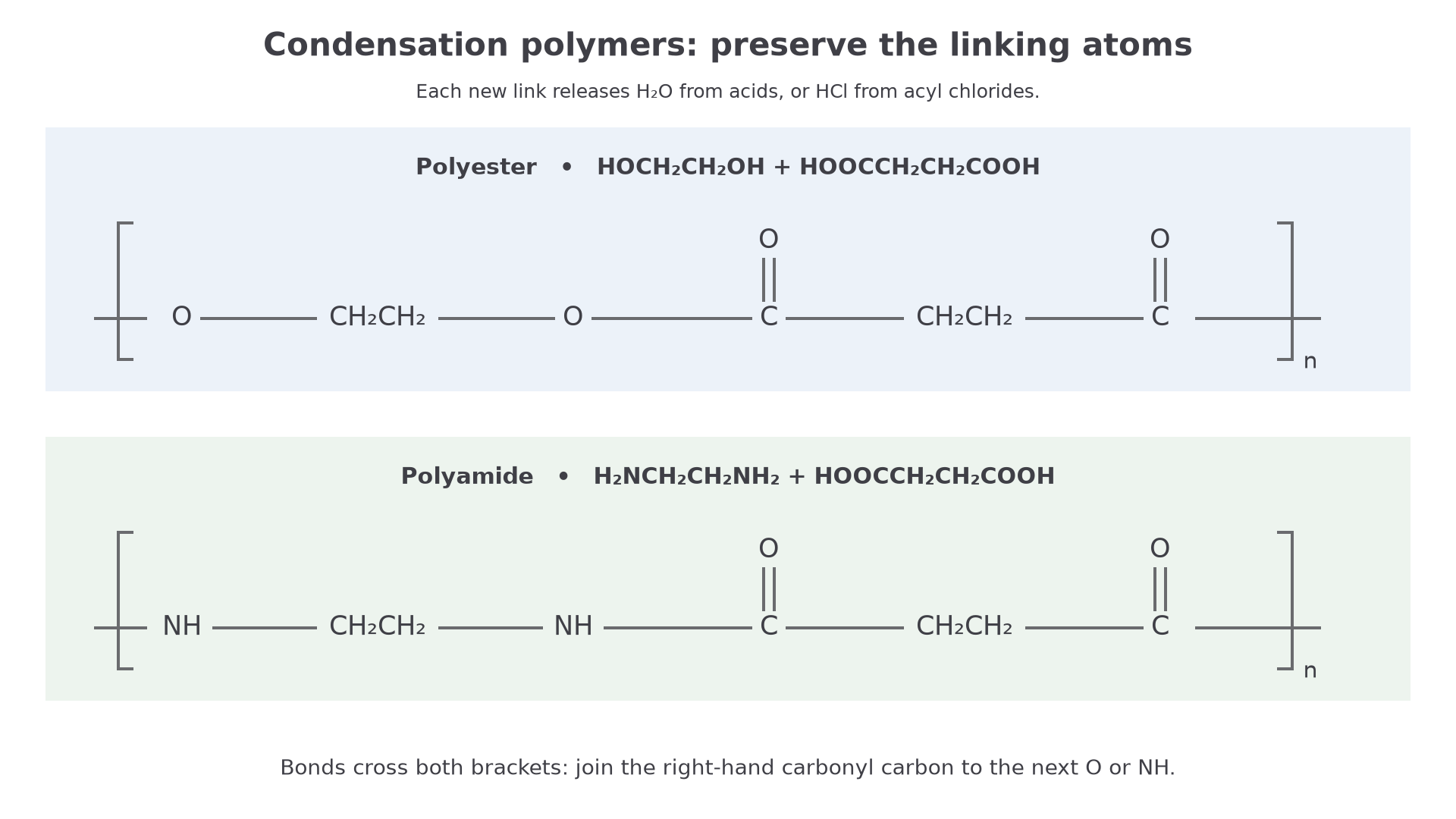
So, a dicarboxylic acid such as and a diol such as can form a polyester repeat containing the pattern:
A single hydroxycarboxylic acid can also supply both ends: forms the repeat . Each new ester link releases water.
The same polyester link can be formed from the corresponding dioyl chloride ; the by-product is then instead of water.
Worked example: butanedioic acid and ethane-1,2-diol.
- Butanedioic acid is HOOCCH₂CH₂COOH.
- Ethane-1,2-diol is HOCH₂CH₂OH.
- Each end reacts with an end to form an ester link.
- One acceptable repeat unit is:
[-OCH₂CH₂OCOCH₂CH₂CO-]n
This repeat unit can also be written starting at a different point in the same repeating pattern, such as [-COCH₂CH₂COOCH₂CH₂O-]n. The key marks are the ester links and the correct continuation bonds.
[DIAGRAM: asset_name: Lesson 6.2.3: Polyesters, polyamides and condensation polymers - diagram 01; asset_slug: 06_02_03_polyesters_polyamides_and_condensation_polymers__diagram_01; recommended_method: drawn_chem; description: Formation map for polyester and polyamide links from dicarboxylic acids or dioyl chlorides with diols or diamines, showing ester and amide links and water or HCl elimination.]
OCR does not require you to recall structures of named synthetic polyesters or their monomers. The question should provide the structures you need; your job is to map the functional groups correctly.
Making polyamides
A polyamide contains amide links, , in the polymer chain. At A level, polyamides form when carboxylic acid or acyl chloride groups react with amine groups. The polymer-forming examples are usually a dicarboxylic acid or dioyl chloride with a diamine, or a single given monomer containing both an amine group and a carboxylic acid group.
The two formation patterns are:
Polyamide link formation
For a dicarboxylic acid and a diamine H₂N-R'-NH₂, the repeat contains the pattern:
Worked example: hexanedioic acid and ethane-1,2-diamine.
- Hexanedioic acid is HOOC(CH₂)₄COOH.
- Ethane-1,2-diamine is H₂NCH₂CH₂NH₂.
- Each acid end reacts with an amine end to form an amide link and water.
- One acceptable repeat unit is:
[-NHCH₂CH₂NHCO(CH₂)₄CO-]n
The repeat can be drawn in the opposite direction without changing the chemistry. What must not change is the amide connectivity: the carbonyl carbon is bonded to nitrogen in .
Amino acids fit the same idea when a question supplies one. An amino acid has NH₂ and in the same molecule, so repeated condensation can form amide links between molecules. OCR questions may use this kind of unfamiliar monomer, but the structural method is still the same.
Acid and base hydrolysis
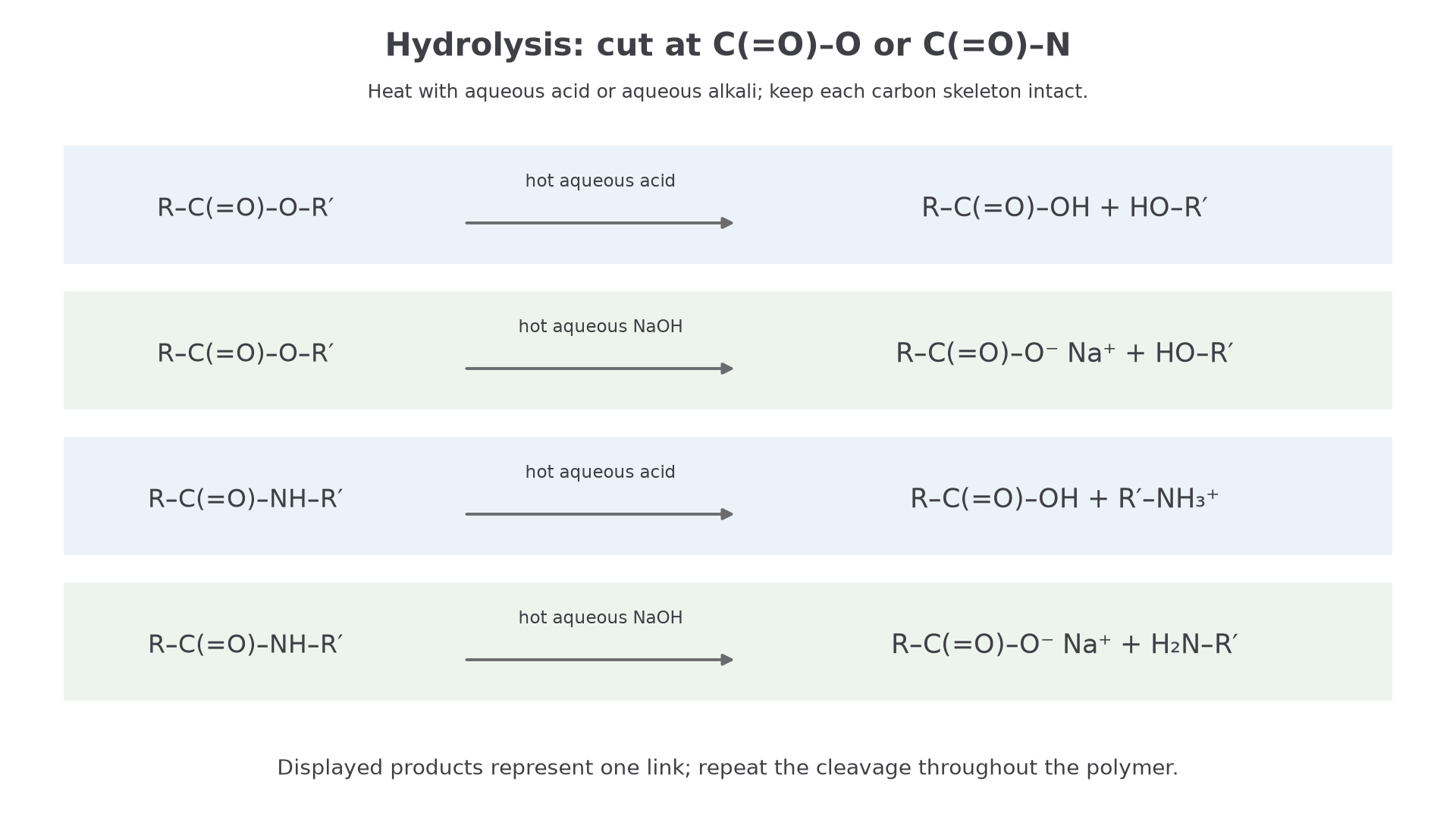
Hydrolysis breaks a bond using water. For condensation polymers, hydrolysis breaks the ester or amide links that were formed during polymerisation. The polymer chain is split into smaller molecules or ions.
[DIAGRAM: asset_name: Lesson 6.2.3: Polyesters, polyamides and condensation polymers - diagram 02; asset_slug: 06_02_03_polyesters_polyamides_and_condensation_polymers__diagram_02; recommended_method: drawn_chem; description: Acid and base hydrolysis decision map for polyester ester links and polyamide amide links, showing carboxylic acid, carboxylate, alcohol, amine and ammonium outcomes.]
Continue this lesson.
You’re previewing NovaLearn without an account. Create a free account to read the rest.
Create free account