4.1.3(j)-(l) - Addition polymers and polymer sustainability
Addition polymers are made when alkene molecules join together to form very long saturated chains. In this lesson, you will learn the two structural skills OCR expects: deducing a repeat unit from an alkene monomer, and working backwards from a polymer section to the monomer. You will then connect polymer chemistry to sustainability: energy recovery, feedstock recycling, toxic-product removal and degradable polymers.
Addition polymerisation model
A monomer is a small molecule that can join with many other monomer molecules. A polymer is a very large molecule made from many repeating units joined in a long chain.
In this lesson, the monomers are alkenes or substituted alkenes. A substituted alkene is still built around a C=C double bond, but one or more hydrogen atoms has been replaced by another atom or group. Propene, , and chloroethene, , are examples.
Addition polymerisation
Addition polymerisation is the reaction in which many unsaturated monomer molecules join together to form a polymer as the only product.
The key chemical change is local and simple: the C=C double bond in each monomer becomes part of a saturated C-C polymer backbone. The attached atoms or groups stay attached to the same carbon atoms; they do not become part of a separate product.
For ethene:
Poly(ethene) formation
This is called addition polymerisation because the monomers add together without eliminating a small molecule such as water or hydrogen chloride. The polymer contains the atoms from the monomers; the bonding arrangement has changed.
Be careful with the word repeat unit. For an alkene addition polymer, show the repeat unit derived from one monomer: the two former C=C carbons and all their attached groups. A chain can have a smaller repeating pattern by symmetry, but the two-carbon monomer-derived unit makes the reverse deduction unambiguous. It is not a free monomer molecule, because the C=C double bond has gone and the unit is linked by single bonds into the longer chain.
From monomer to repeat unit
To deduce the repeat unit from a given alkene monomer, focus on the two carbon atoms in the C=C bond.
Use this method:
- Find the two carbon atoms in the C=C double bond.
- Change the C=C double bond to a C-C single bond.
- Keep every attached atom or group on the same carbon as before.
- Add continuation bonds from the two backbone carbon atoms to show the chain carries on.
- Put the repeat unit in brackets with n outside if you are representing the polymer.
Worked example: propene, , forms poly(propene). The two C=C carbons become the two carbon atoms in the polymer backbone. The group remains attached to the second carbon:
The methyl group is a side group, not a third carbon inserted into the main chain repeat. This is a common source of wrong polymer structures.
[DIAGRAM: asset_name: Lesson 4.1.3j-l: Addition polymers and polymer sustainability - diagram 01; asset_slug: 04_01_03d_addition_polymers_and_polymer_sustainability__diagram_01; recommended_method: drawn_chem; description: Two-panel 16:9 structural diagram showing propene converted into the poly(propene) repeat unit, and chloroethene converted into the poly(chloroethene) repeat unit, with the C=C bond changed to C–C, C-C backbone continuation bonds, side groups retained, brackets and n.]
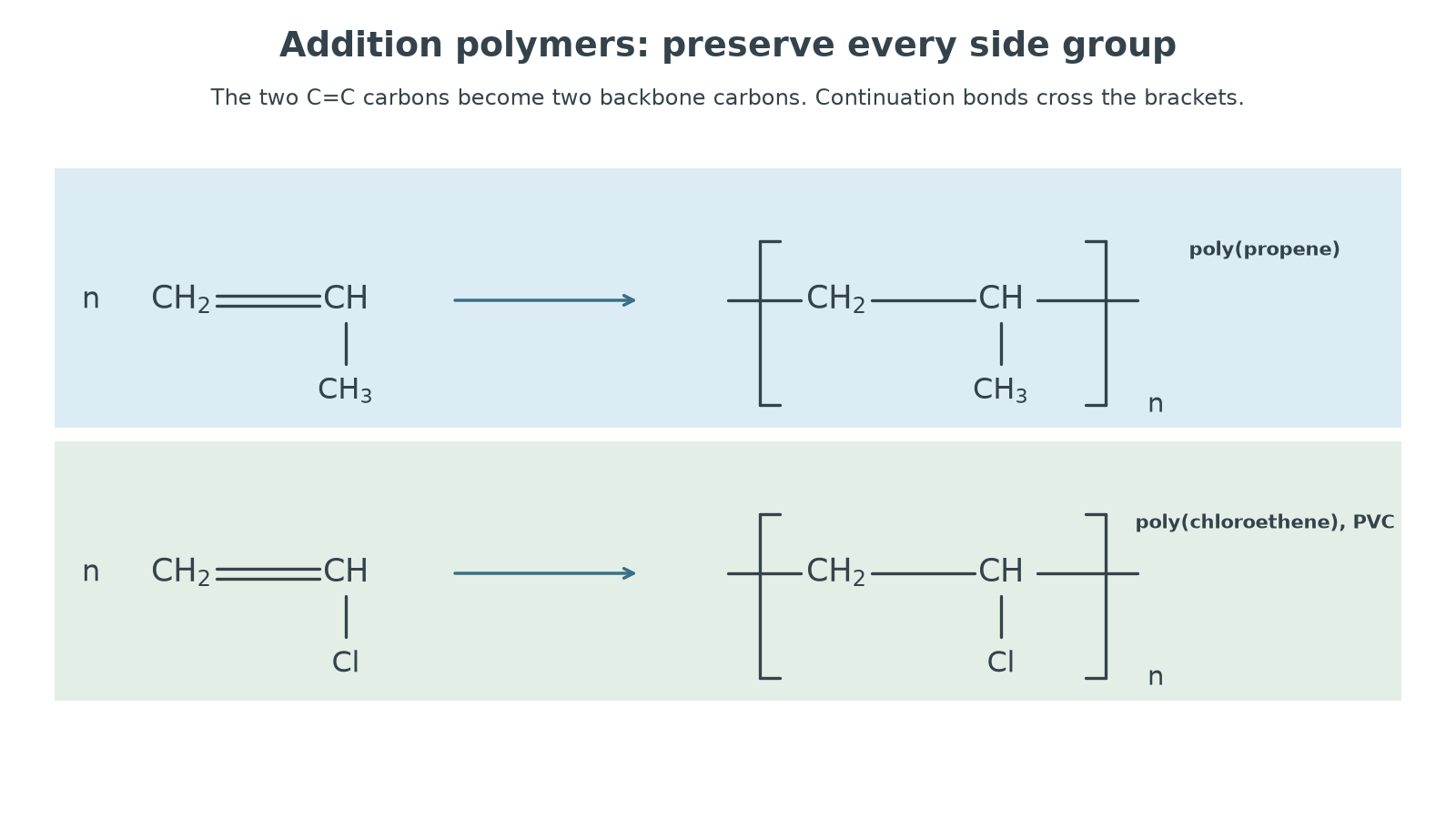
Worked example: chloroethene, , forms poly(chloroethene), commonly called PVC:
The chlorine atom is retained on the repeat unit. This matters later because halogenated plastics can form toxic acidic gases during disposal by combustion.
From polymer section to monomer
OCR can also give you a section of an addition polymer and ask for the monomer that made it. This is the reverse of the previous skill.
Use this method:
- Find the two-carbon monomer-derived pattern that repeats along the polymer backbone.
- Keep the attached side groups on those two carbon atoms.
- Remove the continuation bonds to the rest of the polymer.
- Put a C=C double bond between the two backbone carbon atoms.
Worked example: a polymer section contains this repeating pattern:
The repeat unit is . Put the double bond back between the two backbone carbons:
That monomer is phenylethene. The phenyl group, , stays as a side group; it does not become part of a new double bond elsewhere.
There can be more than one visually acceptable way to draw the same repeat unit, because the polymer section can be viewed from left to right or right to left. What matters chemically is that the same side groups are attached to the same two-carbon backbone pattern, and the monomer has the C=C bond between those two carbons.
Forward: C=C in the monomer becomes C-C in the polymer backbone. Reverse: C-C in the two-carbon repeat becomes C=C in the monomer.
Waste polymer processing
Cheap oil-derived plastics are useful because they are light, strong, mouldable and chemically resistant. Those same properties create the environmental problem: many plastics persist for a long time if they are sent to landfill or lost into the environment.
Continue this lesson.
You’re previewing NovaLearn without an account. Create a free account to read the rest.
Create free account