6.2.5(a) - Organic solid preparation and purification
Organic synthesis is only useful if the product can be separated and checked. In this lesson you will learn the practical sequence used for an organic solid: prepare the product safely, isolate the crude solid, purify it by recrystallisation, and use melting point data to judge purity. The focus is practical reasoning: what each step does, why the apparatus is chosen, and how to write an exam-clean method.
The Practical Aim
An organic solid preparation normally has four jobs:
- make the organic product under suitable reaction conditions;
- separate the crude solid from the reaction mixture;
- remove impurities by recrystallisation;
- check the purity of the dried solid using a melting point range.
The word solid matters. A solid product is not purified by a separating funnel, drying agent and redistillation. Those are liquid-product methods. For an organic solid, the central purification method is recrystallisation, followed by filtration under reduced pressure and melting point measurement.
Crude product
A crude product is the product first obtained from the reaction mixture. It contains the desired compound plus impurities such as unreacted reagents, solvent, side products or soluble salts.
PAG6 practicals can use different named preparations, such as making aspirin, benzoic acid or a substituted aromatic ester. You do not need one memorised recipe here. You need the transferable technique sequence: prepare, isolate, recrystallise, filter, dry and test purity.
Risk management runs through the whole method. Organic solvents may be flammable or irritant, some reagents are corrosive, and heated Quickfit glassware must be clamped securely. Use eye protection, avoid naked flames with flammable solvents, keep heated apparatus open to the air where required, and handle hot glassware and crystals carefully.
Quickfit Preparation
Quickfit apparatus uses ground-glass joints so that reaction flasks, condensers, still heads and receivers can be assembled securely. For organic preparation, the two key arrangements are heating under reflux and distillation.
In heating under reflux, the reaction mixture is boiled while a vertical condenser cools vapour and returns liquid to the flask. This lets the mixture be heated for long enough to react without losing volatile reactants, product or solvent. The top of the condenser is not sealed, because pressure must not build up.
In distillation, vapour leaves the flask, passes through a sloping condenser and is collected in a receiver. Distillation separates or collects a liquid fraction by boiling point. It may be part of an organic preparation, but it is not the final purification method for an organic solid.
[DIAGRAM: asset_name: 6.2.5a - Organic solid preparation and purification - diagram 01; asset_slug: 06_02_05a_organic_solid_preparation_and_purification__diagram_01; recommended_method: drawn_chem; description: Open reflux and distillation apparatus with lower water inlet, upper outlet, thermometer bulb and electric heating.]
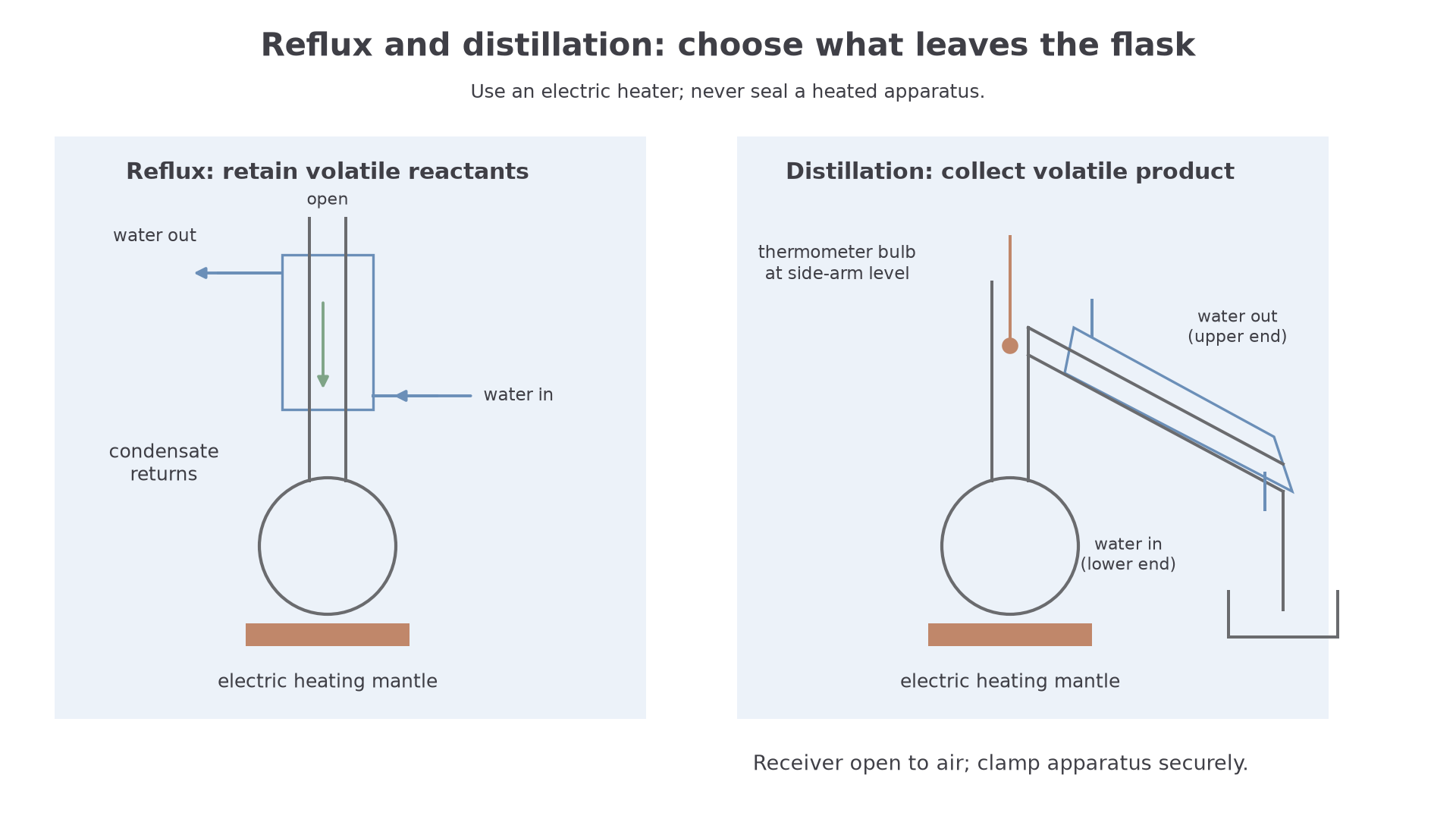
Both setups need practical detail:
- water enters the condenser at the bottom and leaves at the top, so the water jacket stays full;
- anti-bumping granules are added before heating, so boiling is smooth;
- an electric heater or water bath is safer than a naked flame for flammable organic solvents;
- in distillation, the thermometer bulb is placed at the side-arm outlet so it measures the vapour being collected.
Worked reasoning. A reaction mixture contains volatile solvent and must be heated for 30 minutes to form a solid product after cooling.
Use reflux for the reaction stage. Reflux heats the mixture while returning condensed vapour to the flask, so volatile substances are not lost. After the reaction, the solid product can be isolated and purified using solid-product techniques.
Crude Solid Isolation
After the reaction, the product may appear as crystals when the mixture cools or when another reagent is added to make the product less soluble. At this stage the solid is crude: it contains the product, but it may also trap solution or contain insoluble impurities.
The first isolation step is usually filtration under reduced pressure, often using a Buchner funnel and Buchner flask. Reduced pressure pulls liquid through the filter paper faster than gravity alone, leaving the solid on the filter paper.
Filtration under reduced pressure
Filtration under reduced pressure is a filtration method where a pressure difference pulls liquid through the filter paper into a side-arm flask, leaving the solid residue in the funnel.
A good suction-filtration method includes these points:
- place a flat piece of filter paper in the Buchner funnel;
- wet the paper with a suitable solvent so it seals against the funnel;
- connect the side-arm flask to the vacuum source;
- pour the suspension onto the centre of the filter paper;
- wash the solid with a small amount of cold solvent if needed;
- keep the solid residue as the crude product.
[DIAGRAM: asset_name: 6.2.5a - Organic solid preparation and purification - diagram 02; asset_slug: 06_02_05a_organic_solid_preparation_and_purification__diagram_02; recommended_method: drawn_chem; description: Suction filtration using wetted paper on perforated plate, side-arm vacuum flask and crystal purification sequence.]
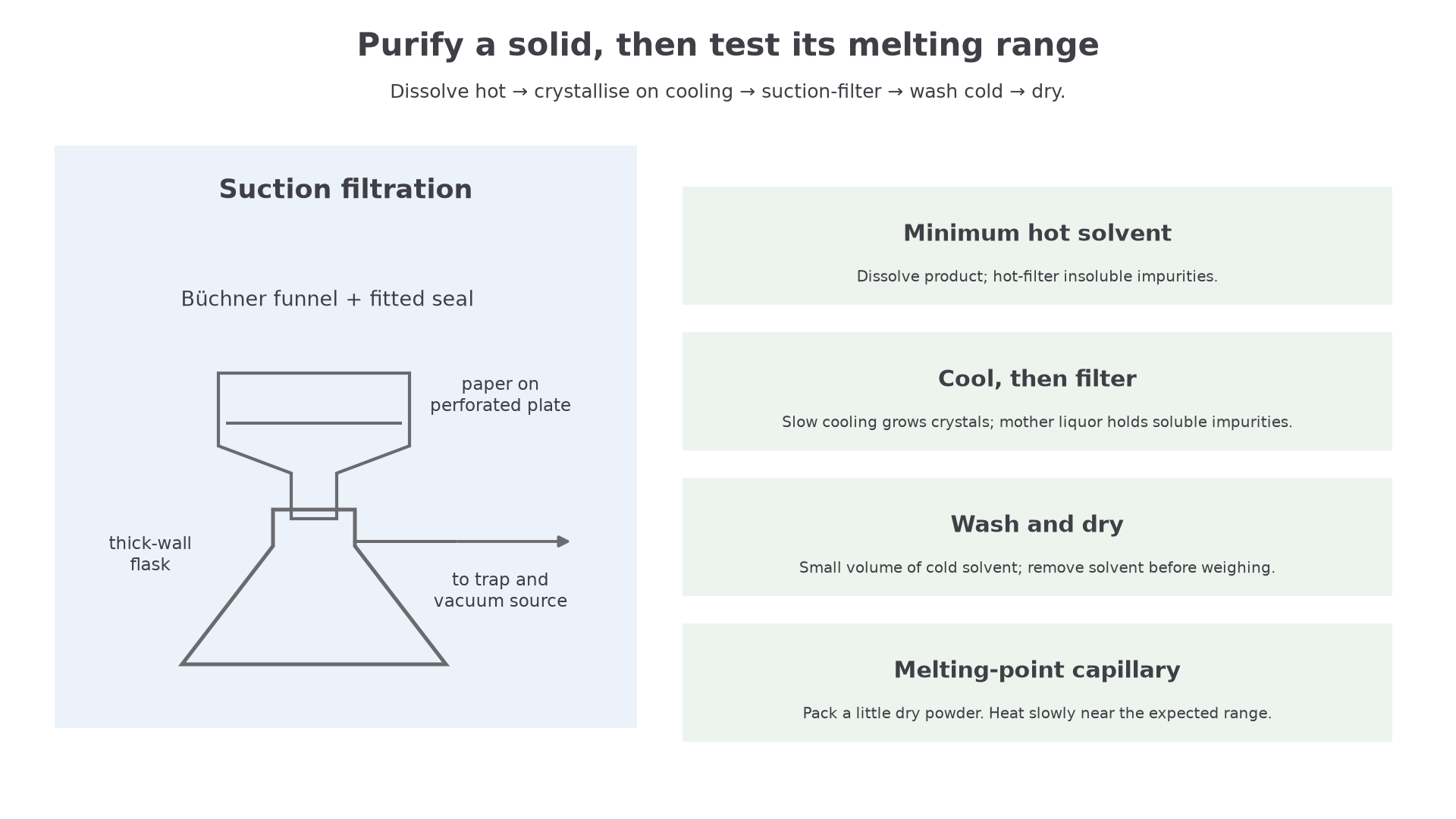
The wash solvent is cold because a warm solvent may dissolve some product and reduce the yield. The wash volume is small for the same reason: use enough to remove surface impurities, not enough to dissolve a significant amount of the product.
Worked reasoning. A student cools a reaction mixture and obtains pale crystals in a liquid. The desired product is the crystals.
Use filtration under reduced pressure. The crystals are retained as the residue in the Buchner funnel while the liquid passes into the flask. The residue is the crude product and should be purified further by recrystallisation.
Continue this lesson.
You’re previewing NovaLearn without an account. Create a free account to read the rest.
Create free account