3.1.1(a)-(c) - Periodic table, periodicity and ionisation energy
The periodic table is more than a list of element symbols. It is a map built from atomic number, electron configuration and repeated chemical behaviour. In this lesson you will connect the layout of the table to Period 2 and Period 3 electron configurations, then use first and successive ionisation energy data as evidence for shells and sub-shells.
The periodic table as an evidence-based arrangement
The modern periodic table arranges elements in order of increasing atomic number. Atomic number means proton number, so the sequence is based on the number of protons in each atom's nucleus.
Period
A period is a horizontal row in the periodic table. Physical and chemical properties change across a period; corresponding patterns recur across successive periods as atomic number increases.
Group
A group is a vertical column in the periodic table. Elements in the same group usually have similar chemical properties because their atoms have similar outer-shell electron configurations.
Periodicity means a repeating pattern in properties at regular intervals. For example, Period 2 and Period 3 both begin with a reactive Group 1 metal and end with a noble gas. The details differ, but the same kind of pattern returns because the outer-shell electron patterns repeat.
Worked reasoning: correcting a common statement
A student says, "The position of an element is decided by relative atomic mass."
That is not the modern rule. The modern periodic table is ordered by atomic number. Argon and potassium are a useful warning from earlier chemistry: argon has a greater relative atomic mass than potassium, but argon has atomic number 18 and potassium has atomic number 19, so argon comes before potassium.
Electron configuration patterns in Periods 2 and 3
Across a period, electrons are added one at a time to the same main shell. Period 2 fills the second shell; Period 3 fills the third shell. The repeating pattern is easiest to see if you write the outer part of each configuration.
| Element | Atomic number | Electron configuration | Outer-shell pattern |
|---|---|---|---|
| Li | 3 | 1s² 2s¹ | 2s¹ |
| Be | 4 | 1s² 2s² | 2s² |
| B | 5 | 1s² 2s² 2p¹ | 2s² 2p¹ |
| C | 6 | 1s² 2s² 2p² | 2s² 2p² |
| N | 7 | 1s² 2s² 2p³ | 2s² 2p³ |
| O | 8 | 1s² 2s² 2p⁴ | 2s² 2p⁴ |
| F | 9 | 1s² 2s² 2p⁵ | 2s² 2p⁵ |
| Ne | 10 | 1s² 2s² 2p⁶ | 2s² 2p⁶ |
Period 3 repeats the same outer-shell pattern, but with 3s and 3p sub-shells:
| Element | Atomic number | Electron configuration | Outer-shell pattern |
|---|---|---|---|
| Na | 11 | 1s² 2s² 2p⁶ 3s¹ | 3s¹ |
| Mg | 12 | 1s² 2s² 2p⁶ 3s² | 3s² |
| Al | 13 | 1s² 2s² 2p⁶ 3s² 3p¹ | 3s² 3p¹ |
| Si | 14 | 1s² 2s² 2p⁶ 3s² 3p² | 3s² 3p² |
| P | 15 | 1s² 2s² 2p⁶ 3s² 3p³ | 3s² 3p³ |
| S | 16 | 1s² 2s² 2p⁶ 3s² 3p⁴ | 3s² 3p⁴ |
| Cl | 17 | 1s² 2s² 2p⁶ 3s² 3p⁵ | 3s² 3p⁵ |
| Ar | 18 | 1s² 2s² 2p⁶ 3s² 3p⁶ | 3s² 3p⁶ |
This pattern explains why groups have similar chemical properties. Lithium and sodium both have one outer s electron. Fluorine and chlorine both have outer-shell pattern ns² np⁵, so each is one electron short of a full outer shell.
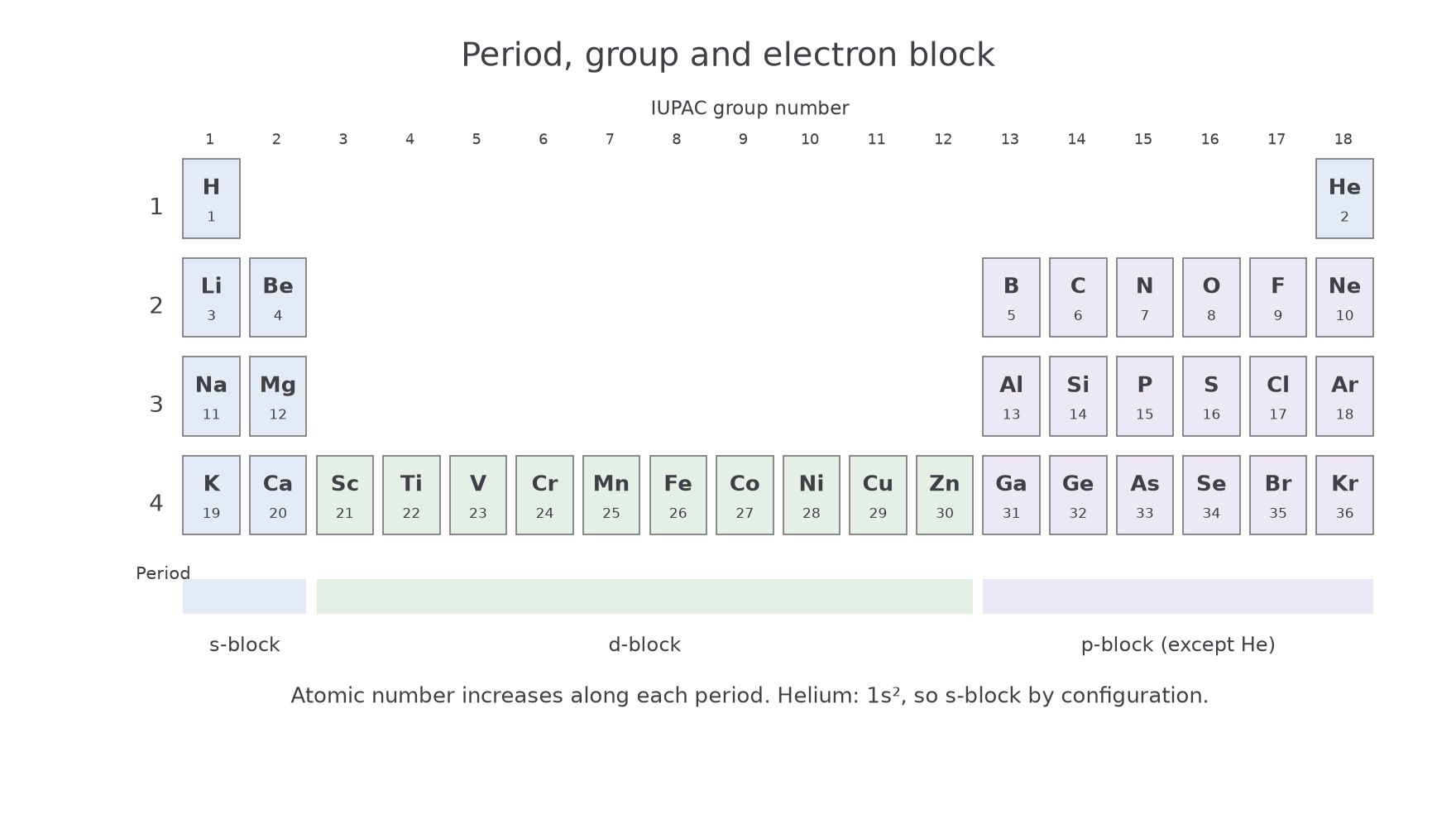
The block of an element is named from the type of sub-shell being filled by its highest-energy electron in the atom:
| Block | Where it appears in the table | Typical outer configuration pattern |
|---|---|---|
| s-block | Groups 1 and 2, plus helium by configuration | ns¹ or ns² |
| p-block | Main groups on the right, excluding helium | ns² np¹ to ns² np⁶ |
| d-block | Central block beginning in Period 4 | d sub-shell being filled |
For this lesson, the most important link is Periods 2 and 3: the first two elements are s-block, then the next six are p-block.
Helium is placed with the noble gases because it has a full outer shell and similar chemical behaviour, but its configuration is , so it is an s-block element. Group position and block classification answer different questions.
Worked example: identify the block
Element X has electron configuration:
The highest-energy electron is in a 3p sub-shell, so X is in the p-block. Its outer-shell pattern has five electrons, 3s² 3p³, so it is in the same main-group pattern as nitrogen.
[DIAGRAM: asset_slug: 03_01_01a_periodic_table_ionisation_energy_and_electron_configuration__diagram_01; description: Periods 1–4 with atomic numbers and s/p/d blocks; helium configuration exception.]
First ionisation energy
Ionisation energy measures how much energy is needed to remove an electron from an atom or ion. In this lesson the formal definition you need is for first ionisation energy.
First ionisation energy
The first ionisation energy is the energy required to remove 1 mol of electrons from 1 mol of gaseous atoms to form 1 mol of gaseous 1+ ions.
For a general element X:
The state symbols matter. The atom must be gaseous, and the ion formed is gaseous. First ionisation energy values are usually given in kJ mol⁻¹.
For sodium:
Even a non-metal is written as a single gaseous atom in this definition. For sulfur the change is , not a change involving or formation of a sulfide ion. Ionisation means electron removal here, regardless of the ion normally formed in compounds.
The electron removed is the outer 3s electron. The size of the first ionisation energy depends on the attraction between that outer electron and the nucleus.
The main factors are:
- nuclear charge: more protons give a stronger attraction;
- atomic radius: an outer electron farther from the nucleus is less strongly attracted;
- shielding: inner electrons reduce the attraction felt by the outer electron.
High first ionisation energy means the outer electron is strongly attracted to the nucleus. Low first ionisation energy means it is easier to remove the outer electron.
Worked example: energy for one ion
The first ionisation energy of lithium is about 520 kJ mol⁻¹. This means 520 kJ is needed to form 1 mol of Li⁺(g) ions from 1 mol of Li(g) atoms.
To estimate the energy for one Li(g) atom:
To two significant figures:
This is a data-translation calculation: the chemistry idea is molar ionisation energy, and the mathematical move is dividing by the Avogadro constant.
Explaining first-ionisation-energy trends
First ionisation energy is periodic: it shows repeating patterns as atomic number increases.
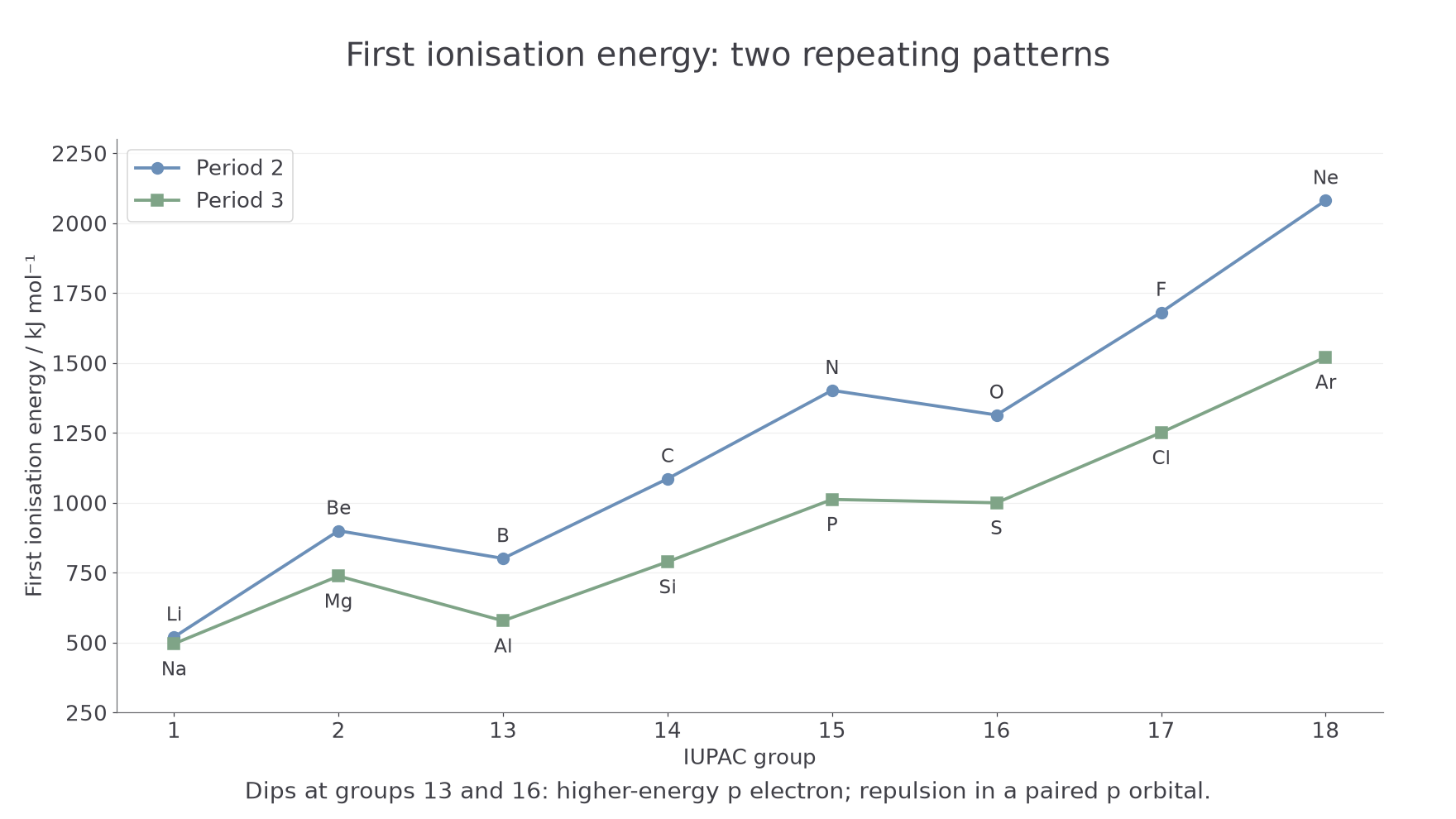
Across Period 2 from Li to Ne, and across Period 3 from Na to Ar, first ionisation energy generally increases. The outer electron is being removed from the same main shell across a period, so there is no new outer shell. At the same time, nuclear charge increases because each element has one more proton. The atomic radius also tends to decrease. The outer electron is therefore more strongly attracted to the nucleus, so more energy is needed to remove it.
That general trend has two important small decreases in each period.
Decrease from Be to B, and from Mg to Al
Beryllium has outer configuration 2s². Boron has outer configuration 2s² 2p¹. The electron removed from boron is in a 2p sub-shell, which is higher in energy and slightly easier to remove than a 2s electron. So boron's first ionisation energy is lower than beryllium's, even though boron has a higher nuclear charge.
The same idea explains Mg to Al:
- Mg: 3s²
- Al: 3s² 3p¹
The first electron removed from Al is a 3p electron rather than a 3s electron, so there is a small decrease from Mg to Al.
Decrease from N to O, and from P to S
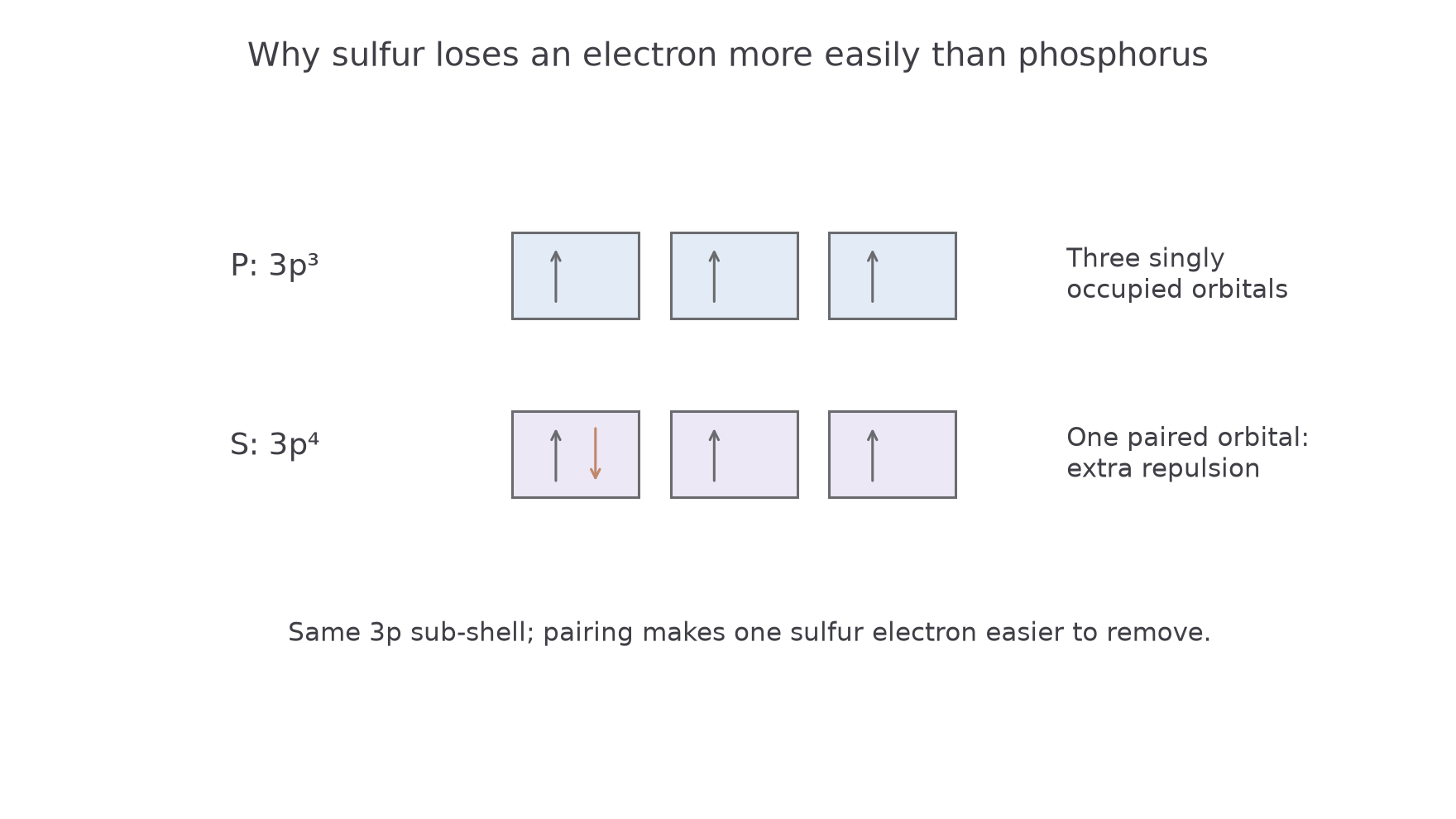
Nitrogen has outer configuration 2s² 2p³. The three 2p electrons occupy separate p orbitals. Oxygen has outer configuration 2s² 2p⁴, so one 2p orbital contains a pair of electrons. Repulsion between paired electrons makes one of those paired p electrons easier to remove. So oxygen's first ionisation energy is lower than nitrogen's.
The same paired-electron repulsion explains P to S:
- P: 3s² 3p³
- S: 3s² 3p⁴
Sulfur has a pair of electrons in one 3p orbital, so removing one paired p electron is slightly easier.
Down a group, first ionisation energy generally decreases. The outer electron is in a shell with a higher principal quantum number, farther from the nucleus. Even though nuclear charge increases down the group, the increased atomic radius and increased shielding by inner shells outweigh the increased nuclear charge, making the outer electron easier to remove.
Worked explanation: why Be is higher than B
Start from the trend, then explain the exception:
- B has a higher nuclear charge than Be, so a simple trend would suggest B should be higher.
- However, Be loses a 2s electron, while B loses a 2p electron.
- The 2p electron is in a higher-energy sub-shell and is easier to remove.
- Therefore the first ionisation energy of B is lower than that of Be.
[DIAGRAM: asset_slug: 03_01_01a_periodic_table_ionisation_energy_and_electron_configuration__diagram_02; description: First ionisation energy across Periods 2 and 3, with both dips and labelled values on a linear scale.]
[DIAGRAM: asset_slug: paired_p_orbitals; description: Three p-orbital boxes; P unpaired triple and S one opposite-spin pair causing additional repulsion.]
Successive ionisation energy as shell evidence
Successive ionisation energies are the energies needed to remove electrons one after another from the same atom. Each removal needs more energy than the previous one because the electron is being removed from an increasingly positive ion.
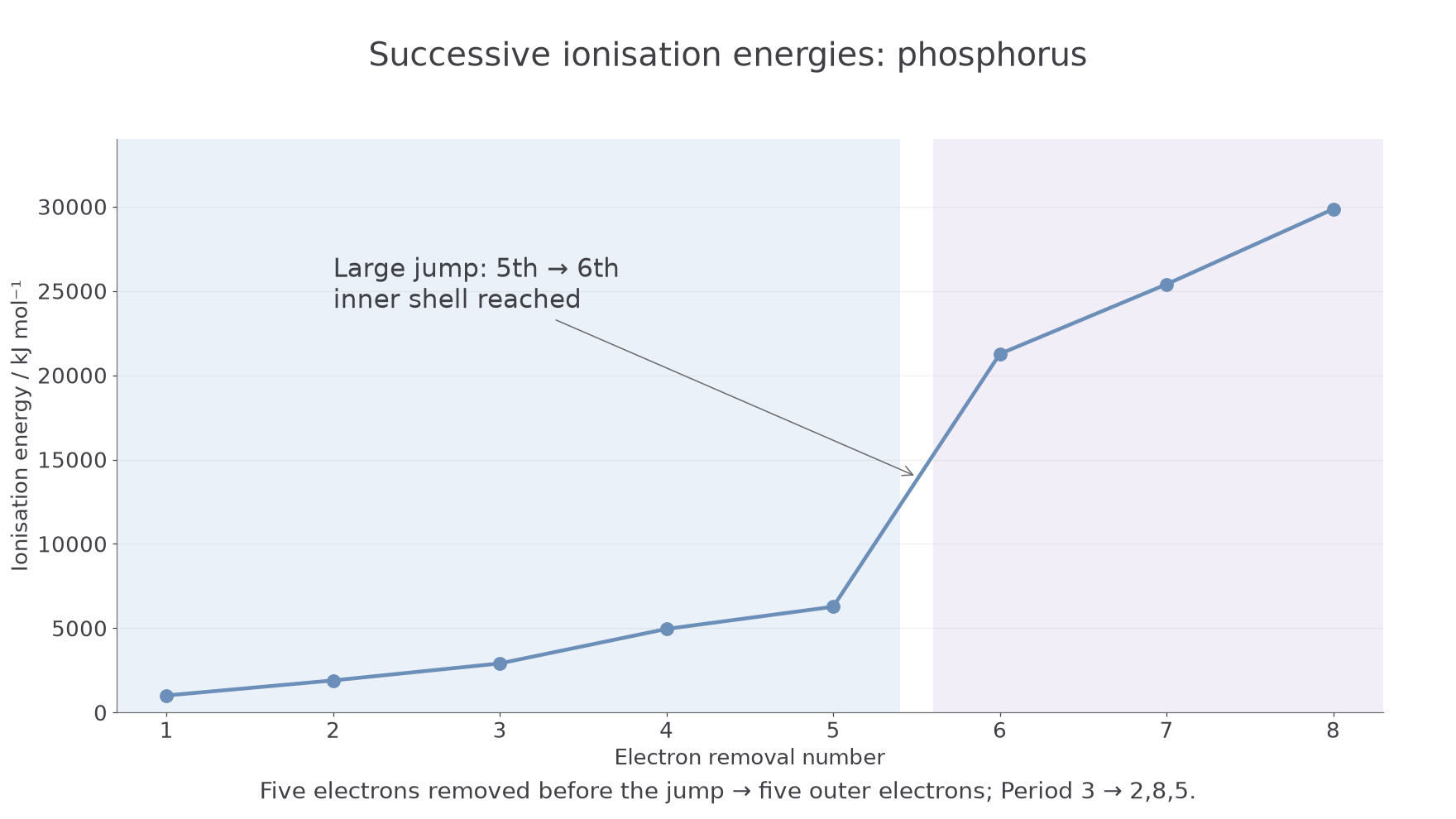
The powerful exam skill is not memorising exact numbers. It is spotting the large jump.
When a large jump appears, the next electron is being removed from an inner shell closer to the nucleus. Inner-shell electrons experience a much stronger attraction, so their ionisation energies are much larger.
Method for successive-ionisation data
- Read the values in order.
- Find the first very large jump.
- Count the number of electrons removed before that jump.
- That count is the number of outer-shell electrons.
- Use the total number of electrons, if known, to build the shell pattern and identify the main group.
For main-group elements in the school-course grouping, one outer-shell electron means Group 1, two means Group 2, five means Group 5, seven means Group 7, and a full outer shell means Group 0. Modern IUPAC group numbers are also used in chemistry, but the shell-count logic is the same.
If enough successive energies are supplied, locate all large shell jumps. An atom with 12 electrons has jumps after removals 2 and 10: the removal groups contain 2, then 8, then 2 electrons. These are removed outside-in. Reverse that order to write the occupied shells inside-out: . One early jump alone identifies the outer-shell count; it does not reveal every inner-shell population without further data or a known period.
Worked example: identify a Period 3 element from successive ionisation energies
An element in Period 3 has these first eight successive ionisation energies, in kJ mol⁻¹:
| Electron removed | 1st | 2nd | 3rd | 4th | 5th | 6th | 7th | 8th |
|---|---|---|---|---|---|---|---|---|
| Ionisation energy | 1012 | 1903 | 2912 | 4957 | 6274 | 21269 | 25398 | 29855 |
The first large jump is between the 5th and 6th ionisation energies:
So five electrons are removed before the atom reaches an inner shell. The atom has five outer-shell electrons.
Because the element is in Period 3, its shell pattern is:
That corresponds to phosphorus, P. In main-group course language it is Group 5; in IUPAC numbering it is Group 15.
[DIAGRAM: asset_slug: 03_01_01a_periodic_table_ionisation_energy_and_electron_configuration__diagram_03; description: Linear successive ionisation-energy plot; large jump after fifth electron identifies phosphorus outer shell.]
Evidence for electron shells and sub-shells
The periodic table and ionisation-energy data are scientific models supported by predictions and observations.
The periodic table was accepted because it worked as a scientific model. Early versions arranged elements by patterns in properties and left gaps where unknown elements should fit. As new elements were discovered and their properties matched predictions, the Periodic Law became stronger evidence rather than just a neat arrangement. The table is still extended when new elements are discovered, tested and confirmed by the scientific community.
Successive ionisation energy data support a shell model of the atom. If all electrons were equally easy to remove, the graph would rise smoothly. Instead, very large jumps appear when removal moves into a shell closer to the nucleus. Smaller irregularities within a shell also support the idea of sub-shells and paired-electron repulsion.
Quick recap
- Periods, groups and blocks reflect electron configurations; modern ordering is by atomic number.
- First ionisation removes an electron from a gaseous atom; attraction depends on charge, distance and shielding.
- The Be/B and Mg/Al decreases concern sub-shell energy; N/O and P/S concern paired-electron repulsion.
- Large successive-ionisation jumps mark entry into an inner shell; count electrons before and between jumps.