5.2.3(j)-(k) - Storage cells and fuel cells
Storage cells and fuel cells are electrochemical cells used as practical sources of electrical energy. In this lesson, you will use supplied electrode-potential data to work out what happens in a modern storage cell, then explain how a fuel cell turns the reaction of a fuel with oxygen into a voltage. OCR will provide the cell details, half-equations and relevant electrode potentials, so the skill is careful reasoning from the data rather than memorising commercial cell chemistry.
Storage cells and fuel cells
An electrochemical cell separates a redox reaction into two half-reactions. Electrons released by oxidation move through an external circuit, while ions move within the cell to maintain charge balance. The voltage comes from the difference in electrode potentials between the two redox systems. A voltage can exist with the circuit open; completing the external circuit allows that voltage to drive electron flow.
Storage cell
A storage cell stores chemical energy in substances inside the cell and releases it as electrical energy during discharge. In OCR questions on modern storage cells, the exact cell chemistry and required equations are supplied.
Fuel cell
A fuel cell uses the energy from the reaction of a fuel with oxygen to create a voltage. The fuel and oxygen are supplied continuously, so the main reactants are not simply stored in fixed amounts inside the cell.
The important contrast is where the reacting chemicals come from. A storage cell already contains the reactants needed for the cell reaction. A fuel cell is fed with fuel at one electrode and oxygen at the other, and it can keep producing a current while those reactants keep arriving and products are removed.
For a discharging electrochemical cell:
Cell potential from supplied reduction potentials
The more positive supplied reduction potential usually identifies the half-equation that runs as a reduction. The other half-equation is reversed so it runs as oxidation. This is the same principle you used for electrode-potential feasibility; this lesson applies it to storage cells and fuel cells.
Using supplied data for a storage cell
When a question gives half-equations for a storage cell, treat them as reduction half-equations unless the question states otherwise. Then decide which one stays as reduction and which one must be reversed for oxidation.
Use this sequence:
- Read the supplied half-equations and E values.
- Identify the more positive E value; this reduction occurs at the positive electrode during discharge.
- Reverse the other half-equation so it becomes oxidation.
- Balance the number of electrons.
- Add the half-equations and cancel electrons and any species that appear on both sides.
- Calculate if asked.
[DIAGRAM: asset_name: Lesson 5.2.3j-k: Storage cells and fuel cells - diagram 01; asset_slug: 05_02_03d_storage_cells_and_fuel_cells__diagram_01; recommended_method: drawn_chem; description: Deterministic workflow for using supplied storage-cell half-equations and electrode potentials: select more positive reduction, reverse lower potential half-equation, balance electrons, add, cancel and calculate Ecell.]
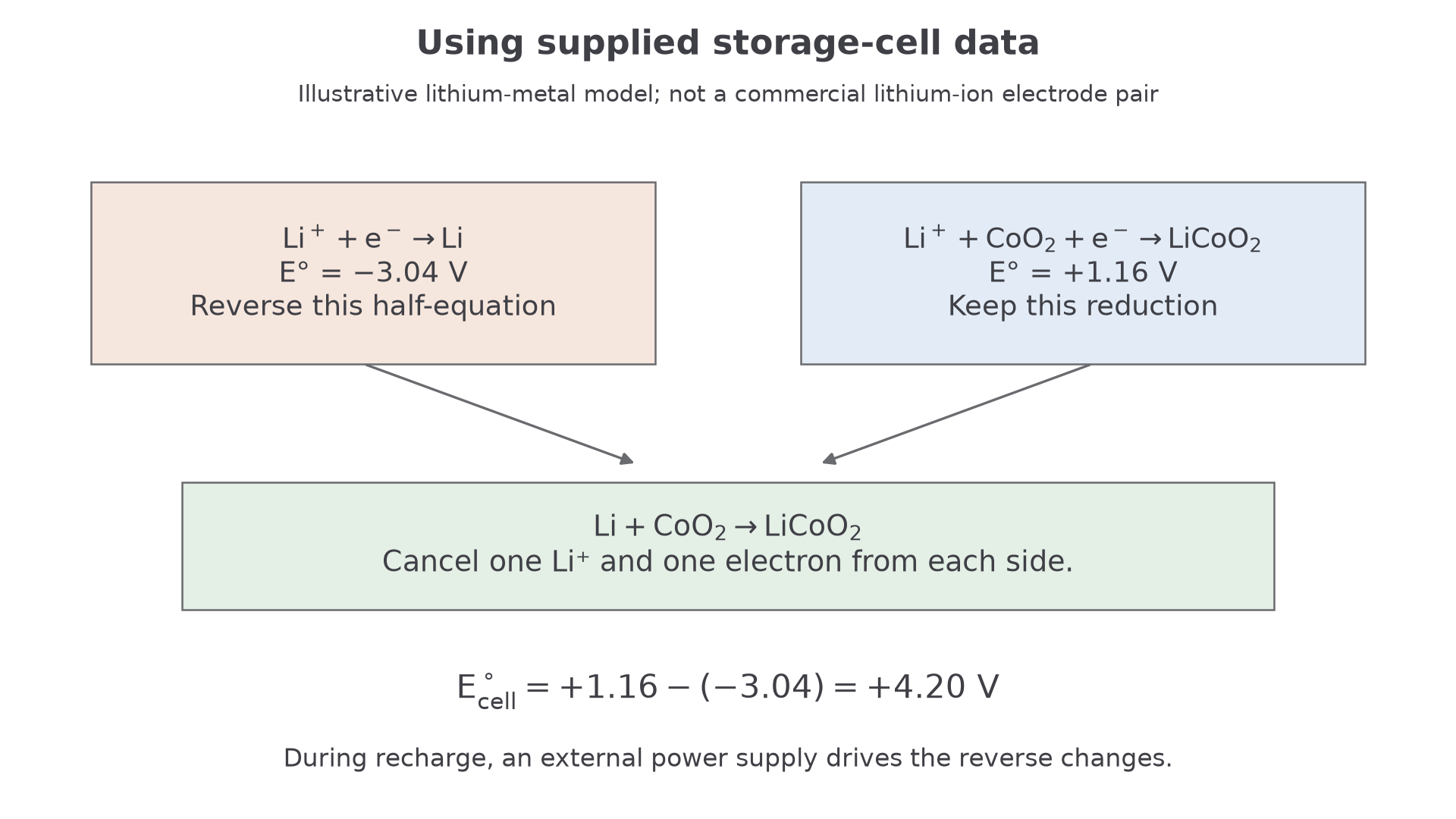
Worked example, using an illustrative lithium-metal storage-cell model (not the electrode chemistry of a commercial lithium-ion cell):
| Redox system | Supplied reduction half-equation | E / V |
|---|---|---|
| 1 | + → | -3.04 |
| 2 | + + → | +1.16 |
The more positive reduction potential is +1.16 V, so this half-equation runs as reduction:
Reduction in the supplied storage cell
The / half-equation is reversed to make oxidation:
Oxidation in the supplied storage cell
Now add them:
Cancel and from both sides:
Overall cell equation
If the question asks for the standard cell potential:
Recharging
During charging, an external power supply drives the reverse chemical changes and stores electrical energy as chemical energy. For this idealised example, the reverse overall equation is . Real rechargeable lithium-ion cells usually transfer lithium ions between host materials rather than plating lithium metal; use the electrode chemistry supplied in the question. Rechargeability requires suitably reversible reactions, not merely a large positive discharge voltage.
The common mistake is to keep both supplied half-equations in the reduction direction. That leaves electrons on the left of both equations and cannot produce a valid overall cell equation for a discharging cell.
How a fuel cell creates a voltage
A fuel cell does not work by burning fuel directly in a flame. It separates the redox reaction into electrode reactions so that electron transfer is organised through an external circuit.
At the anode, the fuel is oxidised. For a hydrogen fuel cell, hydrogen loses electrons. Those electrons cannot pass straight through the electrolyte, so they move around the external circuit and can do electrical work.
At the cathode, oxygen is reduced. Oxygen accepts electrons arriving from the external circuit and reacts with ions in the cell to form products. In a hydrogen-oxygen fuel cell, the overall product is water, although the intermediate ions depend on whether the conditions are acidic, alkaline or another supplied system.
[DIAGRAM: asset_name: Lesson 5.2.3j-k: Storage cells and fuel cells - diagram 02; asset_slug: 05_02_03d_storage_cells_and_fuel_cells__diagram_02; recommended_method: drawn_chem; description: Deterministic hydrogen-oxygen fuel-cell layout showing fuel entering the anode and being oxidised, oxygen entering the cathode and being reduced, electron flow through the external circuit, ion movement through the electrolyte and water leaving as product.]
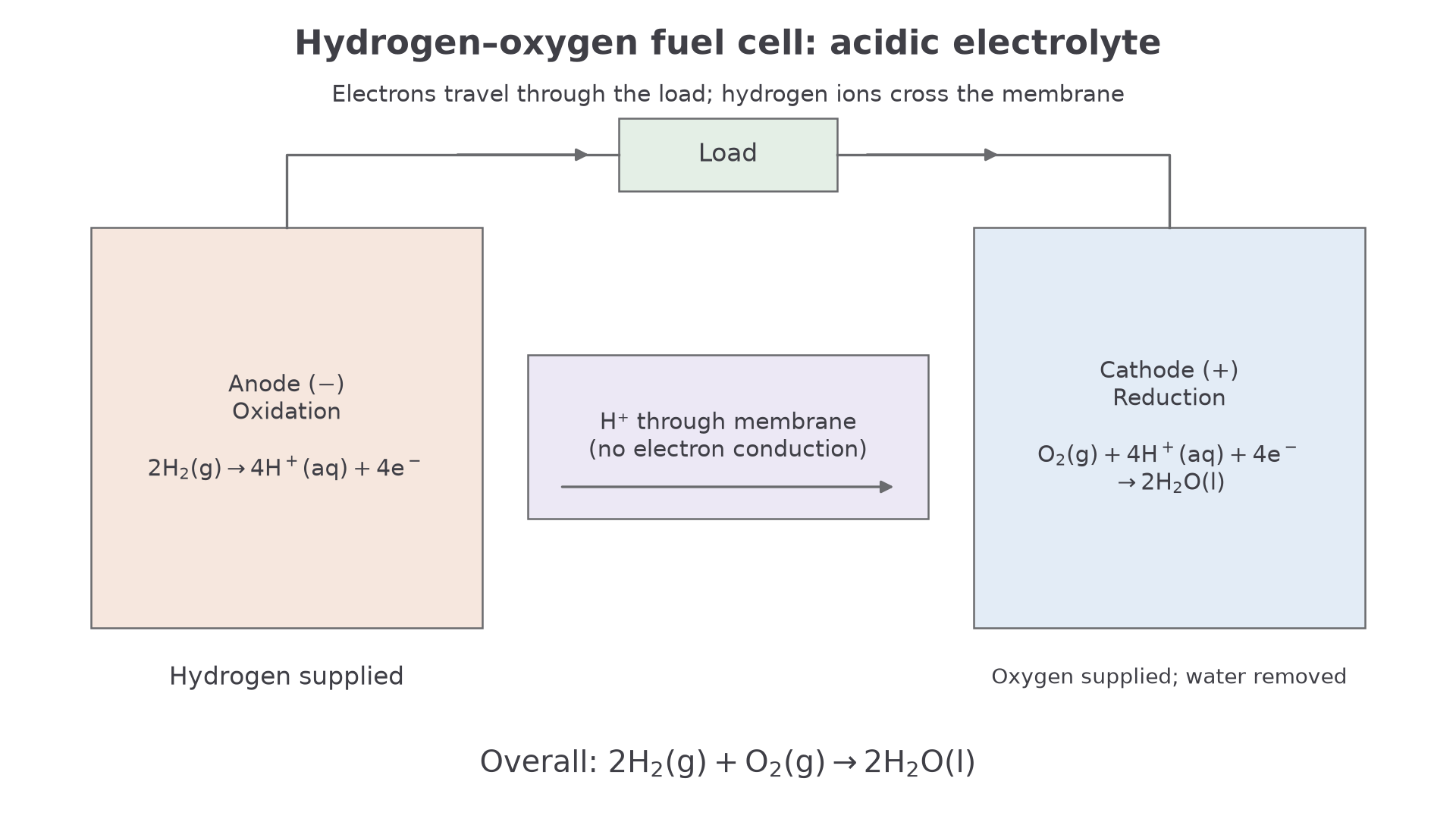
In an acidic hydrogen cell, moves through the membrane from the hydrogen anode towards the oxygen cathode. In an alkaline cell, is formed at the oxygen cathode and consumed at the hydrogen anode, so its net movement is opposite. Electrons still travel from anode to cathode through the external circuit in both cases.
The cell voltage is caused by the difference between the electrode potentials of the oxidation and reduction systems. The cell keeps operating only while fuel and oxygen are supplied and the product is removed or managed.
Continue this lesson.
You’re previewing NovaLearn without an account. Create a free account to read the rest.
Create free account