2.1.4(d)-(e) - Acid-base titrations
Acid-base titration is a practical method for finding an unknown concentration by reacting a measured volume with a solution whose concentration is known accurately. The chemistry is simple neutralisation, but the result is only trustworthy if the volumes, standard solution and mole-ratio calculation are handled carefully. This lesson links the practical technique to the calculation route, so the numbers mean something rather than becoming a set of disconnected steps.
Purpose and key terms
A titration compares two reacting solutions. One solution has a known concentration and the other is being found. A measured fixed volume of one solution is placed in a conical flask, then the other solution is added from a burette until the reaction is just complete.
Standard solution
A standard solution is a solution with an accurately known concentration.
Titre
A titre is the volume delivered from the burette in a titration. It is calculated from final burette reading - initial burette reading.
The endpoint is the point where the indicator shows a colour change. The equivalence point is the chemical point where the reacting amounts are exactly in the mole ratio in the balanced equation. A good titration method chooses and uses an indicator so that the observed endpoint is close enough to the equivalence point for an accurate concentration calculation.
The fixed volume placed in the conical flask is often called an aliquot. In school and college titrations this is commonly 25.00 cm³ measured using a volumetric pipette. Repeated accurate titres should be close together; these are called concordant titres. In many practical methods, titres within 0.10 cm³ are treated as concordant, but always follow the tolerance stated in the method or question.
The most important idea is that each apparatus choice protects one part of the calculation. The volumetric flask fixes the final volume of the standard solution. The pipette fixes the aliquot volume. The burette measures the variable volume needed to reach the endpoint. The balanced equation gives the mole ratio.
Preparing a standard solution
To prepare a standard solution from a solid, the aim is to put a known amount of substance into an accurately known final volume.
A primary standard solid must have known purity and composition and be stable during weighing. A hygroscopic solid or one that absorbs carbon dioxide can give the wrong amount from its apparent mass; solutions such as sodium hydroxide are commonly standardised by titration rather than relying on a directly weighed mass alone.
A careful sequence is:
- Calculate the mass of solid needed.
- Weigh the solid accurately, often by difference using a weighing bottle or boat.
- Dissolve the solid in a beaker using a small volume of deionised water.
- Transfer the solution to a volumetric flask using a funnel.
- Rinse the beaker, stirring rod and funnel into the volumetric flask so no dissolved solid is left behind.
- Allow a warm solution to cool to room temperature before making up the volume. Add deionised water, dropwise near the mark, until the bottom of the meniscus is on the calibration mark at eye level.
- Stopper the flask and invert it several times to make the solution uniform.
The final volume must be the volume in the volumetric flask, not the volume of water first used in the beaker. The beaker stage is for dissolving and quantitative transfer; the volumetric flask stage is what gives the accurate final concentration.
Amount, concentration and volume
where n is amount in mol, c is concentration in mol dm⁻³, and V is volume in dm³.
Worked example: prepare 250.0 cm³ of 0.100 mol dm⁻³ sodium carbonate solution, Na₂CO₃.
First convert the volume:
Find the amount needed:
For Na₂CO₃, relative formula mass is 106.0 and molar mass M = 106.0 g mol⁻¹.
So the method should use about 2.650 g of Na₂CO₃ and make the dissolved solid up to the 250.0 cm³ calibration mark in a volumetric flask. A balance reading to 2 or 3 decimal places may be expected depending on the apparatus used; keep the final calculated concentration to an appropriate number of significant figures.
Two errors are especially damaging. If some solid is lost during transfer, the actual concentration is lower than intended. If the flask is filled above the mark, the concentration is also lower because the same amount is spread through too large a volume.
Carrying out the titration
The burette, pipette and conical flask each have a different job.
The burette delivers a measured variable volume. Rinse it with the solution it will contain before filling it; otherwise water left inside dilutes the solution. Run solution through the tap to fill the jet and remove any air bubble before recording the initial reading. An initial jet bubble uses some recorded volume to fill the jet rather than deliver titrant to the flask. Remove the funnel after filling, because drops falling from the funnel during the titration would change the volume without being included in the initial reading.
The volumetric pipette transfers a fixed aliquot, usually 25.00 cm³. Rinse it with the solution it will transfer. Use a pipette filler, never mouth pipetting. Let the pipette drain naturally; do not blow out the last drop unless the pipette is designed for that.
The conical flask holds the aliquot and indicator. It does not need to be dry, and it may be rinsed with deionised water during the titration because extra water changes concentration but not the amount of substance already in the flask. Add only a few drops of indicator, then swirl the flask as the burette solution is added.
[DIAGRAM: asset_name: Titration apparatus; asset_slug: 02_01_04d_titration_apparatus; recommended_method: drawn_chem; description: Clamped vertical burette with tap and filled jet over conical flask on white tile; fixed aliquot and indicator, eye-level reading and dropwise addition near endpoint.]
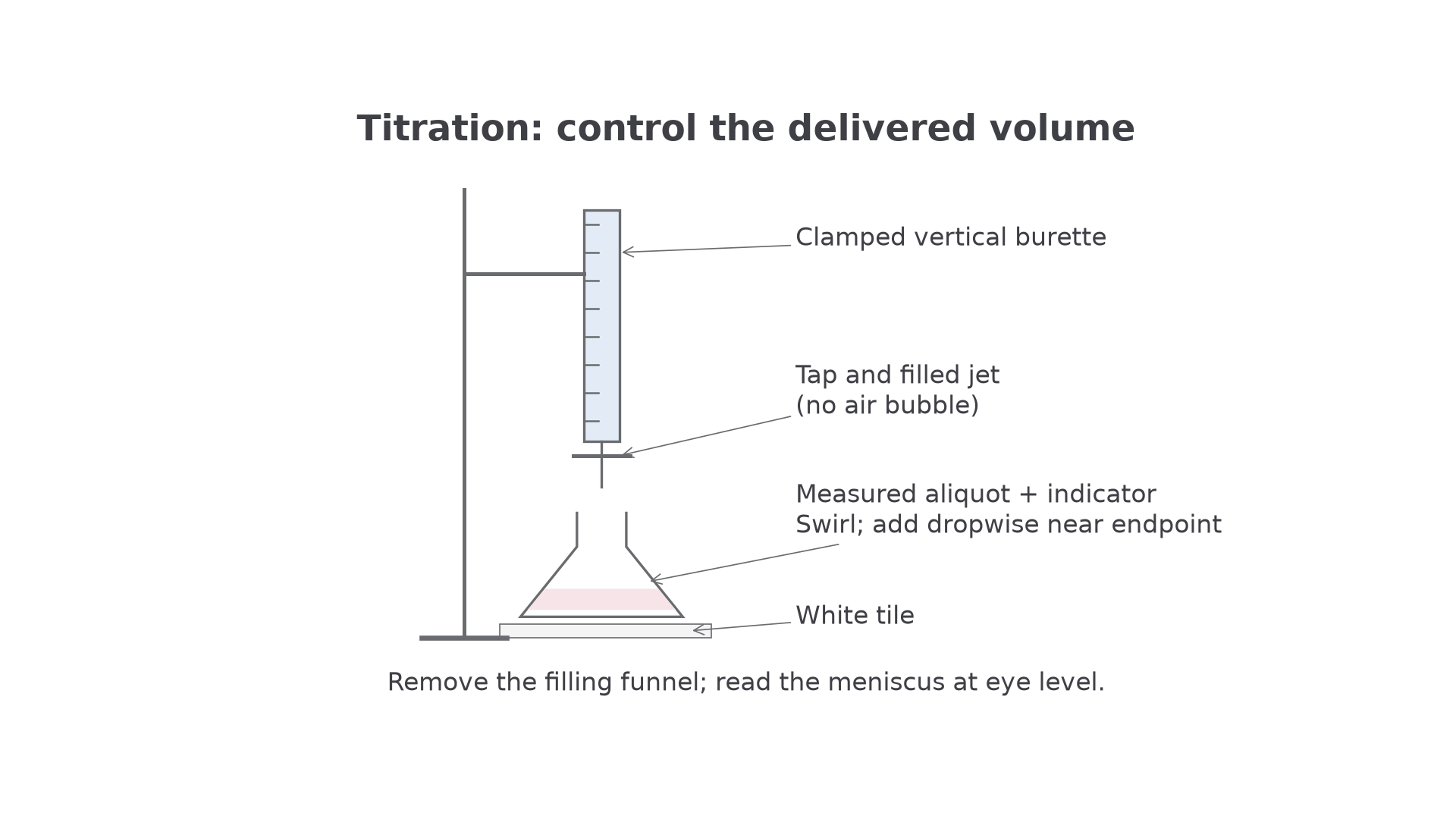
Place the flask on a white tile to make the first lasting colour change easier to see.
A practical titration usually begins with a rough titre. After that, repeat accurate titres, adding the titrant quickly at first and dropwise near the endpoint. A sharp endpoint is a colour change that remains after swirling. Read the burette at eye level and record readings to a sensible precision, usually two decimal places for a burette scale read to the nearest 0.05 cm³.
Worked example: choosing a mean titre.
| Titration | Initial / cm³ | Final / cm³ | Titre / cm³ |
|---|---|---|---|
| Rough | 0.00 | 25.40 | 25.40 |
| 1 | 0.10 | 24.80 | 24.70 |
| 2 | 0.00 | 24.60 | 24.60 |
| 3 | 0.20 | 24.80 | 24.60 |
The rough titre is not used in the mean. With a stated concordance tolerance of 0.10 cm³, all three accurate titres are concordant: their range is exactly 0.10 cm³. Use all three unless the question explicitly requests another selection:
Risk management is part of the method. Acids and alkalis can be irritant or corrosive depending on concentration, so wear eye protection, clean spills promptly, and keep the burette below eye level when filling. Use the indicator specified for the reaction. Phenolphthalein is colourless in acid and pink in alkali; methyl orange is red in acid and yellow in alkali, passing through orange near its endpoint. A strong acid–strong alkali titration can use either; weak acid–strong alkali usually uses phenolphthalein. Do not use universal indicator for a precise endpoint because its colour change is gradual. Indicator choice from full pH curves is developed later.
Structured titration calculations
Most titration calculations use the same core route:
- Convert the titre from cm³ to dm³.
- Use n = cV to find moles of the solution with known concentration.
- Use the balanced equation to convert moles of one reactant into moles of the other.
- Use the pipette volume or total solution volume to find the required concentration.
Worked example: 25.00 cm³ of hydrochloric acid is pipetted into a conical flask. It requires 23.60 cm³ of 0.100 mol dm⁻³ sodium hydroxide for neutralisation.
Equation:
Find moles of NaOH:
The mole ratio HCl : NaOH is 1 : 1, so:
This amount of HCl was in 25.00 cm³:
The balanced equation is not decoration. It is the step that changes the measured moles of one solution into the reacting moles of the other. A common error is to assume every acid-base titration has a 1 : 1 ratio; this only works when the equation says so.
Less-structured titration problems
In less-structured questions, the calculation route is the same, but you must decide which volume or scaling step matters. Label each amount as you go. This prevents the most common mistake: calculating the amount in the 25.00 cm³ aliquot, then forgetting to scale up to the full volumetric flask.
A useful route is:
- Identify the known concentration and the titre.
- Calculate moles of the known solution used in the titre.
- Use the equation to find moles of the unknown in the aliquot.
- If the aliquot came from a larger solution, multiply by the dilution factor.
- Use the question's target: concentration, mass, percentage purity or molar mass.
If the target is percentage purity, first use the titration to find the mass of the pure acid or base present. Then compare that with the mass of the original sample:
For example, if titration data show that a 1.50 g sample contains 1.20 g of pure acid, the percentage purity is (1.20 / 1.50) x 100 = 80.0%.
Worked example: a 1.260 g sample of a solid diprotic acid, H₂A, is dissolved and made up to 250.0 cm³ in a volumetric flask. 25.00 cm³ portions of this solution require a mean titre of 21.00 cm³ of 0.150 mol dm⁻³ NaOH(aq). Calculate the molar mass of H₂A.
Equation:
Moles of NaOH in the titre:
The equation shows 1 mol H₂A reacts with 2 mol NaOH:
The full solution is 250.0 cm³, which is 10 times the aliquot:
Now use mass = amount x molar mass, rearranged:
Worked example: using repeat titres to find purity
A 2.500 g solid sample contains anhydrous sodium carbonate and an impurity that does not react with hydrochloric acid. It is dissolved and made up to 250.0 cm³. A 25.00 cm³ aliquot is titrated with 0.1000 mol dm⁻³ HCl. Accurate titres are 23.50, 23.60 and 24.20 cm³; use a concordance tolerance of 0.10 cm³. Find the percentage purity of the solid. Use .
The data now require a complete chain, rather than just substituting a supplied mean:
- Choose and average concordant titres: 23.50 and 23.60 differ by 0.10 cm³; 24.20 is not concordant. Mean = 23.55 cm³.
- Find titrant amount: .
- Apply the equation: carbonate amount in the aliquot is , because two HCl react per carbonate.
- Scale to the whole flask: .
- Convert pure carbonate to mass: .
- Compare with the original solid: , giving 49.9% to three significant figures.
The result is less than 100%, as expected for this impure sample. Omitting the aliquot scale-up would give about 4.99%, a tenfold error. The unrounded values are kept through the chain and only the final purity is rounded.
For unfamiliar acids and bases, do not guess the formula from the name unless the question gives enough information. Use the balanced equation, formula or stated basicity/acidity provided in the question to get the mole ratio.
How practical errors affect the result
The direction of an error depends on where the known solution is placed. Suppose known NaOH is in the burette and an unknown acid is in the flask. If water left in the burette dilutes NaOH, a larger volume is needed. Using the intended, higher NaOH concentration with that titre overestimates the amount and concentration of acid. If instead a water-wet pipette dilutes the acid aliquot, less acid is transferred, the titre is lower, and the calculated acid concentration is too low. Water added directly to the flask after a correctly measured aliquot changes neither the amount nor the ideal titre.
An overshot endpoint makes the titre too high. With known concentration in the burette, that overestimates the amount in the flask. Always trace the measured error through the actual calculation rather than memorising a universal “too high” rule.
Good titration answers show both chemical method and mathematical control. Use cm³ for recorded volumes, but convert to dm³ before using concentration in mol dm⁻³. A millilitre equals a cm³ and a litre equals a dm³; use the units requested and convert consistently.
Record burette readings and titres with an appropriate number of decimal places. A titre written as 24.6 cm³ may lose precision compared with 24.60 cm³ if the apparatus supports two decimal places. In a calculation, give the final answer to a sensible number of significant figures, normally guided by the data in the question.
When choosing a mean titre, do not average all results automatically. Exclude the rough titre and any non-concordant result. If several accurate titres are concordant, average the selected concordant set and state what you used.
Common practical and calculation errors include:
- using the trial titre in the mean
- forgetting cm³ to dm³, so the answer is 1000 times too large or too small
- using the wrong mole ratio from the balanced equation
- treating the aliquot amount as the amount in the whole volumetric flask; for a 250.0 cm³ flask and 25.00 cm³ aliquot, this underestimates total amount by a factor of 10 and overestimates molar mass by a factor of 10
- forgetting a mass conversion such as g to mg, if the question asks for it
- over-shooting the endpoint and accepting a titre that is too high
- failing to rinse the burette or pipette with the solution they will contain
A reliable titration answer is a chain: accurate solution preparation, careful endpoint technique, selected concordant mean, n = cV, balanced-equation ratio, then any required scaling or conversion.
Quick Recap
- Make a standard solution by accurate weighing, quantitative transfer, making up to the calibrated volume and thorough mixing.
- A pipette measures a fixed aliquot; the burette measures the titre. Rinse each with its solution, remove the filling funnel and approach the endpoint dropwise.
- Select concordant accurate titres and exclude the rough titre. The endpoint is observed; the equivalence point is defined by stoichiometry.
- Calculate amount from cV, apply the balanced-equation ratio and scale an aliquot to the full flask when required.
- Trace each practical error through the actual arrangement; added water in the conical flask changes concentration, not the transferred amount.