ME6 - Moments and couples
Determine forces that keep a rigid body at rest by balancing both force and turning effect. You will use couples, model supports and friction, and choose moment points that simplify the algebra while checking that the resulting forces are physically possible.
Balance forces and moments
Can equal and opposite forces still turn a body? Push upwards with 10 N at the right end of a 1 m horizontal rod and downwards with 10 N at the left. Total force is zero, but the turning effect about the left end is 10 N m anticlockwise. Force balance alone cannot establish equilibrium.
A rigid body is modelled as retaining its shape under the applied forces. Its force diagram must retain where forces act; moving every arrow to a single particle would lose the lever arms. Replace the body's distributed weight by one force through its centre of mass.
The magnitude of a force's moment about a point is force magnitude times the perpendicular distance to its line of action. For a force acting a distance away at angle to the position vector, this is . A force through the chosen point has zero moment even if it is large.
Rigid-body equilibrium
For coplanar forces, with anticlockwise moments chosen positive,
A moment has unit . Include any applied couples in the moment sum. Once resultant force is zero, balancing moments about one point balances them about every point.
Not in the formula booklet: learn it.
The last statement follows because shifting the moment point adds the moment of the resultant force, which is zero. In space, force and moment are vectors; all three components of each must vanish.
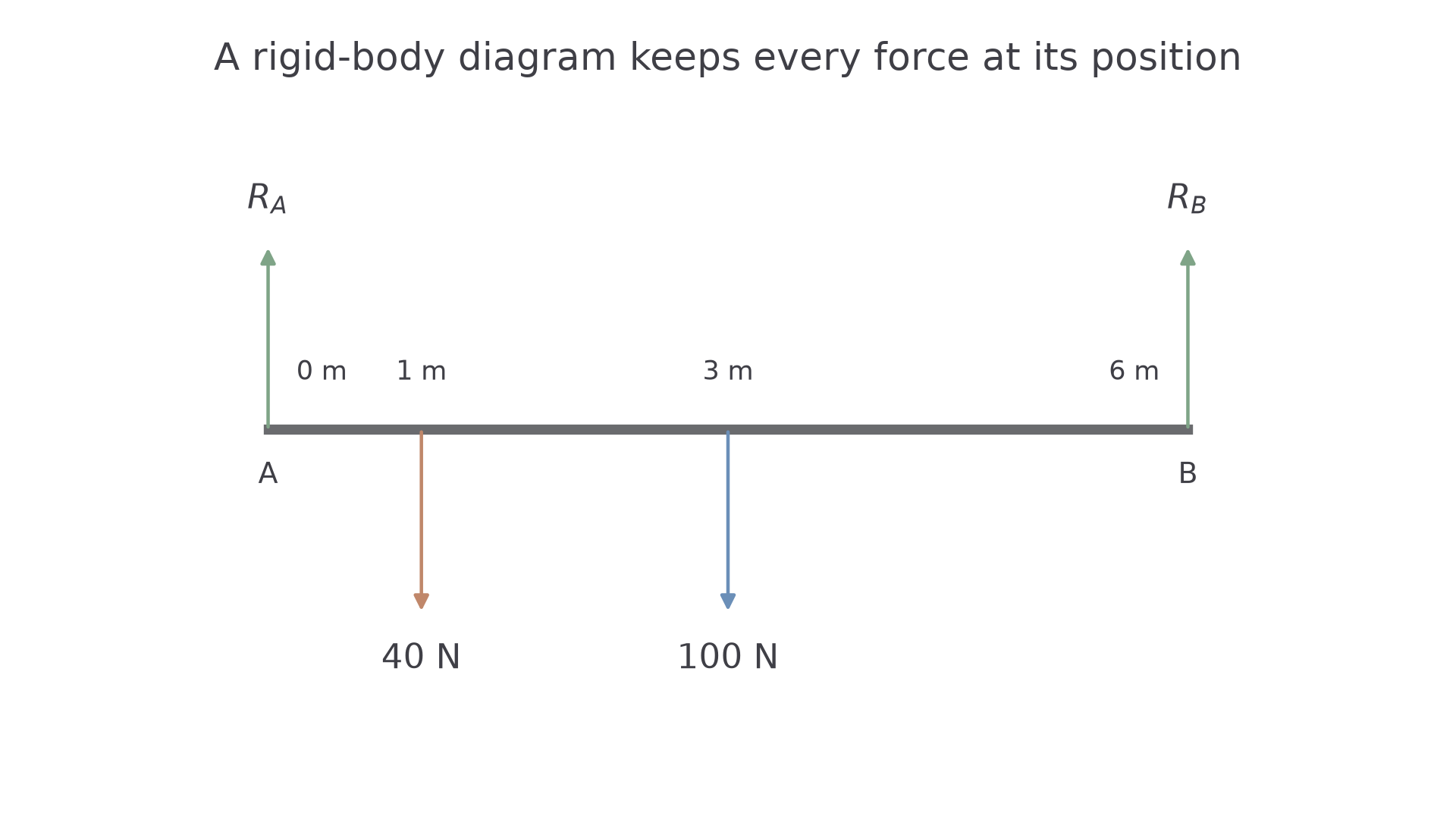
[DIAGRAM: asset_name: A supported beam retains force positions; asset_slug: aqa7367-equilibrium-beam; caption: Balance the upward reactions and their moments against the two loads; description: A six-metre horizontal beam has upward reactions A at zero and B at six metres, its own 100 N weight downward at three metres, and a 40 N load downward at one metre. All force arrows start at their points on the beam. A labelled distance scale gives load and support positions.]
Worked example 1: two upward reactions
Question. A uniform horizontal beam of length 6 m and weight 100 N rests on smooth supports at its ends and . A 40 N load acts 1 m from . Find the reactions.
Plan. Take moments about to eliminate its reaction, then balance vertical forces.
The uniform beam's own weight acts at its midpoint.
Answer. N and N, both upwards.
Check. Moments about : , matching N m. Both pushing-support reactions are positive.
Move only the 40 N load from 1 m to 5 m from . Reflection should interchange the reactions.
Worked example 2: moving the load
Question. Find the reactions for the same beam when the 40 N load acts 5 m from .
Plan. Keep the balance equations, changing only the load's moment arm.
Answer. N and N, both upwards.
Check. Reflecting the original loading in the beam's midpoint swaps and , exactly as these values do. The reactions still sum to 140 N.
Moment balance and force balance are separate conditions.
Watch out
Wrong: equal total upward and downward force proves equilibrium. Equal opposite separated forces can still turn a body. Check both the force sums and a moment sum, using perpendicular lever arms.
Try a fresh load position and beam length.
Couples
A couple consists of two equal, opposite, parallel forces with different lines of action. Its resultant force is zero, but its moment need not be zero. A couple produces a pure turning effect.
Suppose two vertical forces of magnitude act at horizontal positions and , downward at the first and upward at the second. About any point with horizontal coordinate , their combined moment is
Both and disappear: a couple's moment is independent of the moment point. The relevant separation is perpendicular distance between the lines, not necessarily distance between the application points.
Moment of a couple
Two equal opposite parallel forces of magnitude , with perpendicular line separation , form a couple of magnitude
State clockwise or anticlockwise sense. Add its signed moment directly to a rigid-body moment equation; it adds no resultant force.
Not in the formula booklet: learn it.
With vertical forces, measure their line separation horizontally. The height of either application point does not change that perpendicular separation.
Worked example 3: a vertical force pair
Question. A 10 N downward force acts at and a 10 N upward force acts at , in metres. Find their resultant force and moment.
Plan. Sum forces, then use the perpendicular separation of their vertical lines.
The upward force on the right turns anticlockwise.
Answer. Zero resultant force and a 6 N m anticlockwise couple.
Check. About , the downward force gives N m and the upward force gives N m. Their sum is still N m.
Move the upward force's application point vertically while keeping its vertical line of action. This changes the distance between the points but not the couple.
Worked example 4: separating points is not separating lines
Question. Keep the downward 10 N force at , but apply the upward 10 N force at . Find the couple's moment.
Plan. Use horizontal separation 0.6 m, perpendicular to the vertical forces.
The application points are m apart, but that is not the moment arm.
Answer. 6 N m anticlockwise.
Check. Resolve the position vector relative to the upward force: only its horizontal component contributes to turning, giving .
To hold a body under this couple, the other forces must supply a 6 N m clockwise moment as well as satisfying force balance. Merely adding another force at the chosen moment point cannot cancel that couple's moment about that point.
Watch out
Wrong: “equal and opposite” means no mechanical effect. Their force sum is zero, but a separation of their lines creates a couple. Use perpendicular line separation, not the diagonal between application points.
Keep the lines and their perpendicular separation distinct in the next pair.
Supports, friction and geometry
A support model decides which forces can act. A smooth contact supplies only a normal reaction; a rough contact also supplies tangential friction. A light taut string pulls along itself. A pin can provide two force components but no resisting couple in the ideal model. A contact can push, so its normal reaction must be non-negative.
Static friction takes the value needed by equilibrium, provided its magnitude is no greater than . Equality applies only at impending slip. Its direction opposes the tendency to relative motion. A diagram with the correct force directions and actual perpendicular arms often does more than a long list of equations.
Worked example 5: a ladder against a smooth wall
Question. A uniform 5 m ladder of weight 200 N rests on rough horizontal ground and against a smooth vertical wall. Its foot is 3 m from the wall and its top is 4 m above the ground. Find the contact forces and the minimum coefficient of ground friction for equilibrium.
Plan. Take moments about the foot; use force balance for ground normal and friction.
The wall force is horizontal, away from the wall; friction at the foot acts towards the wall. The ladder's centre is halfway along, giving horizontal weight arm 1.5 m.
Answer. Wall reaction 75 N, ground normal 200 N, ground friction 75 N towards the wall; .
Check. About the top, ground normal gives 600 N m clockwise; ground friction and weight give N m anticlockwise.
Continue this lesson.
You’re previewing NovaLearn without an account. Create a free account to read the rest.
Create free account