D8 - Polynomial inequalities
An equation finds the inputs where a polynomial is zero; an inequality asks what happens between those inputs. You will use factors to determine the signs of cubics and quartics, explain what repeated roots do, and give complete exact solution sets with the right endpoints.
Cubic and quartic signs
Can three roots, together with one known interval sign, tell you where a cubic is positive? Consider . At , its three factors have signs positive, negative, negative, so their product is positive. We can extend that conclusion throughout : none of the factors changes sign inside that interval.
A polynomial is continuous. It cannot change from positive to negative without passing through zero. Once you have found all its real roots, they split the real line into intervals on which the polynomial has a constant sign. A test value in each interval therefore determines the sign throughout that interval.
Sign chart
A sign chart records whether an expression is positive, zero or negative on the intervals separated by its critical values. For a polynomial, those critical values are its real roots. Zero itself is neither positive nor negative.
Factorise before choosing test values. Finding a few roots on a calculator is insufficient unless you know that the factorisation accounts for the remaining polynomial too. A factor such as has no real roots and stays positive, so it introduces no extra boundary.
Worked example 1: the intervals of a cubic
Question. Solve .
Plan. Put the three roots in order, then multiply the factor signs in each interval.
The requested sign is positive, so select the second and fourth intervals. The roots give zero and cannot satisfy a strict inequality.
Answer. or .
Check. In the expanded form , the test inputs give , matching the four signs independently.
Now add just one factor, . Its sign reverses the old product to the left of 4 and leaves it unchanged to the right. This turns the cubic into a quartic without requiring a new solving method.
Worked example 2: one additional root
Question. Solve .
Plan. Insert the new boundary 4 and combine the cubic's signs with the sign of .
Answer. , or .
Check. The leading term is , so both far ends must be positive. Direct substitution at gives , and at gives 8; these agree with the two interior choices.
The leading term gives a useful first sign: a cubic with positive leading coefficient goes down on the far left and up on the far right; a quartic with positive leading coefficient goes up at both ends. A negative leading coefficient reverses those directions. The actual roots still determine the intervening signs.
Roots alone cannot determine positivity: and have the same roots and multiplicities, but opposite signs wherever they are nonzero. You also need one known interval sign, which can come from a test value or the sign of the leading coefficient.
Watch out
Wrong: a positive product requires every factor to be positive. Two negative factors also make a positive contribution. Determine the sign of the whole product on each interval.
Try another quartic, with all four roots different.
Repeated roots and sign changes
Two identical factors change the picture. The square is positive on both sides of 1 and zero at 1. It cannot reverse the sign of the remaining factors when you pass through its root.
If , where , then has multiplicity . Close to , the factor keeps its sign. An odd power changes sign across ; an even power does not. This proves the crossing rule rather than asking you to memorise a sketch.
Multiplicity and crossing
At a real root of odd multiplicity, a polynomial changes sign and its graph crosses the horizontal axis. At a root of even multiplicity, its sign is the same on both sides and the graph touches the axis. A triple root is repeated but still crosses.
The next pair changes only the exponent at 1. Notice that the degree changes too, from three to four.
Worked example 3: an isolated solution at a double root
Question. Solve .
Plan. Use the square's non-negative sign, handling its zero separately.
This gives . At , the original product is zero too, so that single input must be restored. The root 1 is a touch, not a boundary between positive and negative intervals.
Answer. or , written .
Check. At and , the values are 2 and 4, so neither neighbouring interval around 1 belongs. Directly at 1 the value is zero: an isolated solution is entirely possible.
Replace the squared factor by a cube. Now both roots have odd multiplicity and both must reverse the sign.
Worked example 4: a triple root crosses
Question. Solve .
Plan. Track the signs on the three intervals and include zero-valued endpoints.
Answer. .
Check. Substitution gives 64 at , at , and 4 at . Both boundary substitutions give zero. The resulting closed interval matches all five checks.
The graph below shows why “repeated” alone does not determine whether a curve touches or crosses.
[DIAGRAM: asset_name: Double and triple roots have different sign behaviour; asset_slug: aqa7367-root-multiplicity; caption: A double root touches the axis while a triple root crosses it; description: Two coordinate panels compare y equals (x plus 2) times (x minus 1) squared with y equals (x plus 2) times (x minus 1) cubed. Both roots minus 2 and 1 are labelled. The cubic crosses at minus 2 and touches from above at 1. The quartic crosses at both roots, flattening as it crosses at 1. Positive and negative regions are visibly distinguished by the graph's position relative to the horizontal axis.]
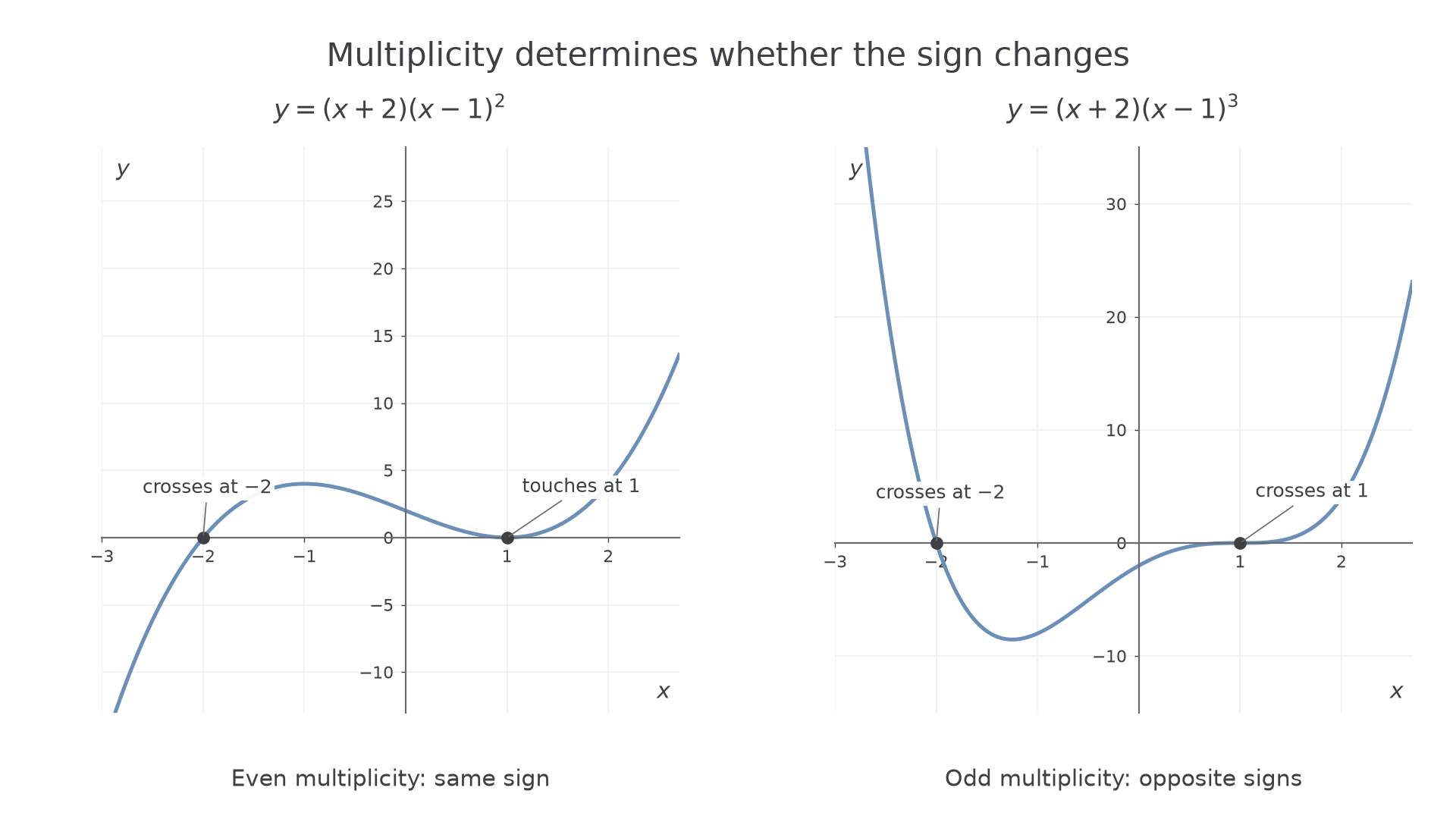
A useful surprise is that a polynomial inequality can have a single isolated solution alongside an interval. Dividing by a squared factor and forgetting its zero would lose exactly that feature.
Watch out
Wrong: every repeated root is a touch. Even multiplicity gives a touch; odd multiplicity gives a crossing. Also, do not divide by until you have dealt separately with .
Keep the zero of the square when answering the next question.
Exact solution sets and endpoints
After finding the signs, express the answer as a set of inputs. The inequality symbol determines which roots belong: and exclude zero-valued boundaries; and include them. Polynomial expressions have no denominator restrictions.
Intervals and unions
is an open interval; includes both endpoints. The mixed intervals and include just their square-bracket endpoint. The union means “in or ”; the intersection means “in both”. Infinity is not an endpoint you can include, so use a round bracket beside .
For example, 0 belongs to , written ; 2 does not, written . A single allowed value is a singleton such as , while no allowed values gives the empty set . If an extra domain is supplied, intersect your solution set with . Thus an interval is a subset of , not a list of only its integer inputs.
Recall a few set symbols when a question restricts the domain:
| Notation | Meaning |
|---|---|
| Every element of belongs to ; equality is allowed. | |
| is a proper subset of : it is a subset and . | |
| The number of elements of a finite set . | |
| , | The stated universal set, and the elements of that universal set outside . |
| Positive integers , using this specification's convention for natural numbers. | |
| , | All integers , and nonnegative integers , respectively. |
| , | Rational numbers with integer and , and real numbers, respectively. |
For and , we have , and . Complements depend on the stated universal set. Restricting to leaves only ; restricting it to leaves .
The symbol can mark an identity: holds for every real , unlike an equation whose solutions you must find. In modular arithmetic, instead means that is an integer multiple of the positive integer , for example . Also, means for a fixed constant ; it does not mean .
Exact roots matter: , but replacing it by 1.414 changes the exact boundary. Keep the surd in your final interval.
Worked example 5: exact quartic boundaries
Question. Solve , giving an exact solution set.
Plan. Treat the expression as a quadratic in , then order all four real roots.
The ordered boundaries are . All are simple, and the leading term is positive, so the five signs are . Include each root because equality is allowed.
Answer.
Check. Put . The quadratic is non-negative when or . With , these give exactly the central and two outer intervals above.
Change only to . The interval signs stay the same; only endpoint membership changes.
Worked example 6: making the inequality strict
Question. Solve , giving an exact solution set.
Plan. Retain the positive intervals and remove all four zero-valued inputs.
The condition gives two outer intervals, not just the positive branch .
Answer.
Check. At each of , the original expression is exactly zero, so none belongs. The test values and give 6 and 2, confirming a central and an outer positive region.
This answers the opening question: the complete root list, each root's multiplicity and one interval sign determine every interval sign. You do not need to calculate the turning points to solve the inequality.
Problem-solving
Separate three decisions: locate the exact boundaries, determine each interval's sign, then decide endpoint membership. A list of roots answers an equation, not an inequality.
Use the same quadratic-in-a-square idea with a new quartic.
Quick Recap
- Factorise completely enough to find every real root.
- An odd-multiplicity root reverses the sign; an even-multiplicity root does not.
- Strict inequalities exclude roots; non-strict inequalities may include isolated roots.
- Use exact endpoints and join separate allowed intervals with .
Yes: the roots and their multiplicities, together with one known interval sign, determine where a cubic is positive without finding its turning points.