E7 - Surface area of revolution
Rotating a curve produces a surface, whose thin bands have area equal to circumference times slant length in the limit. You will derive this rule, use Cartesian and parametric curves about either coordinate axis, and select nonnegative radii and branches that count the surface once.
Derive the frustum-element formula
Why does rotating a semicircle of radius 2 give a sphere with area , even though the semicircle's length is only ? Different points travel around circles of different radii. Surface area depends on both the generating curve's length and each point's distance from the axis.
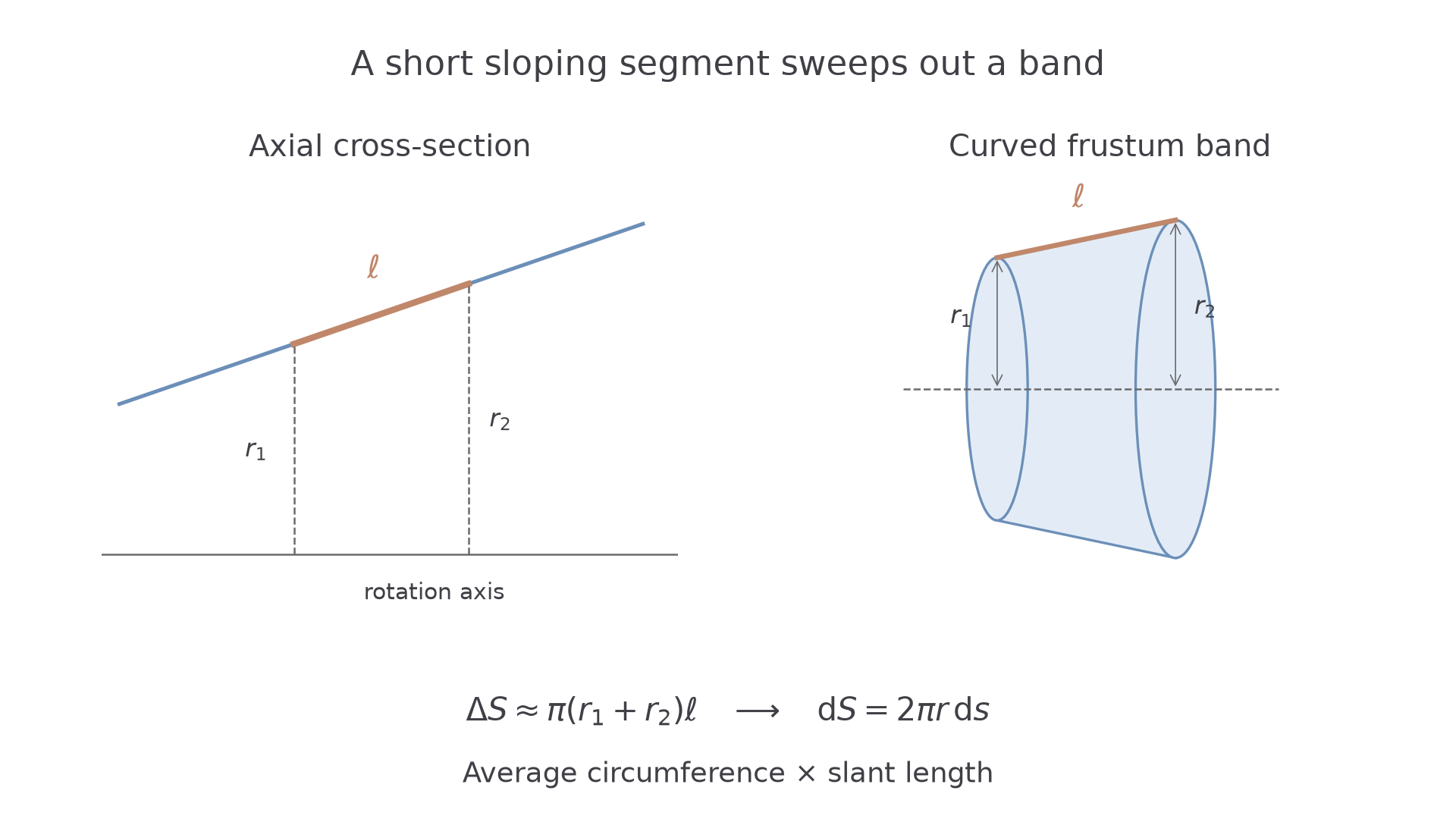
Approximate a short curve segment by a straight chord. Rotating that chord about an axis produces a narrow cone frustum. If its endpoint radii are and its slant length is , its curved area is : average circumference times slant length.
To derive this, suppose and extend the straight sides to form two similar cones with slant heights . Similarity and subtraction give when , and . Thus and , also valid when the smaller cone has radius and height zero. Subtract their curved areas:
Equal radii give the cylindrical band area directly.
As the segment shrinks, both endpoint radii approach , while the chord approaches arc element . Thus .
[DIAGRAM: asset_name: A narrow surface band; asset_slug: aqa7367-surface-band; caption: A frustum band approaches circumference times slant length; description: An axial cross-section shows two nearby points on a rising generating curve at radii r1 and r2 from the horizontal rotation axis. Their chord has slant length ell. A right schematic shows the frustum formed by rotating the chord, with endpoint circular rims and the curved band shaded. Its area pi times r1 plus r2 times ell is shown, tending to 2 pi r ds for a short curve element.]
Surface area from a generating curve
For a full rotation about the -axis, the radius is , so
Use increasing -bounds and a curve branch that generates each surface patch once. The booklet supplies the Cartesian -axis formula with as radius, for a branch with .
This gives the curved surface swept out by the curve. Circular end caps are separate areas unless included in the question's surface.
Worked example 1: a cone's curved surface
Question. The segment , , rotates about the -axis. Find the generated surface area.
Plan. Use radius and length factor .
Answer. square units, excluding the base disc.
Check. The cone has radius 1 and slant height , so its curved area is .
Keep the horizontal interval and double the gradient. Both the radius and the slant-length factor change.
Worked example 2: a steeper cone
Question. The segment , , rotates about the -axis. Find the generated area.
Plan. Use radius and length factor .
Answer. square units.
Check. The cone has radius 2 and slant height . Its curved area is , agreeing independently.
A length factor distinguishes surface area from both volume and ordinary area under a graph.
Watch out
Wrong: . This omits the slant length. Use ; add end caps only if asked for them.
Use a new cone slope for your own calculation.
Cartesian and parametric curves about either axis
Surface area always uses the same two ingredients: distance from the chosen axis and distance along the curve. Changing the axis changes the radius; changing the parameter changes the speed.
Coordinate forms of surface area
For , write . Then
For a Cartesian curve , the -axis form is . If instead , it is .
The booklet prints Cartesian and parametric forms about the -axis with nonnegative as radius. The -axis forms follow by changing the radius; they are not separately printed.
Use a branch and interval that generate the required surface once. In a parametric calculation, speed is nonnegative regardless of direction; there is no requirement that increase. A repeated or opposite branch can still sweep out surface already counted.
Continue this lesson.
You’re previewing NovaLearn without an account. Create a free account to read the rest.
Create free account