D3 - Sums of powers
How can you add the first hundred cubes without calculating a hundred separate cubes? You will learn to read sigma notation, use the sums of integers, squares and cubes, and reshape other finite sums so these formulae apply. One striking connection is that a sum of cubes is itself a perfect square.
Sigma notation
How can you add the first hundred cubes efficiently? Before finding a shortcut, we need a precise way to say which terms are included. For a small sum, such as , the first index is , the last is , and the rule for each term is “cube the index”.
Sigma notation
The notation means , where and are integers with . Both endpoints are included, so there are terms. The index is a temporary label: replacing it consistently by gives the same sum.
Substitute an index into the whole term. For example, the term at is . A constant inside the sigma sign appears once for every index: .
For a sequence with terms , denotes the sum of its first terms. Recognise the different symbol : it multiplies terms rather than adding them. The notation denotes a sum to infinity only when the finite partial sums approach a finite limit; no infinite sum is needed for the finite formulae here.
Worked example 1: reading the limits
Question. Find .
Plan. Substitute each of the four included indices, then add the terms.
Answer. .
Check. The four terms form an arithmetic progression, so their sum is .
Keep the limits and coefficient of fixed, but change the constant from to . Each term will decrease by , so the total should decrease by .
Worked example 2: changing every term
Question. Find .
Plan. Generate the terms from the same four indices.
Answer. .
Check. The change from the previous sum is , and .
Counting the terms correctly is as important as calculating them.
Watch out
There are terms from to , not three. The difference between the limits counts the gaps.
Try a new pair of limits.
Sums of integers, squares and cubes
Pairing the first and last terms of gives pairs with total . More precisely, writing the sum forwards and backwards gives , whether is odd or even.
You already know
An arithmetic sequence has first term , common difference , and term in position ; write its last term as . Its sum is . A geometric sequence has first term , common ratio , and term in position . This is a ratio, whereas under a sigma sign below is an index: read its role from context.
For , take , and in that arithmetic sum.
Sum of integers
For a positive integer ,
This follows from the arithmetic-series formula in the formula booklet.
Squaring each term before adding produces a different result from squaring the total. The standard square and cube sums give efficient alternatives to listing every term.
Sums of squares and cubes
For a positive integer ,
In the formula booklet.
These formulae can be checked structurally: if is the proposed total, then and must be the new term. For squares, the difference of the two cubic expressions simplifies to . For cubes, put :
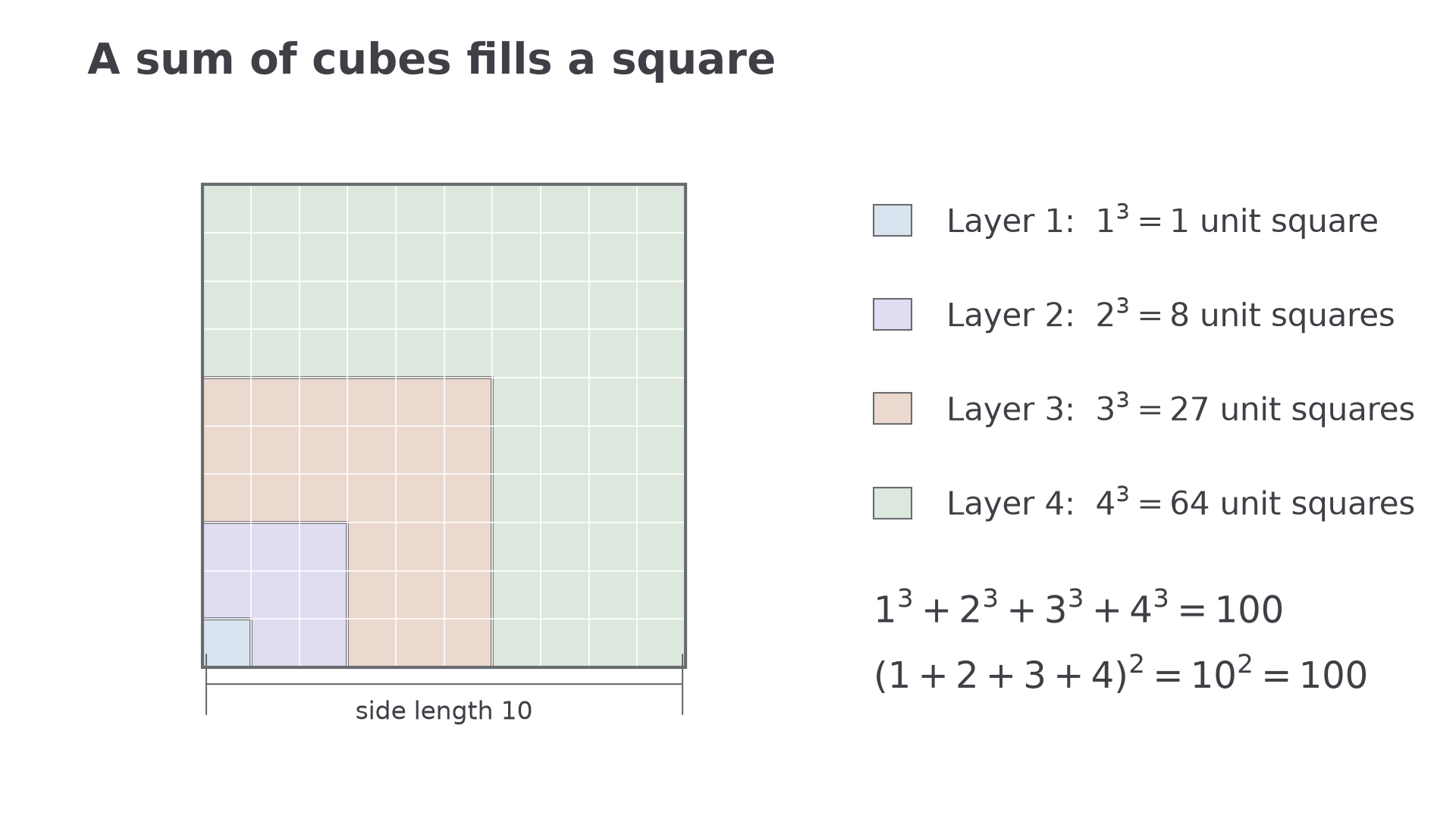
This explains the surprise: adding the first cubes gives , the square of the triangular number . The picture shows the first four layers; their areas are .
[DIAGRAM: asset_name: Cubes as layers of a square; asset_slug: aqa7367-cube-layers; caption: The first four cubes fill a square of side ten; description: An exact square diagram with nested square side lengths one, three, six and ten. The successive L shaped layers have areas one, eight, twenty seven and sixty four, equal to the first four cubes. A legend identifies each layer and an equation shows one cubed plus two cubed plus three cubed plus four cubed equals ten squared.]
Worked example 3: a square sum
Question. Find .
Plan. Use the square-sum formula with .
Answer. .
Check. Direct addition gives .
Now change only the power from to . The limit is still five, but the correct formula changes.
Worked example 4: a cube sum
Question. Find .
Plan. Square the sum of the first five integers using the cube-sum identity.
Answer. .
Check. Direct addition gives , and .
The special identity for cubes must not be transferred to squares.
Watch out
In general, . For example, , whereas .
Use the corresponding formula with a new upper limit.
Reshaping finite sums
The standard formulae start at , but a question may start later, finish at , or contain a polynomial. You can reshape such a sum before applying the formulae.
For fixed finite limits, summation distributes over addition and constant multiples:
Here and do not depend on . In particular, , not . To start at an integer , subtract the unwanted initial terms:
For a shifted term such as , either expand it to , or change index to . If runs from to , then runs from to . Both limits must change.
Worked example 5: a shifted square
Question. Find for a positive integer .
Plan. The actual squares run from to , so use a square sum and remove .
Answer. .
Check. An independent expansion gives . Substituting the three standard totals and simplifying gives the same expression. At , both give .
Change only the lower limit to . The missing terms are the values at , which are and , rather than and .
Worked example 6: removing initial shifted terms
Question. Find , where is an integer with .
Plan. Reindex to the squares from to , then subtract the first three squares.
Answer. .
Check. Subtracting the omitted from Worked example 5 gives exactly this result. At the boundary , it gives , the single term .
If a polynomial contains several powers, expand first, split the sum and collect afterwards. For example,
The same substitution principle handles a changed upper limit: for , put wherever the cube-sum formula has its upper limit. We can now answer the opening question without listing the cubes:
Keep track of what the limits mean before simplifying.
Problem-solving
First identify the actual first and last terms. Then expand or reindex, use standard sums, and check a small allowed value of the parameter.
Apply the changed lower limit to a fresh sum.
Quick Recap
- Sigma limits include both endpoints.
- Use the standard sums of integers, squares and cubes with the actual upper limit.
- Split finite sums across additions and constant multiples; a constant is repeated once per term.
- Shift both limits when changing index, or subtract the unwanted initial terms.
The first hundred cubes total , the square of .