A1 - Proof by induction
Checking a formula for ten, a thousand or a million cases still leaves infinitely many cases unchecked. Proof by induction replaces that endless task with a starting case and a rule that carries truth to the next integer. You will use it to prove finite sums and recurrence formulae, and learn to recognise a gap in a proposed proof.
The structure of an induction proof
How can a finite argument prove infinitely many statements? The first few odd-number sums suggest
There is a reason the pattern continues: adding the next odd number, , changes into . But this link needs a verified starting point.
Proof by induction
Let be a statement about integers . A proof by induction establishes:
- Basis: is true.
- Inductive step: for an arbitrary integer , assume , then deduce .
- Conclusion: since the basis holds and truth passes from each integer to the next, holds for every integer .
The assumption is called the induction hypothesis. You temporarily assume only the case in order to prove the implication ; you do not assume that both cases are true.
[DIAGRAM: asset_name: A starting case and a repeatable implication; asset_slug: aqa7367-induction-chain; caption: The basis starts the chain and the inductive implication extends it; description: A chain of boxes labelled P of one, P of two, P of three and P of four followed by dots. P of one has a checked basis label. Every arrow represents the same proved implication from P of k to P of k plus one. A second line states that the basis and the implication together give every positive integer case.]
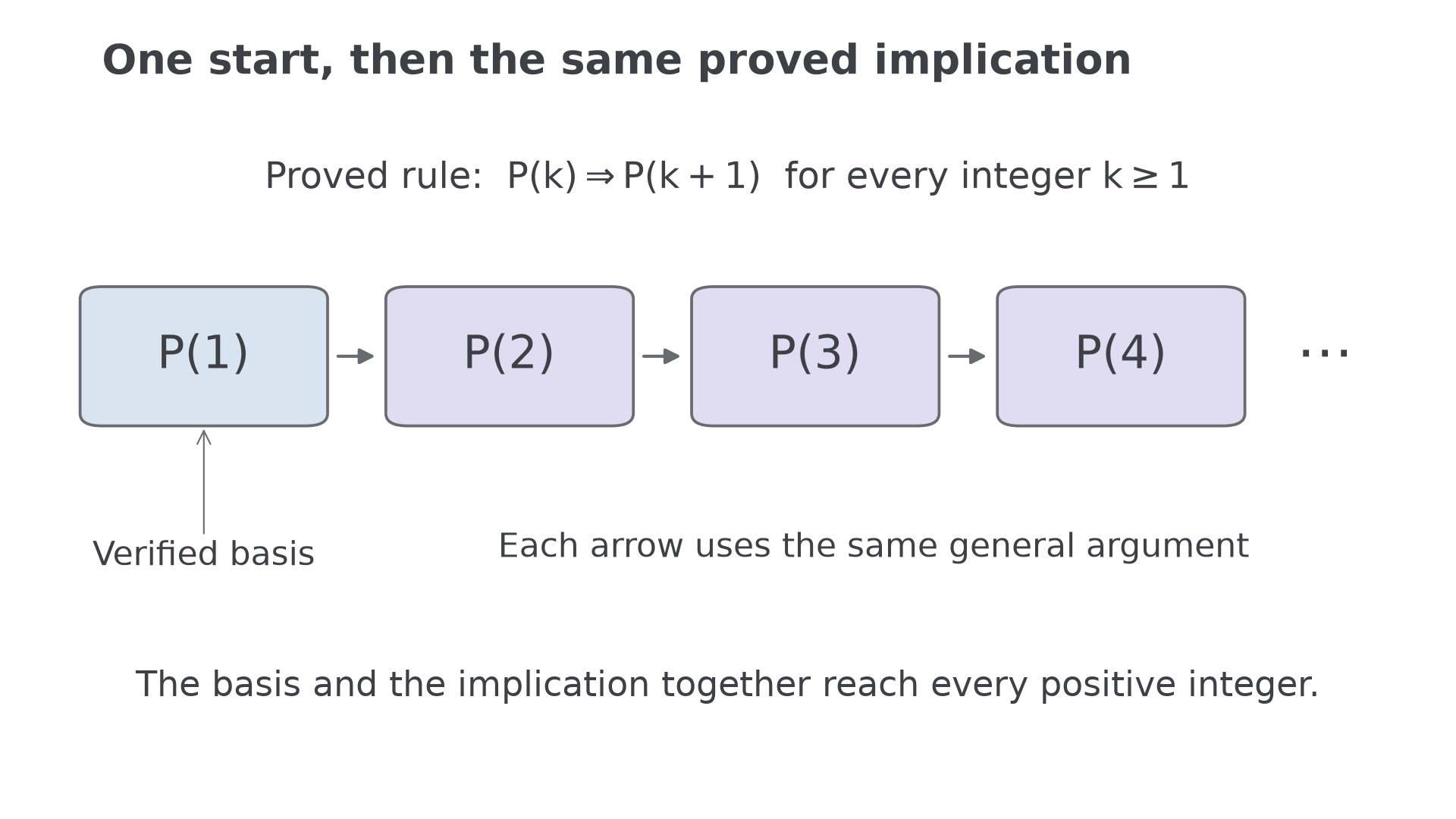
In proof notation, means “if , then ”; means “if , then ”. The symbol claims both directions. Induction needs the forward implication. You may also see for “therefore” and for “because”; words are equally clear.
Worked example 1: the sum of odd numbers
Question. Prove by induction that for all positive integers .
Plan. Verify the first sum and formula separately, then add the next odd number to the assumed sum.
For , the sum is , and the formula is . The basis holds.
Assume, for an arbitrary integer ,
Then
Answer. The result holds for , and if it holds for , it holds for . Therefore, by induction, it holds for all positive integers .
Check. The new term is , not . Independently, , exactly the term added.
Now change every summand by adding : becomes . There are terms, so the proposed total changes from to .
Worked example 2: shifting the odd numbers
Question. Prove by induction that for all positive integers .
Plan. Keep the same proof structure, changing the added term and the target formula.
For , the sum is , and the formula is .
Assume for an arbitrary integer . Then
Answer. The basis is true and . Hence, by induction, for every positive integer .
Check. Finite-sum formulae independently give .
The words in the conclusion describe the logical work you have done.
Watch out
“Assume true for , therefore true for ” skips the proof. Show where the hypothesis is used and reach the formula with every replaced by .
Try another constant shift of the same sum.
Proving recurrence formulae
A recurrence relation defines each term from earlier terms. Induction can prove a proposed explicit formula because the recurrence itself tells you how to move from term to the next.
For example, if and , the first few terms are . These are each one less than a power of two, suggesting . The initial terms suggest the formula; the proof establishes it.
Worked example 3: a recurrence with a constant addition
Question. The sequence is defined by and for integers . Prove that for all integers .
Plan. Check the initial term, then substitute the assumed explicit formula into the recurrence.
At , the recurrence's initial value is , and .
Assume for an arbitrary integer . Then
Answer. The formula holds at , and its truth at implies its truth at . Thus for all integers , by induction.
Check. Add to both sides of the recurrence: . Thus the shifted sequence doubles from , independently explaining the powers of two.
Change only the constant added in the recurrence, from to , while keeping . The explicit formula must change too.
Worked example 4: changing the recurrence constant
Question. Now and for integers . Prove that for all integers .
Plan. Verify the same initial value, then use the changed recurrence in the inductive step.
At , the given term is , and .
Assume for an arbitrary integer . Then
Answer. The basis and inductive implication hold. Therefore for every integer , by induction.
Check. The first terms from the recurrence are ; the formula gives the same. More structurally, , so the shifted sequence doubles from .
In both examples, the given recurrence supplies a justified first line for . Starting with the formula you want for and merely rearranging it would not show that the defined sequence satisfies it.
Problem-solving
For a recurrence, write the definition of the next term first. Substitute the induction hypothesis only after that line, then compare with the explicit formula at .
Keep the initial value and change the constant again.
Why examples are not a proof
A numerical check can reveal an error, but even many successful checks do not establish a claim about every positive integer. There is always another integer beyond the last one checked.
For a concrete warning, consider the claim
At , one factor in the product is zero, so every check succeeds. At , the left side is , while the right side is . The formula was designed to agree at the checked values, then fail.
Counterexample
A counterexample is one allowed case in which a universal claim is false. One counterexample disproves “for every”; a finite collection of successful examples does not prove it.
An induction argument avoids the gap because is arbitrary. Its algebra proves the implication for every allowed step, rather than checking just one transition such as to . With the basis, this reaches any positive integer after finitely many steps.
When checking a proposed proof, ask whether the basis was actually evaluated, whether only the current case was assumed, and whether the next case was deduced. The sentence “it is true for and for ” states two truths without explaining their dependence. The needed statement is “if it is true for , then it is true for ”.
Key idea
The basis supplies truth; the inductive step passes it on. Neither a collection of examples nor an implication without a starting case supplies both.
This answers the opening question: a finite proof can cover infinitely many integer cases because it proves a repeatable implication, not because it checks a very large sample.
Quick Recap
- Verify the starting case on both sides of the proposed equality.
- Assume the statement at an arbitrary allowed integer .
- Use that hypothesis to deduce the statement at .
- Conclude for the stated integer domain using both the basis and the implication.
Induction proves infinitely many cases through a starting point and a repeatable logical step.