F6 - Perpendicular distances
The shortest route to a line or plane is perpendicular to it. You will find perpendicular feet and distances, then extend the same idea to two lines in space. Choosing the right normal matters: skew lines and parallel lines require different calculations.
Point-line distance by projection or cross product
A point is not on a line. Which point on the line is closest to it? Choosing the line's stated starting point rarely gives the shortest route. You need the foot of a perpendicular.
For a concrete case, let , let the line have direction , and take . Moving from along the line first brings you closer to , then takes you away again. At the closest point , the joining vector has zero scalar product with .
Write the line as , where , and put . If has parameter , then . Perpendicularity gives
Since , the denominator is positive. Once is found, the distance is . Any other point on the line makes a right triangle with and , so . This proves the perpendicular route is shortest, including distance zero when lies on the line.
There is a second route when only the distance is wanted. The parallelogram spanned by and has area ; it also has base and height equal to the required distance.
Point-line distance
For with position vector and the line , with ,
Alternatively, find the foot using , then calculate .
These distance and foot formulae are not in the formula booklet: learn the perpendicularity argument. The booklet supplies vector-product and resolved-part formulae.
Use projection when the foot itself is required; the cross product is often shorter when only distance is required.
Worked example 1: finding the perpendicular foot
Question. Find the point on closest to , and find the distance from to .
Plan. Make the joining vector perpendicular to the line, solve for , and calculate its length.
Answer. The closest point is , at distance .
Check. The cross-product method gives , so , independently confirming the length.
Keep the line fixed and change only 's height from to . The line direction has zero third component, so the projection parameter will stay the same.
Worked example 2: using the area route
Question. Find the distance from to the same line .
Plan. Form the displacement from a point on the line, then divide the parallelogram area by the direction-vector length.
Answer. .
Check. Projection still gives and . Now , whose squared length is , and whose dot product with is zero.
In the cross-section below, both the line and the point lie in the page. To construct your own distance diagram, draw the line, mark a point on it and place off it. Drop a perpendicular from to the line, label its foot , and mark the right angle. The triangle separates movement along the line from the perpendicular distance; its page is the plane containing the line and , rather than necessarily a coordinate plane.
[DIAGRAM: asset_name: A perpendicular foot gives the shortest route; asset_slug: aqa7367-point-line-foot; caption: The displacement AP splits into a component along the line and the perpendicular HP; description: An equal-scale cross-section through A, H and P from Worked example 2. A is drawn at (0,0), H at (square root of two,0) and P at (square root of two,square root of eleven) in local orthogonal coordinates. The horizontal blue line extends through A and H. A dashed grey AP has length square root of thirteen, the blue AH has length square root of two and the clay perpendicular HP has length square root of eleven. A right-angle marker appears at H. The actual three-dimensional coordinates A equals (1,0,1), H equals (2,1,1) and P equals (3,0,4) are labelled separately.]
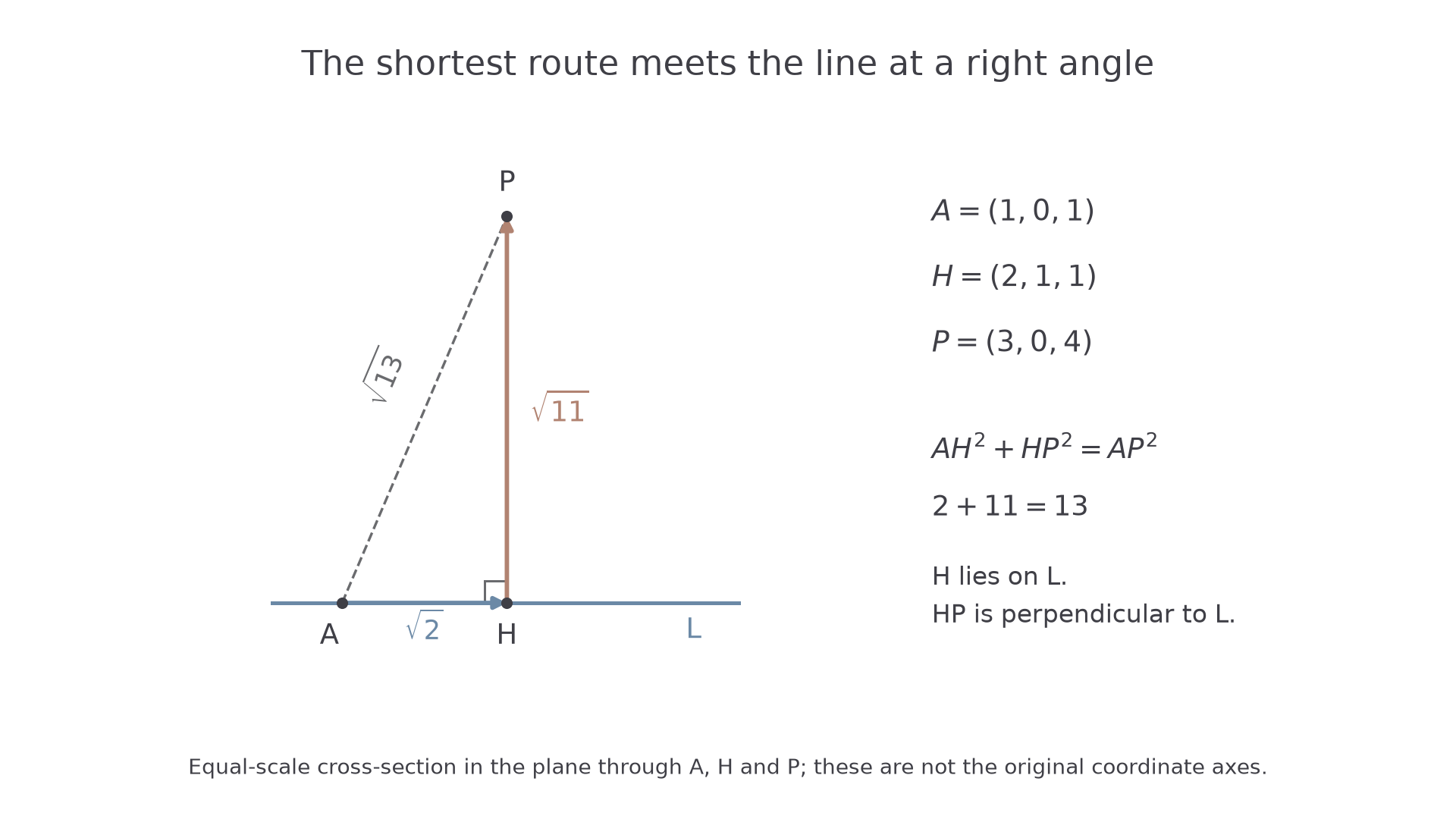
The diagram also explains the area formula: the same height is perpendicular to every base segment along the line. Reading off instead would use the hypotenuse and overestimate the distance.
Watch out
Wrong: . This is the distance to the chosen point , not necessarily to the line. It gives the shortest distance only when that displacement is perpendicular to the line.
Find both the foot and distance for a fresh line.
Point-plane distance along a normal
To reach a plane by the shortest route, move along its normal. Movement within the plane can only make a joining segment longer.
For example, the distance from to is not the equation's residual . That number uses the normal , whose length is . Dividing by the normal length converts the residual into a distance.
For , with , choose any point in the plane. The scalar projection of onto the normal direction is
It is signed, indicating which side of the plane contains . Its absolute value is the distance. To find the foot, subtract the vector projection onto the normal:
This point lies in the plane because taking its dot product with gives ; its displacement from is a normal multiple. These two checks establish that it is the perpendicular foot.
Point-plane distance
For a plane , where , and a point ,
Not in the formula booklet: learn it through the normal projection.
If the plane is given as , the numerator is . Keep the equation's sign convention consistent. A point already in the plane gives distance zero.
Worked example 3: one side of a plane
Question. Find the distance from to , and find the perpendicular foot.
Plan. Use the normalised residual for the distance, then subtract the normal projection for the foot.
Answer. Distance ; foot .
Check. The foot satisfies . Also , so it is normal to the plane and has length .
Reflect the point through , which lies in the plane. This changes to , reversing the residual but preserving the distance.
Worked example 4: the other side of the same plane
Question. Find the distance from to , and find the perpendicular foot.
Plan. Keep the plane normal fixed and use the signed residual before taking the absolute value.
Answer. Distance ; foot .
Check. The foot satisfies . It is the reflection of the previous foot through , so the two perpendicular segments have equal lengths, as symmetry predicts.
Multiplying the entire plane equation by any nonzero constant changes both numerator and denominator by the same absolute factor, so it cannot change the distance.
Watch out
Wrong: . A signed projection can be negative; a distance cannot. Take the absolute value of the residual and divide by the normal's length, not its squared length.
Use the formula with a new plane and a new point.
Distances between skew or parallel lines
For two skew lines, the shortest joining segment must be perpendicular to both directions. For two parallel lines, a joining segment perpendicular to their shared direction gives the shortest route.
Continue this lesson.
You’re previewing NovaLearn without an account. Create a free account to read the rest.
Create free account