MC1–MC3 - Work and mechanical energy
A force can act on a moving object without doing any work on it. MC1 explains how the direction of a force determines its work; MC2 and MC3 connect that work to gravitational potential energy and kinetic energy. You will use an energy balance to find speeds while keeping resistance and modelling assumptions visible.
Force-displacement angle
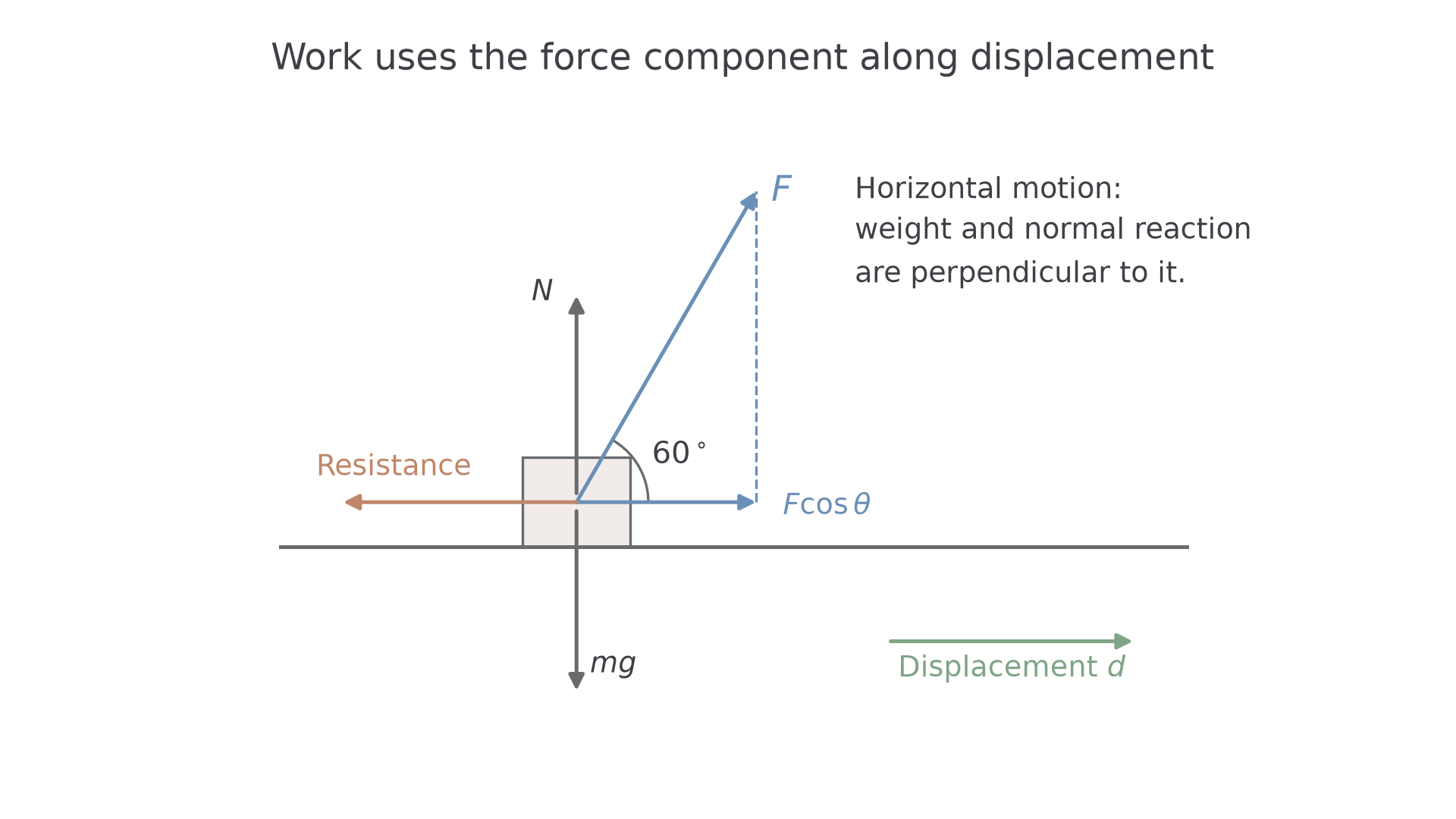
A box starts from rest and is pulled horizontally by a force at above the horizontal. A constant resistance opposes its motion. What speed does it reach? Assume the box stays on the floor. First, decide how much work each force does.
A force pulling directly along a displacement does of work. An equally large force pointing backwards does . A perpendicular force does zero work: it has no component along that displacement.
Work done by a force
Work is the energy transferred by a force through a displacement. Work done on the object is positive when the force has a component along its displacement and negative when the component opposes it. Its SI unit is the joule: .
Resolve a constant force along a straight displacement. The useful component is , rather than the whole magnitude .
Work by a constant force
For a constant force of magnitude , a straight displacement of magnitude , and angle between the force and displacement,
In particular, gives , gives , and gives .
Not in the formula booklet: learn this result.
The angle belongs between the force and displacement, not automatically between the force and the horizontal.
Keep units consistent: mass in kilograms (), distance in metres () and force in newtons (). Convert before using these formulae. Work has units , written as joules; a moment also uses newton metres but is a different physical quantity.
[DIAGRAM: asset_name: Resolving a pulling force along displacement; asset_slug: aqa7367-work-angle; caption: Only the component of the pull along the horizontal displacement does work; description: A box on a horizontal floor with a blue force arrow at 60 degrees above the rightward direction. A horizontal blue component is labelled F cos theta, with a dashed vertical construction line to the force arrow tip. A separate rightward displacement arrow is labelled d. A leftward clay arrow from the box is labelled resistance. Weight and normal reaction are vertical and perpendicular to the displacement.]
Worked example 1: a forward component
Question. A constant force of acts at to a straight displacement. Find its work.
Plan. Multiply the component along the displacement by the displacement.
Answer. , approximately .
Check. The component is less than , so the work is positive and less than .
Keep the magnitudes fixed and reverse the force. The angle changes to ; the component changes sign.
Worked example 2: the reversed force
Question. A constant force of acts at to a straight displacement. Find its work.
Plan. Use the signed component in the same formula.
Answer. .
Check. The component along the displacement is now . Reversing the force reverses the work without changing its magnitude.
Do not attach a minus sign to all forces described as “resistance” before checking the displacement: the minus sign comes from their opposing that particular motion.
Watch out
Wrong: when is the angle between force and displacement. Project along the displacement: . Perpendicular force is not zero force; it does zero work on that displacement.
Use the same method with a new force and angle.
Gravitational and kinetic energies
A moving particle at has of kinetic energy. If it rises, some of that energy can become gravitational potential energy. The rise that matters is vertical height, even when the path is sloping or curved.
Kinetic and gravitational potential energy
Kinetic energy, , is energy associated with motion. Gravitational potential energy, , describes energy associated with height in the uniform-gravity model. Choose a reference level for ; only changes in affect an energy balance.
Weight does work times the vertical distance fallen. Thus a rise gives gravitational work : the gain in gravitational potential energy is the negative of gravity's work.
Mechanical energies
For a particle of mass and speed ,
With height measured upwards from the chosen reference, . Use constant for the small-height, uniform-gravity model. If gravity is the only force doing work, is conserved.
These energy formulae are not in the formula booklet: learn them.
Kinetic energy is nonnegative and uses speed squared. Potential energy may be negative if the point is below your chosen zero. Changing the zero adds the same constant to both endpoint energies and leaves every prediction unchanged.
Worked example 3: rising three metres
Question. A particle of mass has initial speed . It rises , with only gravity doing work. Find its speed there. Use .
Plan. Subtract the gain in gravitational energy from the initial kinetic energy.
Answer. to three significant figures.
Check. , and rising has reduced the speed.
Change only the height reached. Near the highest attainable level, the remaining kinetic energy is much smaller.
Worked example 4: rising five metres
Question. The same particle starts at and rises , with only gravity doing work. Find its speed there. Use .
Plan. Use the same energy balance with the new vertical height.
Answer. , approximately .
Check. Independently, for a vertical projection. An attempted rise of would give negative , indicating an unreachable height under these assumptions.
Continue this lesson.
You’re previewing NovaLearn without an account. Create a free account to read the rest.
Create free account