MB1, MB2 - Oblique impacts
An angled collision is easier to understand when velocity is split along and across the contact surface. You will resolve those components, apply smooth-impact laws to walls and pairs of bodies, and reconstruct the outgoing velocity, speed and direction.
Normal and tangential components
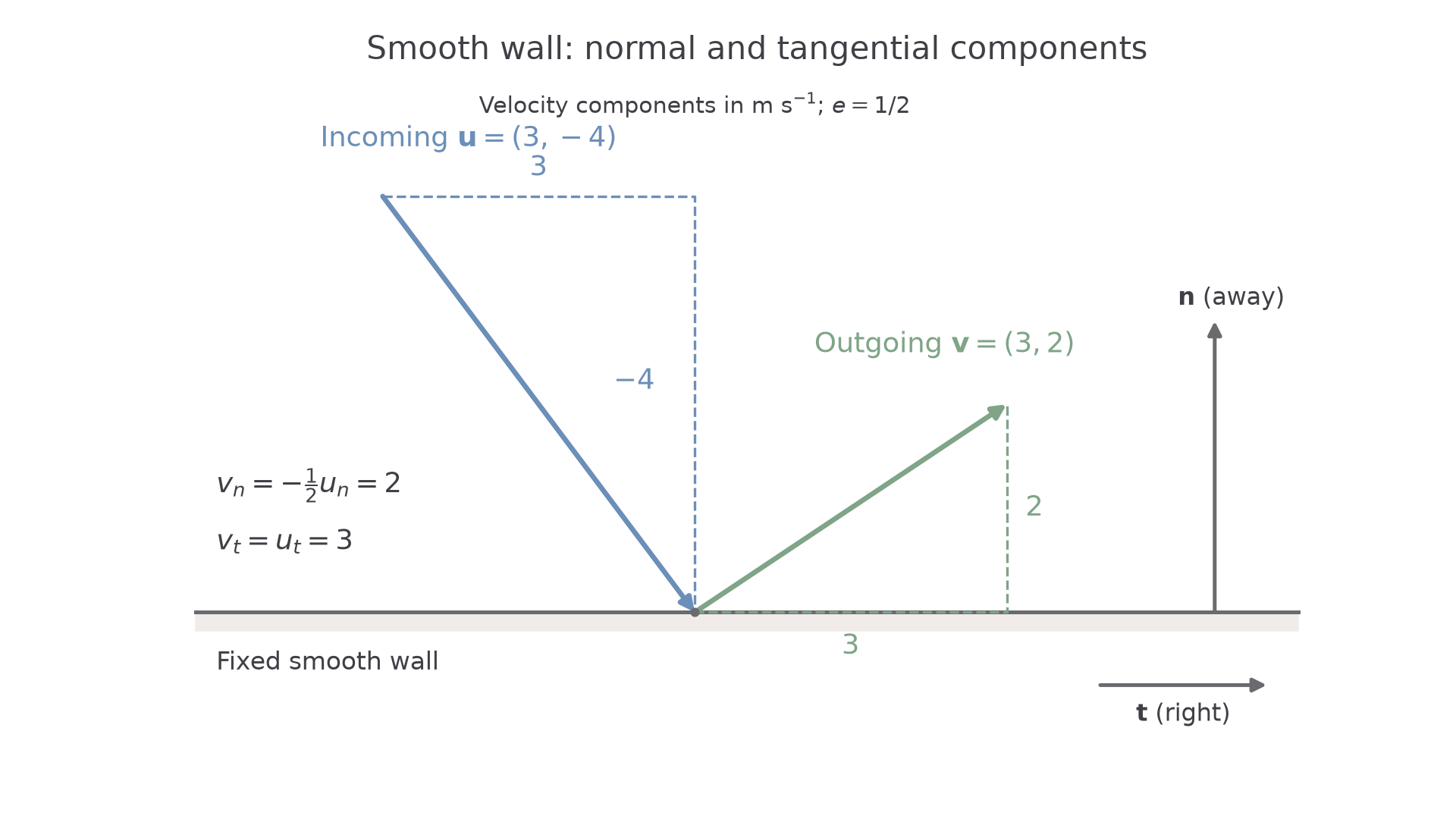
A ball reaches a smooth horizontal wall with velocity . If restitution is , is its outgoing speed simply half its incoming speed? The wall changes the velocity perpendicular to itself; the component along it behaves differently.
The normal direction is perpendicular to the surface at contact. The tangential direction is parallel to it. For smooth spheres, the normal is the line joining their centres at contact, or line of impact. Choose perpendicular unit vectors and write
These are signed components: and . This uses the A-level vector rule for projection onto a unit vector. For a horizontal wall with accessible region above it, take rightwards and away from the wall. An incoming velocity then has .
[DIAGRAM: asset_name: A smooth wall changes only the normal component; asset_slug: aqa7367-oblique-components; caption: Incoming velocity (3, minus 4) becomes (3, 2) when a horizontal smooth wall has restitution one half; description: A horizontal wall has a normal arrow vertically upwards and tangent arrow to the right. A blue incoming velocity arrow runs down and right to the contact point with components right 3 and down 4. A sage outgoing arrow runs up and right from contact with components right 3 and up 2. A note states tangential component unchanged and normal component reverses and is multiplied by one half. The arrows and component triangles use equal scales.]
When an angle is measured to the wall, the tangential magnitude is and the normal magnitude is . If the angle is to the normal, those sine and cosine roles exchange. Add signs from the actual directions after finding magnitudes.
Worked example 1: an angle to the wall
Question. A ball approaches a horizontal wall from above, moving down and right at , at to the wall. Find its components, taking right and upwards.
Plan. The tangential component is adjacent to the given angle; the normal component points downwards.
Answer. .
Check. ; .
Keep the speed and numerical angle, but change the reference from the wall to the normal. That changes which component is adjacent to the angle.
Worked example 2: an angle to the normal
Question. A ball approaches the same wall down and right at , now at to the normal line. Find the same components.
Plan. The normal magnitude is now adjacent to the angle, with a negative sign for approach.
Answer. .
Check. Its magnitude remains , but , confirming to the normal. It is to the wall.
Resolve relative to the contact geometry even when the original velocity is given using different horizontal and vertical axes. The impact laws belong to normal and tangential components.
Watch out
Wrong: “The normal component is always .” That is true only when is measured to the normal. Mark the stated angle and its reference line before resolving, then give each component its sign.
Try the normal-angle convention with a new speed.
Smooth walls and two-body impacts
A smooth contact exerts no tangential impulse. The component of each body's momentum parallel to the contact surface is therefore unchanged during the impact, provided other impulses in that direction are negligible. With constant mass, each body's tangential velocity component stays unchanged individually.
For a fixed wall, restitution acts on the normal component and reverses it. With away from the wall, gives , while . The opening velocity therefore becomes when . The entire velocity vector is not multiplied by .
For two smooth bodies, use a common normal from towards at contact. Their normal velocities obey the same two equations as a direct collision. Their tangential velocities remain their respective incoming values.
Smooth oblique impact laws
For two smooth constant-mass bodies with negligible external impulse, with ,
For a fixed smooth wall, replace the first two equations by , keeping . These instantaneous laws assume no other appreciable impulse and no tangential contact impulse.
Not in the formula booklet: learn them.
For two bodies, normal momentum is conserved for the pair; normal momentum need not stay constant for either body separately. The unchanged tangential components follow from smoothness, a stronger and more specific fact than total momentum conservation alone.
Worked example 3: two smooth bodies
Question. At impact, points from to , with common perpendicular unit vector . Masses are and ; incoming velocities are and , in . Find their outgoing velocities when , assuming smooth contact and negligible external impulse.
Plan. Solve the normal collision and preserve each body's own tangential component.
Answer. , .
Check. Total final momentum is , equal to the initial total. Normal separation speed is ; both tangential components retain their own initial values.
Continue this lesson.
You’re previewing NovaLearn without an account. Create a free account to read the rest.
Create free account