D14 - Ranges of rational functions
The range is the set of outputs a function actually attains. Learn to turn an output question into an equation in the input, use quadratic theory to decide which outputs are possible, and locate stationary points without calculus.
Turning outputs into an equation in the input
Can ever reach , and what is its largest output? A graph suggests a peak, but an equation can locate it exactly without differentiating.
The notation describes the mapping from an allowed input to its output. Its domain is the set of allowed inputs; its range is the set of attained outputs. For a proposed output , ask whether has at least one real solution in the original domain.
For example, becomes . If , then , so a real input exists exactly when . At , the original equation would give , so that endpoint is excluded.
The output equation
For , where the original denominator is nonzero, rearrange to
Write these coefficients as . The question is whether this equation has an admissible real input . This rearrangement and the discriminant method are not supplied in the formula booklet: learn them.
Use the rearrangement before introducing an inverse function. A many-to-one function may have two possible inputs for an output and no inverse function on its whole domain. The notation means an inverse on a suitable one-to-one domain; it never means the reciprocal .
If acts on an output, the composite notation means apply first. For , this gives , doubling the outputs and hence doubling the range values. It does not mean multiply two functions point by point.
Worked example 1: an attained lower endpoint
Question. Find the range of , for real .
Plan. Solve for , require a nonnegative result, then check the exceptional output .
The quotient is nonnegative for . At , the equation gives , which is impossible. Every value in the interval gives a real , and is always positive.
Answer. The range is .
Check. , so the lower endpoint is attained. Also , with values approaching as grows.
Change only the numerator's constant, from to . The upper limiting value stays the same, but the minimum moves.
Worked example 2: changing the minimum
Question. Find the range of , for real .
Plan. Use the same output equation, then check inclusion of each endpoint.
Nonnegativity gives . The value would require , so is impossible.
Answer. The range is .
Check. , and . The latter expression confirms the strict upper bound and the minimum at zero.
The reasoning needs both directions: values outside the stated interval are impossible, and every value inside has an allowed input.
Watch out
Wrong: include the horizontal asymptote automatically as a range endpoint. An approached value need not be attained. Here gives a contradiction in the output equation.
Use another numerator constant and denominator constant.
Discriminants and exceptional outputs
When the input equation includes both and , use its discriminant. Its coefficients depend on the proposed output ; the discriminant therefore becomes an inequality in .
For with , real roots exist exactly when . A double root is allowed. However, when , the equation is no longer quadratic and must be checked separately.
| Coefficients at a proposed output | Input equation | Decision before domain checks |
|---|---|---|
| Quadratic | Require | |
| Linear | One candidate | |
| Contradiction | No candidate | |
| Identity | Every original-domain input works |
After each case, at least one candidate must satisfy the original denominator restriction. For example, the constant function gives an identity at , not an empty range.
Worked example 3: a bounded range
Question. Find the range of without calculus.
Plan. Rearrange to a quadratic in , use its discriminant for , and handle separately.
At , the equation reduces to , so works. The original denominator is positive for every real input, so no real solution is lost.
Answer. The range is . In particular, the function cannot reach .
Check. implies , hence . Similarly, implies . Equality occurs at and , respectively.
Change only the sign of the denominator's constant. The denominator can now vanish, but the discriminant becomes positive for every proposed nonzero output.
Worked example 4: an unbounded range
Question. Find the range of , with its natural real domain.
Plan. Record , find the discriminant and test the exceptional linear case.
Substituting into this input equation gives , and gives , so its roots never equal the forbidden inputs. At , the linear equation gives the allowed input .
Answer. The range is .
Check. On , the continuous function has values tending to near and near . It therefore attains every real output on that interval alone.
Cancellation needs an extra check. For
the output is impossible, and occurs only at the excluded input . Every other output gives the allowed input . Thus the range is . Cross-multiplication alone would retain the forbidden root .
Watch out
Wrong: “, therefore the output is in the range.” First handle a zero quadratic coefficient, then reject forbidden denominator roots. A real algebraic solution need not be an allowed input.
Check both the discriminant and the exceptional output.
Stationary points without calculus
At a smooth local maximum or minimum, a horizontal line moves from two nearby intersections to one repeated intersection before missing the curve. This connects a stationary point to a repeated root of the input quadratic.
[DIAGRAM: asset_name: Horizontal levels merge at a maximum; asset_slug: aqa7367-rational-levels; caption: For x divided by x squared plus one, two positive intersections merge at the maximum point one, one half; description: Three coordinate panels show the positive branch of y equals x divided by (x squared plus one) with horizontal levels y equals two fifths, one half and three fifths. The first level meets at x equals one half and two, the second touches at x equals one, and the third has no real intersection. The maximum is labelled (one, one half).]
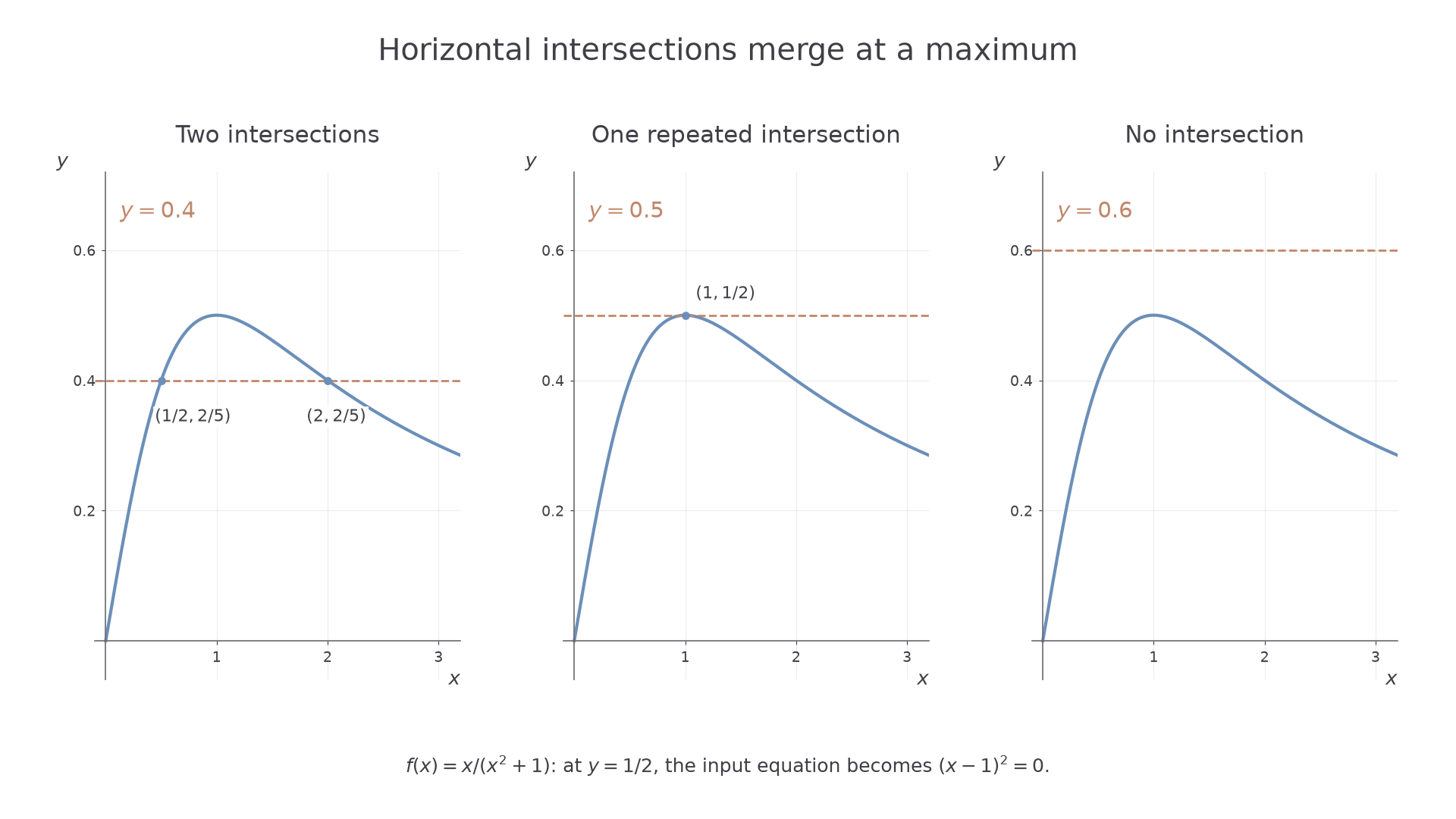
Set the discriminant equal to zero to obtain candidate output levels , then solve the repeated-root equation for . Confirm that is in the original domain and that the attainable nearby levels place it at a maximum or minimum. A hole is not a stationary point.
Worked example 5: two stationary points from repeated roots
Question. Find and classify the stationary points of , without calculus.
Plan. Use the boundary levels of its range, then solve the input equation at each level.
Both inputs are permitted. No output exceeds , and no output is below .
Answer. Maximum ; minimum .
Check. Direct substitution gives these outputs. The identities and show that each bound is reached only at its stated input.
Double only the numerator. The graph doubles its vertical distances, so the stationary inputs should stay fixed while the stationary outputs double.
Worked example 6: changing the vertical scale
Question. Find and classify the stationary points of , without calculus.
Plan. Form the new input quadratic and locate its repeated roots.
The discriminant inequality gives range ; at , the linear equation gives .
Answer. Maximum ; minimum .
Check. and , with equality only at the stated points.
The repeated-root check must retain the domain. For the cancelled function in the previous part, the unreduced input quadratic has discriminant . At it becomes , but is excluded. It identifies a hole, not a stationary point.
If a rational function simplifies to a constant on its domain, its graph is horizontal at every defined point. Use that graph directly: its points have horizontal tangents rather than isolated extrema to locate by a repeated-root search. Any holes remain excluded.
For notation, or denotes a small change in input; it is different from the discriminant . Around a maximum, small nonzero changes give lower outputs. The inequalities above prove this directly, without finding a derivative.
Watch out
Wrong: report only the boundary output as a stationary point. A point needs both coordinates and a valid input. Substitute the output into the quadratic, solve its repeated root and check the original denominator.
AQA's instruction “without using calculus” needs the quadratic-theory reasoning. Show it so the method is visible.
Quick Recap
- An output belongs to the range only if its input equation has an allowed real solution.
- Use the discriminant for a genuine quadratic; check zero leading coefficients separately.
- Original denominator restrictions survive rearrangement and cancellation.
- A stationary-point candidate needs a repeated input root in the domain and a justified extremal output level.
The opening function cannot reach . Its largest output is , attained at , so its maximum point is .