B1, B3 - Quadratics with non-real roots
When a quadratic has no real roots, where do its two solutions go? B1 extends familiar quadratic methods to complex answers; B3 explains why non-real solutions come in conjugate pairs when the coefficients are real. You will solve quadratics by completing the square and using the quadratic formula, while keeping the repeated-root and real-root cases.
Completing the square and the quadratic formula
How can have solutions when its graph has no real intercepts? Completing the square gives . Both and square to , so there are two possibilities for .
For any positive real , the solutions of are . Keep both signs: the equation asks for every value whose square works. This uses the ordinary positive square root of the positive real number ; it does not rely on a rule for multiplying arbitrary complex square roots.
Worked example 1: completing the square
Question. Solve .
Plan. Complete the square and express the negative square using .
Answer. or .
Check. For either sign, substituting into the completed-square expression gives .
The quadratic formula comes from completing the square in . Multiplying by and rearranging gives . This reasoning still works when the right side is negative.
Quadratic formula
For real , with , the equation has solutions
If , write the square-root term as .
Not in the formula booklet: learn it.
Now multiply every coefficient of the first equation by . Its roots must stay the same, which gives an independent way to check the denominator in the formula.
Worked example 2: using the formula
Question. Solve , using the quadratic formula.
Plan. Identify all three coefficients, calculate the discriminant, and divide the entire numerator by .
Answer. .
Check. Dividing the equation by recovers Worked example 1. Directly, for both stated values.
For a quadratic with non-unit leading coefficient, either divide first and complete the square or use the formula directly. Both routes must preserve every coefficient.
Watch out
Wrong: . The denominator divides the entire numerator. Correct: .
Use the formula, or complete the square after simplifying, for this new equation.
Negative discriminants and conjugate roots
The roots and share their real part and have opposite imaginary parts. This is not a numerical coincidence: it follows from the real coefficients in the quadratic formula.
Discriminant
For , the discriminant is the real number , where are real and .
When , put . The two roots are
Both coefficients in each expression are real, so . They are distinct and non-real because . Even when , the signs simply swap which member of the pair is written first.
You can see why a pair produces real coefficients by multiplying its factors. If the roots are and , with real , then
The imaginary coefficients cancel. This is the reverse connection: a non-real conjugate pair builds a quadratic with real coefficients and negative discriminant .
Key idea
A quadratic with real coefficients has two distinct non-real conjugate roots exactly when its discriminant is negative. The real-coefficient condition belongs to the statement.
For example, has discriminant , so it has non-real roots precisely when . At , the discriminant is zero, which is a different case.
Repeated roots and real roots
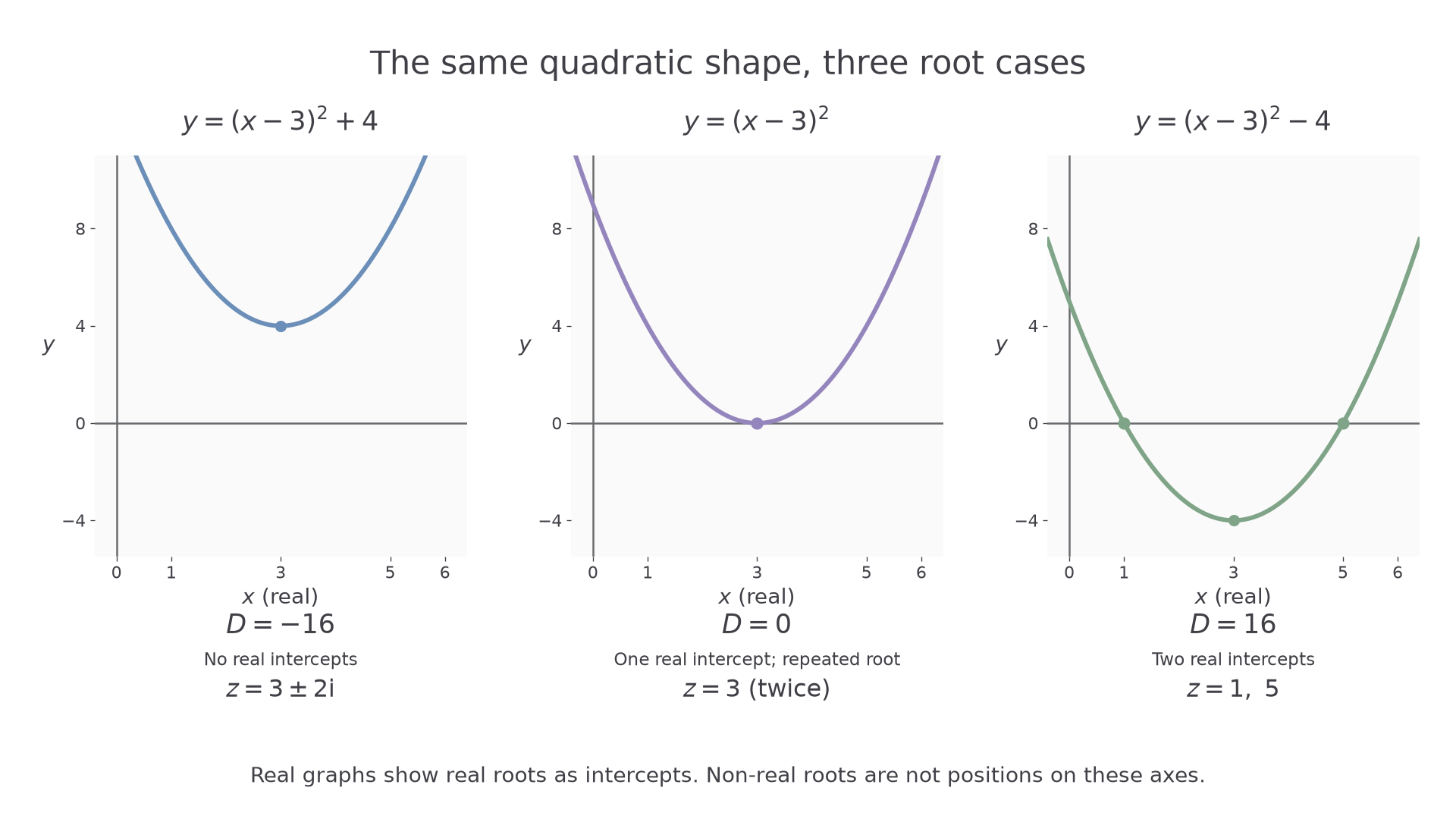
Extending to complex numbers keeps all the real solutions you already know. A zero discriminant makes the two formula values coincide; a positive discriminant makes both values real. The following graphs use a real horizontal coordinate : they show the real-root cases, rather than plotting complex roots.
[DIAGRAM: asset_name: Three quadratic root cases; asset_slug: aqa7367-quadratic-root-cases; caption: Changing the constant moves the parabola between no real roots, a repeated real root and two distinct real roots; description: Three side-by-side real coordinate graphs of y equals (x minus 3) squared plus 4, y equals (x minus 3) squared, and y equals (x minus 3) squared minus 4. The first curve stays above the x axis, the second touches it at x equals 3, and the third crosses at x equals 1 and x equals 5. Each panel states the discriminant and the corresponding complex or real roots.]
Worked example 3: the repeated-root boundary
Question. Solve .
Plan. Factor the perfect square and connect it to the zero discriminant.
Answer. , a repeated root. It is one distinct value, occurring twice as a factor.
Check. Substitution gives . Also, , so both signs in the formula give .
Lower just the constant from to . The vertex moves down, and the repeated root separates into two real roots.
Worked example 4: two distinct real roots
Question. Solve .
Plan. Complete the square, then take both real square-root values.
Answer. or .
Check. . Each stated value makes one factor zero. The discriminant is , consistent with two real roots.
A positive discriminant need not be a perfect square: gives , which are still real. The full classification is therefore:
| Discriminant | Roots for real coefficients |
|---|---|
| Two distinct non-real conjugate roots | |
| One real value, a repeated root | |
| Two distinct real roots |
The leading coefficient must be nonzero throughout. If , the equation is no longer quadratic and the quadratic formula's denominator would be zero.
Watch out
Wrong: “a quadratic with no real roots has no solutions”. Correct: it has no solutions in , but it has two non-real solutions in . A repeated real root is also a valid complex root because real numbers belong to .
Keep both signs when they give different values in this fresh calculation.
Quick Recap
- Complete the square or use the quadratic formula with .
- A negative real square becomes a pair involving .
- For real coefficients, gives distinct non-real conjugate roots; gives a repeated real root; gives distinct real roots.
- Substitute both roots back or verify the factorisation.
The graph can miss the real axis while the equation still has two solutions: has roots .