F2, F3 - Equations of planes
Why does a line need one parameter, while a plane needs two? F2 describes planes using two independent directions or one Cartesian equation. F3 connects those descriptions through a normal vector and the scalar product, so you can convert forms and test whether a point belongs.
Vector plane from two directions
Why does a line need one parameter, while a plane needs two? Imagine starting at . Moving any multiple of traces one line. Allow a second movement in the nonparallel direction , with its own multiplier, and you can reach a whole flat plane.
The two multipliers must be independent. Requiring them to be equal would give , which usually traces just one line in the plane.
Vector equation of a plane
The plane through , parallel to nonzero, nonparallel vectors , is
In the formula booklet. The two directions must be nonparallel: neither may be a scalar multiple of the other.
For three non-collinear points , use and as the directions. Three collinear points do not determine a unique plane: many planes contain their line.
[DIAGRAM: asset_name: Two directions span a plane; asset_slug: aqa7367-plane-directions; caption: Independent movements in two nonparallel directions reach points across a plane; description: A pale blue parallelogram represents part of an infinite plane in perspective. From A, one blue arrow points to B along u and one clay arrow points to C along v. A route from A along u and then two copies of v ends at P, showing P equals a plus u plus two v. Dashed continuations show that the plane is not restricted to the pictured parallelogram. The two real parameters vary independently.]
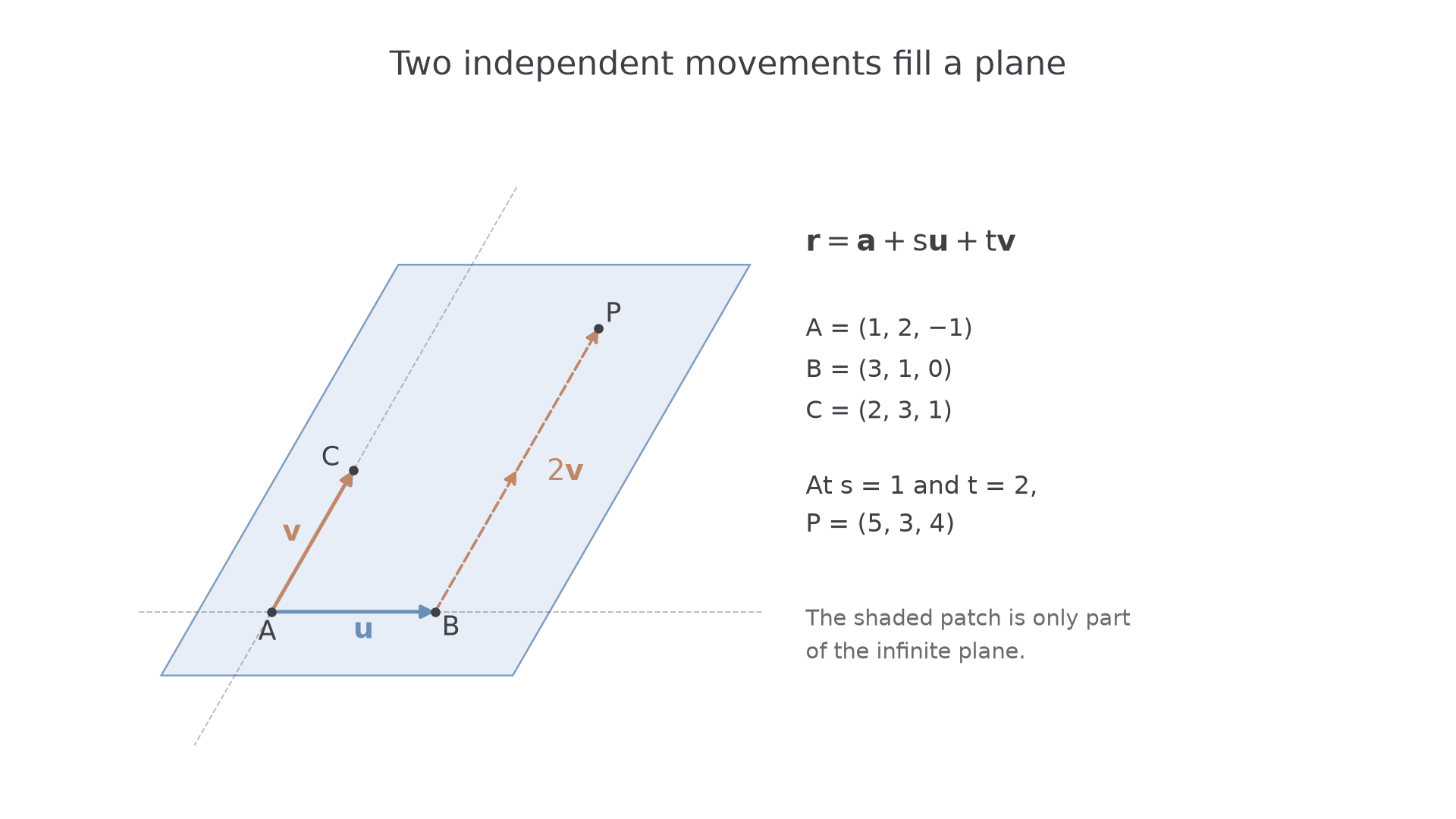
The vector equation describes the infinite plane, not only the bounded patch in the picture.
Worked example 1: a point and two directions
Question. Give a vector equation of the plane through , parallel to and . Find the point given by .
Plan. Combine the starting position with independent multiples of the two directions.
The directions are not proportional: the first components would need multiplier , while the second would need . At ,
Answer. The displayed plane equation, with independent real ; the point is .
Check. The displacement from to that point is . Removing one leaves , confirming the two movements.
Keep the plane unchanged, but now supply points instead of direction vectors. The new step is to obtain the directions by subtraction.
Worked example 2: three points determine the same plane
Question. Find a vector equation of the plane through , and .
Plan. Form two displacements from and use them as the plane directions.
They are the nonparallel directions from the first example.
Answer. , .
Check. produce respectively. Thus the equation contains all three points and has two nonparallel directions.
Changing either direction's nonzero scale, or choosing another point in the plane as the starting point, can give a different equation for the same plane. What matters is the set of points reached.
Cartesian plane via normal
A plane can also be fixed by one point and the direction perpendicular to it. A normal vector is a nonzero vector perpendicular to every direction lying in the plane. It points away from the plane rather than along it.
Let be the position of a known point in the plane. For any other point in it, the displacement lies along the plane, so its dot product with the normal is zero. Conversely, those perpendicular displacements fill the plane through .
Normal and Cartesian equations of a plane
For a nonzero normal ,
The last expression is the Cartesian equation. Not in the formula booklet: learn it.
Unlike the line's three equal ratios, a Cartesian plane equation is one linear relation between . The coefficients of the coordinates give a normal. Multiplying the entire equation by a nonzero constant preserves the plane and rescales the normal.
Continue this lesson.
You’re previewing NovaLearn without an account. Create a free account to read the rest.
Create free account