MD5 - Conical pendulums
Model horizontal circular motion supported by one or two strings. Separate vertical equilibrium from the horizontal inward resultant, use the geometry to find the circle's radius, and decide whether calculated tensions describe strings that can actually stay taut.
One and two strings
Two strings join a rotating particle to fixed points above and below it. Can spinning too slowly make the lower string go slack? A string can pull along its own length, but cannot push. That simple restriction will decide which algebraic answers describe possible motion.
Picture a small particle moving steadily around a horizontal circle beneath a fixed point. A taut string joining them sweeps out a cone. The particle stays at the same height, so its vertical acceleration is zero, even though its horizontal velocity is continually turning.
Conical pendulum
A conical pendulum has a particle moving uniformly in a horizontal circle while constrained by one or more strings attached to fixed points on its vertical axis. Model the strings as light and inextensible and the particle as small; neglect air resistance. A taut string exerts tension towards its attachment point. A slack string exerts no tension.
With one string of length , making angle with the downward vertical, the circle's radius is . Its centre is the point on the vertical axis at the particle's height, not the suspension point. The vertical distance below the suspension point is . For a genuine one-string horizontal circle under gravity, . The endpoint has zero radius and is not a nondegenerate circular path; a horizontal string alone cannot balance the weight.
[DIAGRAM: asset_name: Forces in one-string and two-string conical systems; asset_slug: aqa7367-conical-forces; caption: Vertical components balance while horizontal components provide the inward resultant; description: A one-string conical pendulum beside a two-string system with equal string lengths and fixed attachments A and B on a vertical axis. In the two-string system the particle is midway in height between A and B, each a distance h above or below the plane of its circular path. Both tensions point towards their respective attachments. Upper tension has an upward component; lower tension has a downward component. Weight points down. The horizontal circle radius R is marked separately from either string length.]
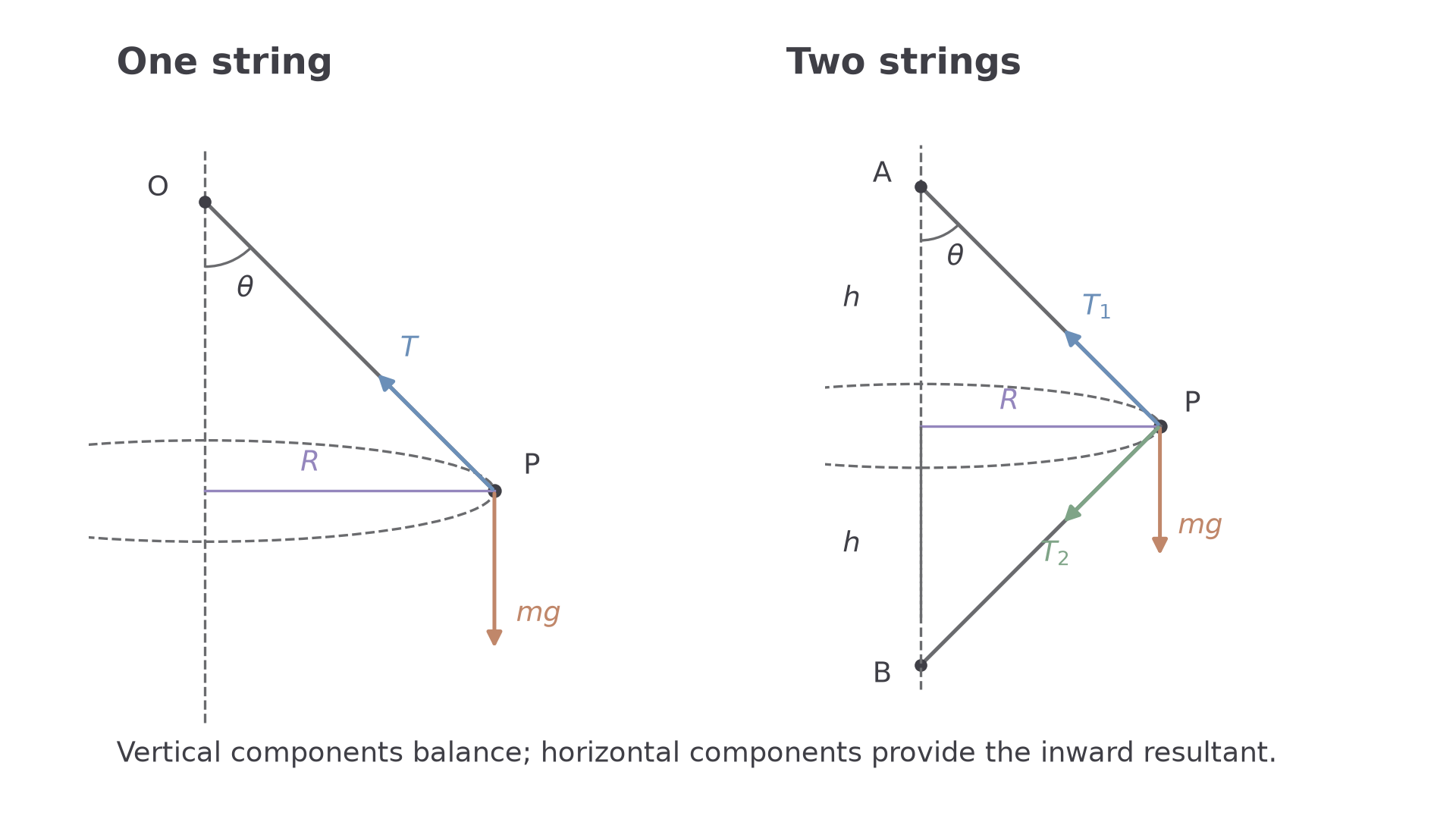
In a two-string system with the particle between the attachment heights, upper tension pulls upwards and inwards, while lower tension pulls downwards and inwards. The vertical components oppose each other, but the horizontal inward components add. The lower string does not help to support the weight; it makes the upper string work harder.
For equal lengths and attachments separated vertically by , both strings taut place the particle in the horizontal plane midway between them. Right-angled triangles give , requiring . If either string goes slack, that two-taut-string geometry can no longer be assumed.
Key idea
Zero vertical acceleration means vertical forces balance. It does not mean all forces balance: the horizontal resultant must point towards the axis. Every tension must be nonnegative, with zero marking the boundary of tautness.
Vertical equilibrium and horizontal radial force
Draw the actual forces before using a circular-motion formula. With one string, the forces are tension along the string and weight downwards. There is no extra “centripetal force”. For angle measured from the vertical, the adjacent component is vertical and the opposite component is horizontal.
One-string conical pendulum
For a steady horizontal circle with , , , and no forces other than tension and weight,
Dividing the equations gives . Cancelling gives . These conical-pendulum equations are not in the formula booklet: derive them by resolving.
Mass cancels from the speed and angular-speed relationships. A heavier particle at the same angle needs a larger tension, but not a larger angular speed. For a given string length, the nondegenerate one-string model requires , since . Equality is the zero-radius limiting configuration.
Use in the following examples.
Worked example 1: resolving a one-string system
Question. A particle forms a conical pendulum with string length and , where is measured from the downward vertical. Find the tension and speed.
Plan. Find the horizontal radius from the triangle, use vertical equilibrium for tension, then resolve horizontally for speed.
Answer. Tension and speed , to three significant figures.
Check. Independently, . The tension exceeds the weight, because only part of it acts upwards.
Keep the mass and string length the same, but reduce the angle so that . Both the horizontal radius and the required tension change.
Worked example 2: changing the angle
Question. The same particle and string form a steady conical pendulum with . Find the tension and speed.
Plan. Recalculate the radius as well as the force components; the string length is not the radius.
Answer. Tension and speed .
Check. , while . The smaller angle gives both a smaller tension and a smaller speed.
For two taut strings, use the same two directions. If upper and lower strings make acute angles and with their respective vertical directions, the equations are
Continue this lesson.
You’re previewing NovaLearn without an account. Create a free account to read the rest.
Create free account