ME1 - Centres of mass of particles
Locate the single point that represents the mass distribution of several particles. You will use weighted coordinates in one, two and three dimensions, recognise genuine mass symmetry and work backwards to find an unknown mass.
Weighted coordinates in one, two and three dimensions
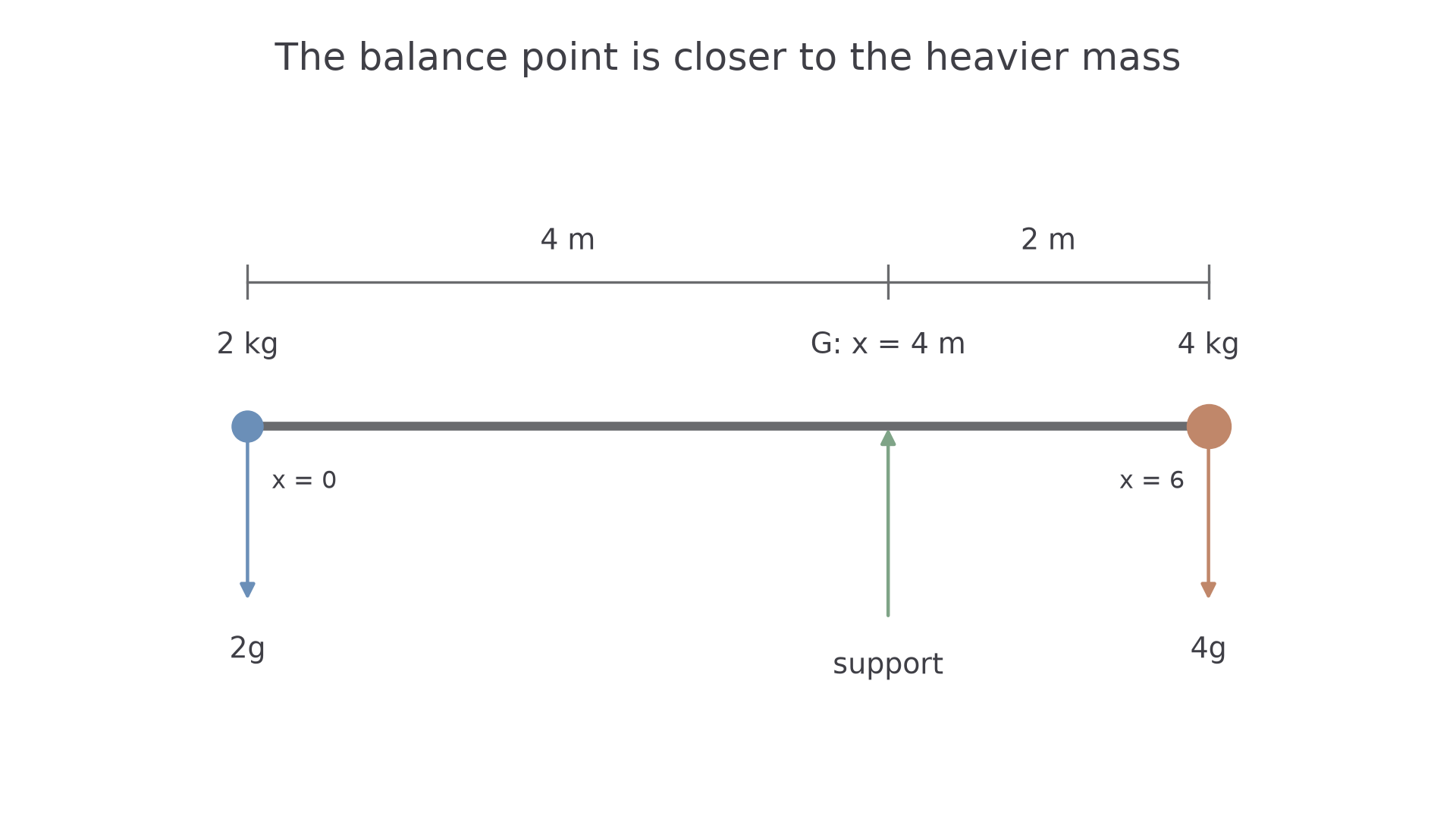
Where should you support a light 6-metre bar carrying 2 kg at one end and 4 kg at the other so that it balances? The midpoint is tempting, but the heavier load needs a shorter lever arm.
Let the support be metres from the 2 kg end. Equal clockwise and anticlockwise moments give , so . The common gravitational acceleration cancels; this is a mass-weighted average of the positions.
Centre of mass
The centre of mass, , is the point whose position represents the weighted mean position of the body's mass. In a uniform gravitational field, the resultant weight acts through . Mass is measured in kilograms; weight is a force measured in newtons.
For particles of positive masses at coordinates , replacing all their parallel weights by one total weight preserves moments if . The sum is a first moment of mass, with units mass times length. Repeat the weighted-coordinate argument in each coordinate direction to obtain the vector version.
Mass-weighted coordinates
For particles with total mass ,
Equivalently . Omit unused coordinates in one or two dimensions. Coordinates are signed distances from the same origin in consistent units.
Not in the formula booklet: learn it.
[DIAGRAM: asset_name: A mass-weighted balance point; asset_slug: aqa7367-particle-balance; caption: The heavier particle has the shorter lever arm; description: A light horizontal bar from x equals zero to x equals six metres carries a 2 kg particle at zero and a 4 kg particle at six. Its centre G is at four, with downward weights 2g and 4g and an upward support at G. Lever arms from G are four metres and two metres.]
Worked example 1: locating the balance point
Question. Particles of masses 2 kg and 4 kg are fixed at and metres on a light bar. Find .
Plan. Divide the sum of mass times coordinate by the total mass.
The larger mass has twice the weight, so contributes twice as much to the weighted sum.
Answer. is 4 m from the 2 kg end.
Check. About , the opposing moments are and , as required.
Now keep the masses and horizontal separation, but place the particles in space. Each coordinate uses the same mass weights; averaging coordinates is not a new three-dimensional method.
Worked example 2: the same weighting in space
Question. Masses 2 kg and 4 kg are at and , with coordinates in metres. Find .
Plan. Apply the weighted mean separately to all three coordinates.
The negative coordinate contributes a negative first moment, not a negative mass.
Answer. metres. The two-dimensional projection has centre .
Check. . Thus , the inverse ratio of the masses, independently confirming all coordinates.
A positive weighted mean lies between the smallest and largest values of each coordinate. For two particles, it lies on the segment joining them. It need not coincide with a particle or with material connecting them.
Watch out
Wrong: for unequal masses. Use ; the denominator is total mass, not number of particles.
Use the same coordinate-by-coordinate method with new positions.
Continue this lesson.
You’re previewing NovaLearn without an account. Create a free account to read the rest.
Create free account