B11 - Roots of unity in geometry
Roots of unity put equally spaced points on the unit circle. You will use them to calculate polygon lengths and angles, explain symmetric sums, and turn the geometry of a translated or rotated polygon into a complex equation. A single equation can then describe every vertex at once.
Roots of unity
Why do equally spaced unit arrows add to zero? The four arrows cancel in opposite pairs. Odd-sided regular polygons have no such opposite pairs, yet their vertex-vectors also balance. Roots of unity give a way to explain both cases.
nth roots of unity
The nth roots of unity are all solutions of , where is a positive integer. Writing
gives the complete list . Their formula is in the formula booklet.
Every root has modulus one. Consecutive powers of turn through , and returns to the starting point. Powers whose exponents differ by represent the same root. Multiplying two roots adds their exponents, so the result stays in the list after reducing the exponent by a multiple of . Their reciprocals also stay in the list: for , while .
Worked example 1: fourth roots of unity
Question. Find all fourth roots of unity in Cartesian form.
Plan. Take four unit-radius points separated by .
Answer. .
Check. , which gives exactly the same four roots.
Double only the root count, from four to eight. The spacing halves, adding a point midway between each previous pair.
Worked example 2: eighth roots of unity
Question. Find all eighth roots of unity in Cartesian form.
Plan. Use unit modulus and arguments for .
Answer. The eight listed values, all on the unit circle and spaced by .
Check. Factoring separates the four previous roots from four new ones. Each new value has fourth power , hence eighth power .
The roots of include the fourth roots, but not every eighth root first returns to one at the eighth power: for example already. Being an eighth root means its eighth power is one, not that eight is the smallest possible exponent.
Watch out
The list includes . Listing is also complete, but adding both and counts the same root twice.
Use a new number of roots and keep the answer in exponential form.
Polygon lengths, angles and symmetric sums
Complex subtraction measures a chord: the distance between points representing and is . For two roots of unity with smaller central angle , where , the two radii have length one.
Recall the triangle rules. For sides opposite angles , the sine rule is ; the cosine rule is ; and the area between sides is . These are not separately printed in the formula booklet: learn them.
In the triangle made by the two unit radii, the cosine rule gives
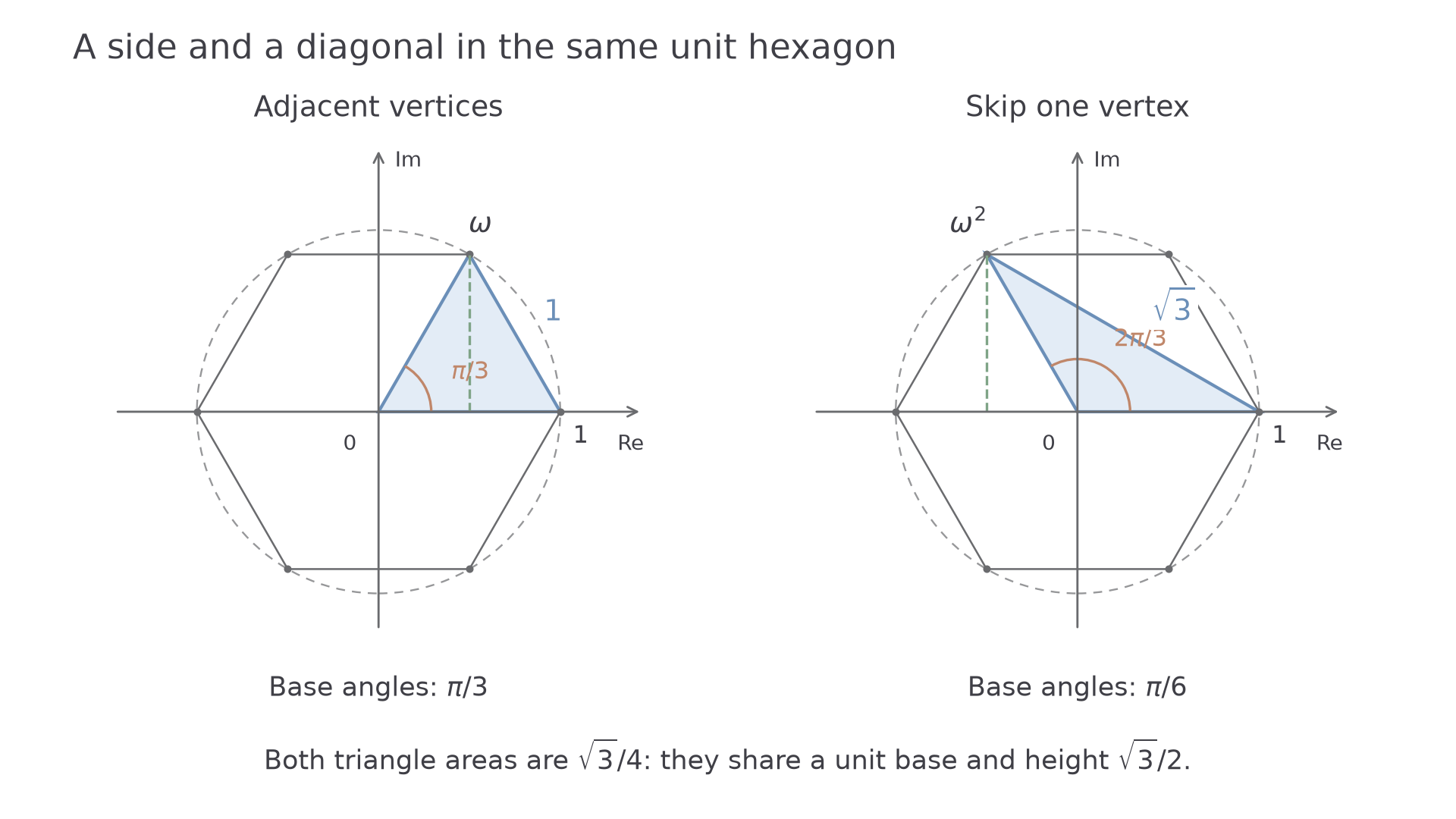
The length is positive, so it is . For , each base angle is ; the sine rule independently gives the same chord length because
The triangle area is . At , the chord is a diameter of length , and the triangle is degenerate with area zero. A regular -gon has central angle , side length , and interior angle , for . The chord formula is derived here, not separately supplied in the booklet.
Worked example 3: a side of a regular hexagon
Question. Let . Find , the base angles of triangle , and its area.
Plan. Use the central angle between the two unit radii.
Answer. Chord length , base angles , and area .
Check. has modulus . An equilateral triangle of side has height , giving area independently.
Keep the same hexagon and skip one vertex instead. Only the central angle changes, from to .
Worked example 4: a diagonal of the same hexagon
Question. Find , the base angles of triangle , and its area, for .
Plan. Apply the same triangle rules with central angle .
Answer. Chord length , base angles , and area .
Check. has squared modulus . The triangle has the same perpendicular height above the line through and ; here the altitude meets the extension of the base. The same area is therefore correct despite the longer chord.
[DIAGRAM: asset_name: A hexagon side and diagonal; asset_slug: aqa7367-unity-chords; caption: Doubling the central angle changes a unit hexagon side into a diagonal of length root three; description: Two equal-scale Argand panels show the six roots of unity on unit circles. The left highlights the triangle with vertices zero, 1 and omega at angle pi over three, with chord length 1 and base angles pi over three. The right highlights zero, 1 and omega squared at angle two pi over three, with chord length root three and base angles pi over six. Both show the altitude root three over two above the segment from zero to 1 and area root three over four.]
Symmetry also controls sums. For , put . Then
Geometrically, multiplying every vertex-vector by rotates and permutes the polygon, so . Since , this again forces . This proves the opening balance even for an odd-sided polygon.
More generally, for an integer , the sum is zero unless is a multiple of . If divides , every term is one and the sum is . This is the ratio-one exception again. For , the sum of the squares of the roots is therefore also zero. Expanding then shows that the sum of all pairwise products is zero. The product of all roots is
These symmetric sums and products depend on the whole root set, not its ordering. The geometric-sum formula is supplied; these consequences are derived rather than separately listed in the booklet.
Watch out
The sum of all nth roots of unity is zero for . A sum of their powers needs its ratio checked: for example, summing the nth powers gives , since every nth power is one.
Use a new polygon and a different chord.
Complex equations for regular polygons
A polygon need not be centred at zero. Subtract its centre first, use roots of unity for its directions, then add the centre back.
If a regular -gon has centre and a vertex , then the displacement from the centre to that vertex is . Its vertices, taken in one direction around the polygon, are
Raising the displacement to power removes , because . Therefore the vertices are exactly the solutions of
Conversely, the right side is nonzero, so this equation has distinct roots with the stated equal spacing. It gives every vertex and no extra point. This translated-polygon equation is derived here, not separately supplied in the formula booklet.
For , the sum of the vertices is . Their average is therefore the centre. This links the balancing arrows to a useful way of locating a polygon.
Worked example 5: recover a square from opposite vertices
Question. A square has opposite vertices represented by and . Find its centre, its other vertices, and a complex equation whose solutions are exactly its four vertices.
Plan. Find the diagonal midpoint, rotate a radius through to find the other pair, then raise each displacement to the fourth power.
Answer. Centre ; other vertices and ; equation .
Check. The four displacements are . Each fourth power is ; their sum is zero, so the four vertex values average to .
Keep the centre and radius fixed, but turn the first diagonal through . This changes the right side of the equation, even though the square’s size stays the same.
Worked example 6: the same square size at another orientation
Question. A square has opposite vertices
Find its centre, its other vertices, and a complex equation whose solutions are exactly its vertices.
Plan. Use the same midpoint and quarter-turn method, retaining the complex direction of the first radius.
Answer. The centre is . The other vertices are and . The equation is .
Check. All four points have real coordinate and imaginary coordinate , forming an axis-parallel square of side . Its half-diagonal is , and each displacement has fourth power .
[DIAGRAM: asset_name: Two translated squares and their equations; asset_slug: aqa7367-translated-squares; caption: Subtracting the centre reveals fourth roots, and orientation determines the right side of the equation; description: Two equal-scale Argand panels have the same centre c at coordinates 1 and 2 and radius 2. The left square has vertices 3 plus 2i, 1 plus 4i, minus 1 plus 2i and 1, with equation (z minus c) to the fourth equals 16. The right square is rotated through pi over four and has coordinates 1 plus or minus root two and 2 plus or minus root two, with equation (z minus c) to the fourth equals minus 16. Each panel highlights a first radius and a perpendicular radius, with uncluttered labels c, a and the quarter-turned vertex.]
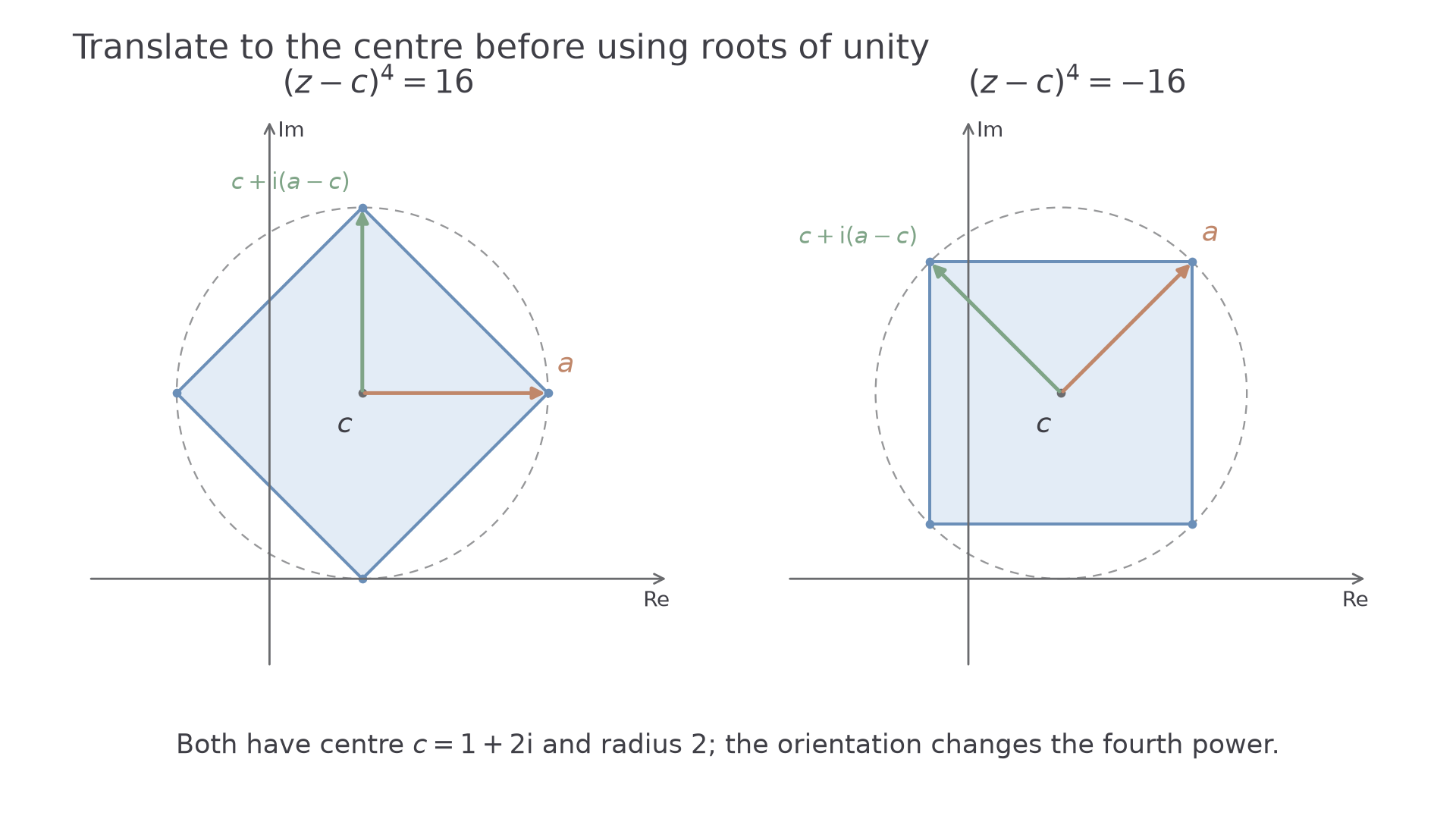
This method combines information rather than relying on a diagram’s appearance: “opposite” determines a midpoint, “square” determines a quarter-turn, and the radius together with its direction determines the equation. The opening balancing property survives translation as ; the original vertex sum is , which is zero only if the centre is zero.
Watch out
For centre , rotate , not . Multiplying by rotates around the origin, while rotates around .
Recover another square from its opposite vertices.
Quick Recap
- The nth roots of unity are , for .
- Unit-circle chords of smaller central angle have length .
- The roots sum to zero for ; sums of their powers need the ratio-one case checked.
- A regular polygon with centre and vertex satisfies .
Equally spaced unit arrows add to zero because a rotation permutes them: their sum obeys , and forces .