F3, F4 - Scalar products and angles
Can multiplying two vectors give a negative number? F3 introduces the scalar product and connects that number to an angle; F4 uses a zero scalar product to detect perpendicular directions. You will distinguish the angle between directed vectors from the smaller angle between unoriented lines.
Dot product in components and magnitude-angle form
Can multiplying two vectors give a negative number? Take and . Multiply matching components and add: . This operation produces a scalar, a number with no direction, rather than another vector. It is called the scalar product or dot product, written .
To see its connection with geometry, put the vectors tail to tail. The cosine rule gives
Expanding the squared components of gives the same expression with the final term . Comparing them explains why the algebra measures the angle.
Scalar product
For , ,
For nonzero , it also equals , where . Thus
Not in the formula booklet: learn it.
The component formula is valid even for a zero vector. The angle formula is not: a zero vector has no direction and would give a zero denominator. Notice also that . The dot product is symmetric, so reversing the order of its two factors does not change its value.
Worked example 1: a negative dot product
Question. For , , find and the angle between the vectors, to one decimal place.
Plan. Calculate the component product and the two magnitudes, then use inverse cosine.
Answer. , , to one decimal place.
Check. , whose squared length is . The cosine rule gives , independently confirming the cosine.
Now reverse only the second vector. Its magnitude stays the same, but the dot product changes sign.
Worked example 2: reversing one vector
Question. Find the dot product and angle for , .
Plan. Recalculate with the reversed direction and compare the angle.
Answer. The dot product is , and , to one decimal place.
Check. , with squared length . The cosine rule gives . The two angles are supplementary, as reversing one arrow predicts.
[DIAGRAM: asset_name: Reversing a vector changes the angle; asset_slug: aqa7367-vector-angle; caption: Reversing one vector changes an obtuse vector angle to its acute supplement; description: Two equal-scale diagrams in the plane spanned by the vectors. The blue vector a points right and has length three. In the left panel the clay vector b has length three and forms an angle of 116.4 degrees with a. In the right panel the clay vector minus b is reversed and forms 63.6 degrees with a. The dot products are labelled minus four and plus four. These are direction diagrams, not projections onto coordinate axes.]
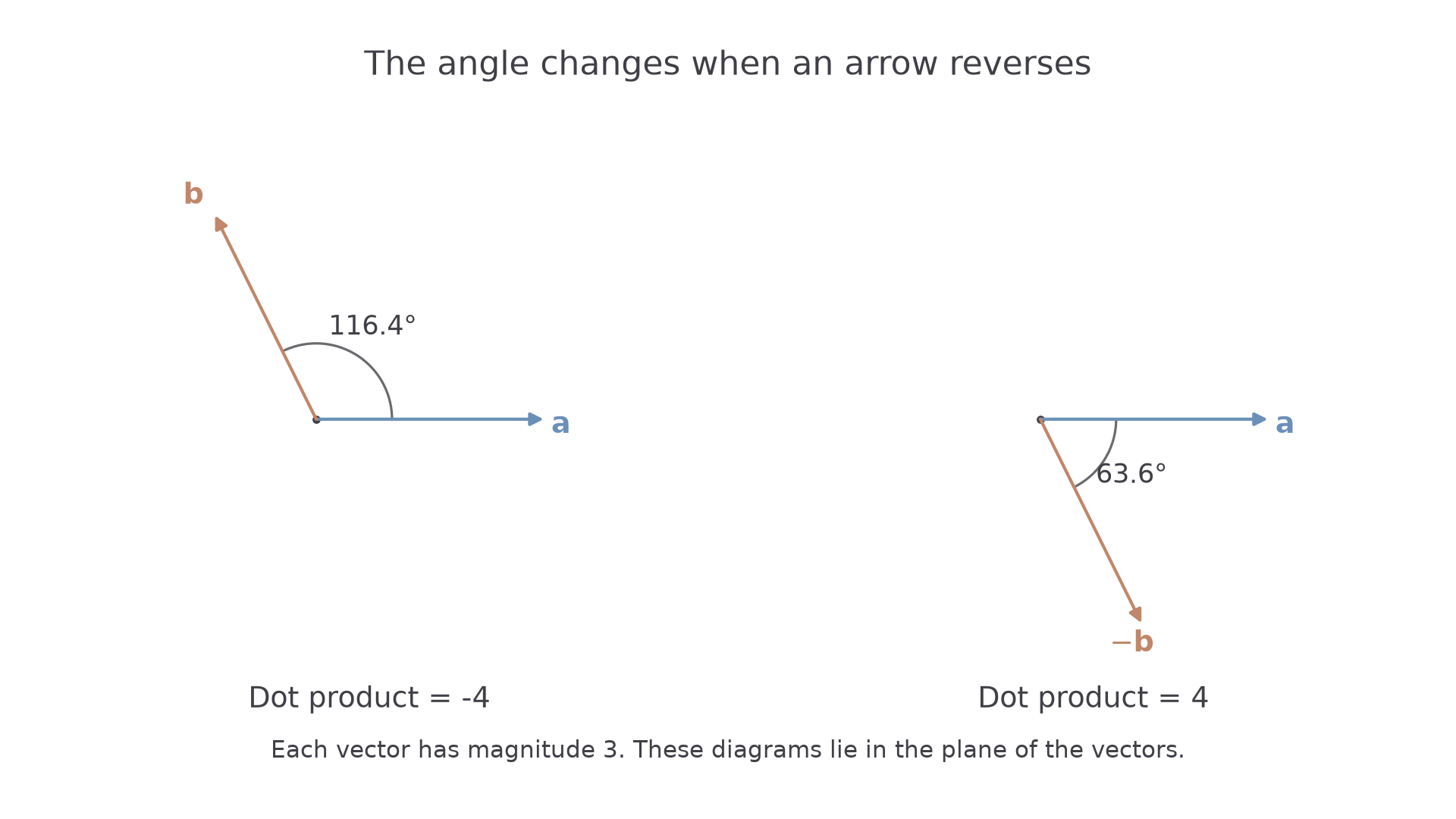
The negative answer to the opening question has a geometric meaning: an obtuse vector angle has negative cosine. For nonzero vectors, a positive dot product means ; a negative product means ; and zero means a right angle. The endpoint cases are equally directed vectors at and oppositely directed vectors at . All these possibilities belong to the same formula.
Perpendicularity
For nonzero vectors, perpendicular directions make an angle of , whose cosine is zero. Since both magnitudes are positive, the dot-product formula gives a quick test in either direction.
Perpendicular vectors
Two nonzero vectors are perpendicular exactly when . Their matching component products cancel in the sum; the individual products need not be zero.
This turns a geometric condition into an ordinary algebraic equation, useful when a component is unknown.
Continue this lesson.
You’re previewing NovaLearn without an account. Create a free account to read the rest.
Create free account