ME5 - Sliding, toppling and suspension
Decide which equilibrium condition fails first when a body is pushed or a supporting plane is tilted. You will compare sliding and toppling thresholds, check contact and friction constraints, and use a centre of mass to predict how a freely suspended body hangs.
Limiting equilibrium
Will a uniform upright block 2 m wide, weighing 100 N, topple or slide first when pushed horizontally 3 m above its base on ground with coefficient of friction 0.4? The answer needs two different limits, not just a friction calculation.
Before investigating that push height, start with the same base width and weight and a push only 1 m above the base. A static contact supplies a normal force and friction , but the normal force's line of action can move across the base to balance the push's turning effect.
Let the horizontal push act rightwards at height , with the centre of mass over the middle of the base. For equilibrium on horizontal ground, , leftwards, and moments about the base midpoint give . Here is the position of the normal reaction to the right of that midpoint. The ground pressure cannot pull on the base, so its resultant must act within the contact base.
Limiting equilibrium
A body is in limiting equilibrium when an equilibrium constraint is just at its boundary. Impending sliding has ; impending toppling has the contact resultant at the relevant base edge. These boundaries need not occur together.
For a base of half-width , admissible static equilibrium under this horizontal-push model requires
For a signed push, check and friction magnitude. The model assumes a rigid body, no other applied forces or couples, and a push whose line stays at the stated height.
Worked example 1: equilibrium within both limits
Question. A block has weight 100 N and base width 2 m. A horizontal 20 N push acts 1 m above its base midpoint. The ground coefficient is 0.4 and the centre of mass is above the midpoint. Can it remain at rest, and is either limit reached?
Plan. Calculate required contact forces and reaction position, then compare both constraints.
The base runs from to .
Answer. Rest is possible and neither limit is reached: and .
Check. The normal reaction gives N m, cancelling the push's clockwise moment N m. Horizontal and vertical force sums are zero.
Increase only the push to 50 N. A moment equation may still place the normal force inside the base, while the friction inequality already fails.
Worked example 2: one failed constraint is enough
Question. For the same block and 1 m push height, test a 50 N horizontal push.
Plan. Keep fixed, but recompute friction demand and reaction position.
The position is inside the base, but required friction exceeds capacity.
Answer. Static equilibrium is impossible because ; the sliding constraint fails. The proposed moment balance alone would not imply toppling.
Check. Even maximum friction leaves a horizontal resultant N rightwards. Thus a zero-resultant-force static solution cannot exist.
Equality is the boundary, not a prediction of the body's subsequent acceleration or rotation.
Watch out
Wrong: satisfying proves rest. The calculated must lie in the base, and required friction must satisfy . Check all constraints before accepting the equilibrium.
Test both limits for a fresh force and geometry.
Compare sliding and toppling
As a horizontal push increases from zero, sliding and toppling are competing ways to lose equilibrium. Calculate both candidate thresholds under the same model, then choose the smaller. Check that the other constraint remains admissible at that first threshold.
At impending toppling about the forward edge, the ground normal and friction act through that edge, so their moments vanish there. The weight gives a restoring moment , where is the horizontal distance from the centre's vertical line to that edge. The push gives moment .
Horizontal-push thresholds
For weight , a horizontal push at fixed height , coefficient , and centre of mass whose vertical line is distance behind the forward base edge,
These assume horizontal ground, no other vertical force or applied couple, and maintained contact. The smaller threshold is reached first. Equal values describe simultaneous limiting sliding and toppling.
Not in the formula booklet: derive them from force and moment balance.
[DIAGRAM: asset_name: Sliding and toppling constraints under a horizontal push; asset_slug: aqa7367-push-topple; caption: At impending toppling the reaction reaches the forward edge and the push moment equals the weight moment; description: A uniform rectangular block has base edges at x equals minus one and plus one metres, weight W down through its central line, and horizontal push P rightwards at height h. The normal reaction N is drawn up at the right base edge and friction F left there. The perpendicular weight arm a equals one metre and push arm h are labelled.]
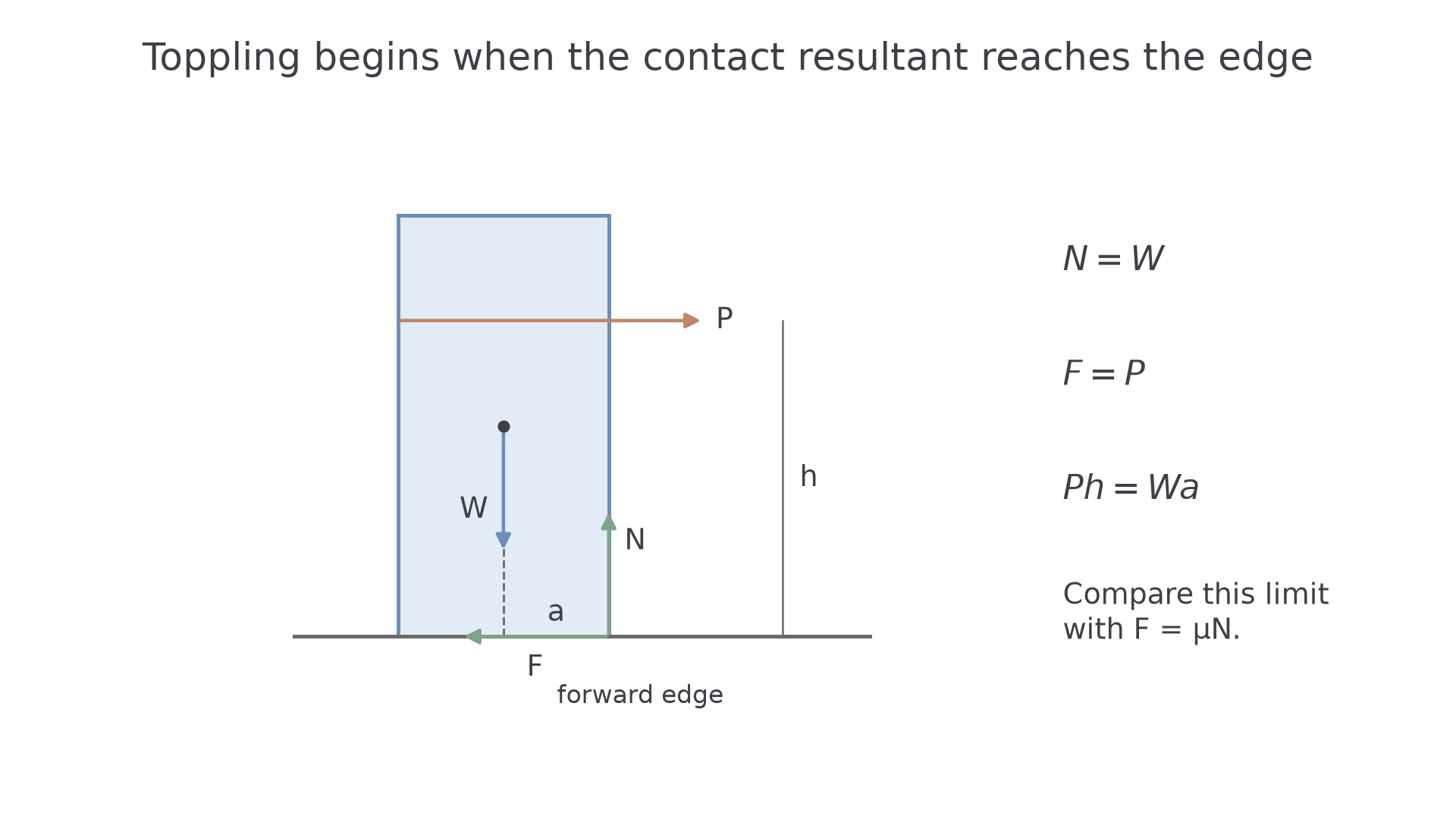
Worked example 3: the opening tall block
Question. The opening block has weight 100 N and base width 2 m, with a central mass line. It is pushed right at height 3 m on ground with . Find which limit occurs first as the push increases.
Plan. Compare sliding capacity with the edge-pivot moment threshold.
The toppling candidate is smaller.
Answer. Toppling occurs first at N.
Check. Required friction there is N, so sliding has not yet become limiting. The reaction position is m, exactly the forward edge.
Change only the ground coefficient to 0.2. The toppling geometry is unchanged, while the sliding threshold falls.
Worked example 4: the same block on smoother ground
Question. Find the first limit for the same block and push height when .
Plan. Retain the toppling candidate and recalculate sliding capacity.
Answer. Sliding occurs first at 20 N.
Check. At 20 N, the reaction position is m, still inside the base. The weight moment about the forward edge, 100 N m, exceeds the push moment 60 N m.
For a uniform upright rectangle, is half its base width. For a non-uniform or composite body, locate its centre first: the relevant distance can be different. A lower push increases the toppling threshold; at base level , that push has no toppling moment under this model, so the division formula with is inapplicable.
Watch out
Wrong: “rougher ground makes the block safer against toppling”. Greater friction can prevent sliding long enough for toppling to occur first. Compare both thresholds; do not assume both limits hold together.
Compare two new candidates and verify the other condition.
Inclined planes
Tilting a rough plane changes both the weight component that drives sliding and the vertical position of the centre relative to the base. Assume the body starts in admissible rest with its base flush against the plane, and the angle increases slowly from zero, with .
If weight is the only non-contact force, resolving perpendicular and parallel to the plane gives and required uphill friction . Thus sliding becomes limiting when .
For toppling, let the centre be at perpendicular height above the base plane, and distance up the base from the downhill edge. The vertical weight line meets the base a distance downhill from the centre's perpendicular projection. It reaches the edge when . Equivalently, moments about the downhill edge give .
Continue this lesson.
You’re previewing NovaLearn without an account. Create a free account to read the rest.
Create free account