DA4 - Proving non-planarity
Some graphs remain non-planar even when extra vertices disguise the familiar complete-graph pattern. Learn to find subdivisions of and , trace their internally disjoint paths, and use Kuratowski's theorem to prove non-planarity. You will also see why crossing lines in one sketch cannot settle the question.
Subdivisions of K5 and K3,3
Replace one edge of by two edges meeting at a new vertex. Can this extra vertex make the graph planar? The edge count has changed, so the earlier numerical test may no longer settle the question, but the underlying obstruction survives.
Recall the two non-planar graphs proved using Euler's bounds: joins all pairs of five vertices, while joins every pair across two sets of three. A subdivision replaces edges of one of these graphs by paths, inserting new degree-2 vertices. The original vertices are called branch vertices. Different replacement paths may meet at their shared branch endpoints, but must not share an internal vertex; their internal vertices are new and are not branch vertices.
An edge may remain unsubdivided, so the original graph itself counts as a subdivision with no inserted vertices. Inserting vertices in total increases both V and E by , because each insertion replaces one edge by two. It preserves , but can disguise degrees and cycle lengths.
[DIAGRAM: asset_name: Forbidden graph subdivisions; asset_slug: aqa7367-kuratowski-subdivisions; caption: A new degree-2 vertex changes an edge into a path without removing the forbidden pattern; description: Left is K3,3 on branch groups A B C and X Y Z except AX is replaced by AP PX. Right is K5 on A B C D E except AB is replaced by AP PB. The new vertex P is shaded clay in each separate graph. Crossings without labelled dots are not vertices.]
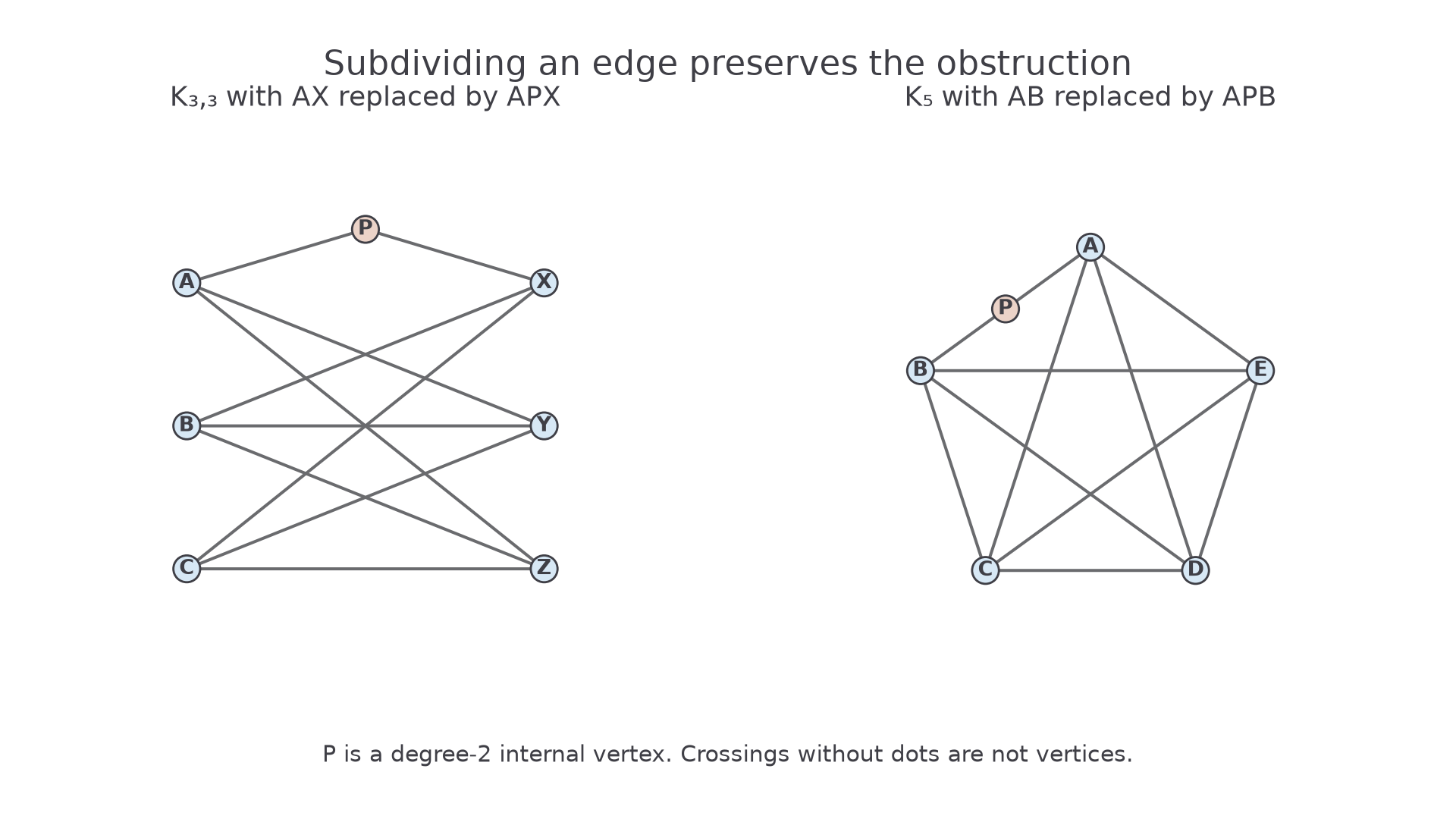
Worked example 1: subdividing K3,3
Question. In with groups , , replace AX by AP and PX. State the branch vertices, V, E and degrees.
Plan. Preserve the six original vertices and all other edges, adding one internal vertex.
The six branch vertices A, B, C, X, Y, Z retain degree 3. P has degree 2.
Answer. This is a subdivision of with seven vertices and ten edges.
Check. Its degree sum is . Suppressing P, by replacing AP and PX with AX, recovers exactly .
Use the identical insertion operation on the other forbidden graph. Its branch degrees differ, but the new vertex still has degree 2.
Worked example 2: subdividing K5
Question. Replace AB in on A, B, C, D, E by AP and PB. Find V, E and the degrees.
Plan. Add one internal vertex while retaining each original vertex's four connections along edges or replacement paths.
A, B, C, D and E all have degree 4, and P has degree 2.
Answer. It is a subdivision of , with six vertices and eleven edges.
Check. The degree sum is ; suppressing P recovers the missing AB edge and all ten edges of .
A subdivision of a bipartite graph need not itself be bipartite. In Worked example 1, A–P–X–B–Y–A is a 5-cycle. The inserted vertex lengthens a former even cycle by one. Therefore you cannot apply the bipartite edge bound merely because the graph arose from . The subdivision structure, rather than the inherited name, is what matters.
Watch out
A subdivision replaces an edge by a path. It does not keep the old edge as well, and it does not identify unrelated vertices. The internal vertices must be distinct from all branch vertices and from internal vertices on other replacement paths.
Count a longer fresh replacement path.
Internally disjoint replacement paths
A convincing subdivision certificate names the branch vertices and gives a separate route for every required edge of the smaller forbidden graph.
For , choose groups and , then supply nine paths: one for each cross-group pair. For , choose five branch vertices and supply ten paths: one for each unordered pair. The interior of each path must contain no branch vertex, and no vertex may lie inside two of the selected paths. “Internally disjoint” allows paths to share a branch endpoint when the original edges did so.
The larger graph may contain extra edges or vertices. Delete them when choosing the subgraph that forms the subdivision. A vertex of degree 3 in the original graph can become a degree-2 internal vertex after an unwanted edge is deleted. Degrees relevant to the subdivision are degrees within the selected subgraph.
Worked example 3: a complete nine-path certificate
Question. G has the eight ordinary cross-group edges of except AX, and also AP, PX. Show exactly how it contains a subdivision of .
Plan. Use the original groups as branch vertices, then list all nine replacement paths.
| From | To X | To Y | To Z |
|---|---|---|---|
| A | A–P–X | A–Y | A–Z |
| B | B–X | B–Y | B–Z |
| C | C–X | C–Y | C–Z |
Only the first path has an internal vertex, P. P is not a branch vertex and occurs on no other path.
Answer. These nine paths form a subdivision of .
Check. They use distinct edges. Suppressing P recovers all nine cross-group pairs and no within-group pair.
Now subdivide a second edge and introduce a distracting edge between the two internal vertices. Deleting that distraction is part of the proof.
[DIAGRAM: asset_name: Finding an obstruction inside a larger graph; asset_slug: aqa7367-kuratowski-paths; caption: Delete PQ before reading P and Q as internal vertices of the selected subdivision; description: Left has all K3,3 cross-pairs on groups A B C and X Y Z except AX and CZ, replaced respectively by AP PX and CQ QZ, with an extra edge PQ. Right removes PQ. The nine selected paths are APX AY AZ BX BY BZ CX CY CQZ; their only internal vertices P and Q are distinct.]
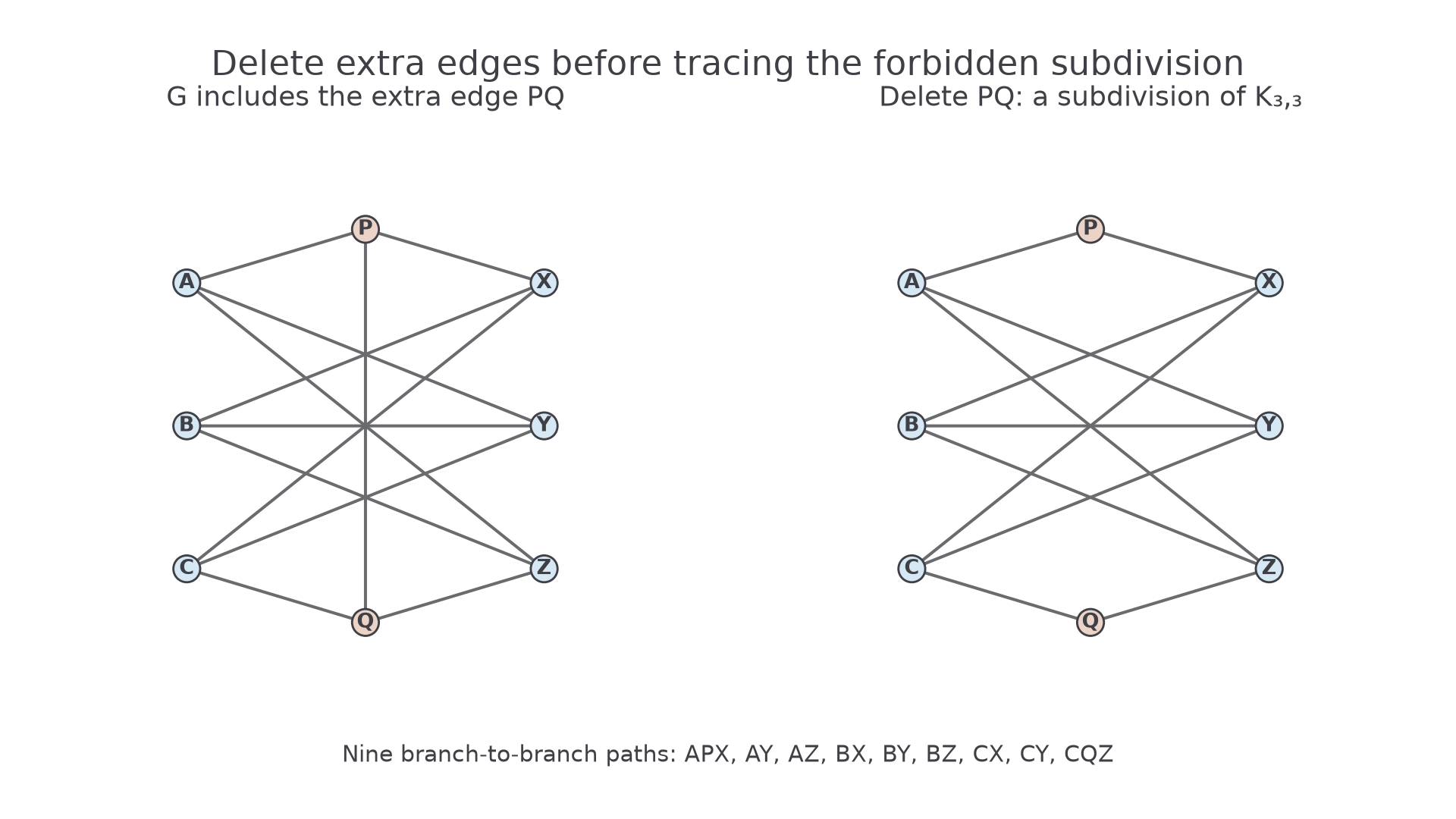
Worked example 4: deleting an extra edge
Question. G has cross-group edges AY, AZ, BX, BY, BZ, CX, CY and also AP, PX, CQ, QZ, PQ. Find a subgraph that is a subdivision of .
Plan. Delete PQ so that P and Q become separate internal vertices on different replacement paths.
Use branch groups and . The paths are
Their only internal vertices are P and Q, used on different paths.
Answer. Deleting PQ leaves the required subdivision.
Check. G has twelve edges. The selected subgraph has eleven, agreeing with nine original edges plus two insertions. Suppressing P and Q gives exactly the nine edges of .
A list such as A–P–X and B–P–Y would fail this certificate if P were internal to both paths. The paths would merge at a vertex that should not be shared. Similarly, a proposed path through a third branch vertex is invalid for a single replaced edge: it combines two intended connections. A path certificate avoids these errors more reliably than saying a drawing “looks like” a familiar graph.
Watch out
Delete unwanted edges first, then verify all required branch-to-branch paths. Internal disjointness is a condition on the chosen paths; a shared crossing without a dot is harmless, but a shared internal vertex is not.
Supply a fresh certificate from a complete edge list.
Kuratowski’s theorem
Kuratowski's theorem turns a verified subdivision into a conclusive obstruction to every possible plane embedding.
Kuratowski’s theorem
A finite graph is planar if and only if it contains no subgraph that is a subdivision of or . Equivalently, a graph is non-planar if and only if it contains a subgraph isomorphic to a subdivision of one of these two graphs. The theorem is not supplied in the exam formula booklet.
Continue this lesson.
You’re previewing NovaLearn without an account. Create a free account to read the rest.
Create free account