D10 - Modulus functions and inequalities
A modulus turns a signed value into a distance from zero. You will use its piecewise definition to build graphs, solve inequalities by distance or by cases, and keep the sign and domain restrictions that prevent false solutions.
The piecewise definition of modulus
If a graph dips below the horizontal axis, how can we make every output non-negative without moving any input? Replace each negative output by its opposite: becomes 5, while 5 and 0 stay unchanged. This operation is called taking the modulus, written with vertical bars.
For a real number , its modulus is its distance from zero. The distance is non-negative, not always positive: .
Modulus
For real ,
Thus , , and . The second branch has a non-negative output because it is used only when is negative.
With , split the domain where the inside expression changes sign. The switch is not necessarily at . At a zero, either branch formula gives zero, so you can assign that endpoint to either branch consistently.
Worked example 1: a linear expression in modulus
Question. Write as a piecewise function and find its value at .
Plan. Find where is negative, then negate that whole expression on that branch.
At , use the left branch: .
Answer. The piecewise function above, with .
Check. Directly, the inside value at is , whose distance from zero is 8. Both branch formulas give zero at the switch .
Change only the constant from to . The switching input moves to the other side of zero; the output remains a distance.
Worked example 2: moving the switching input
Question. Write as a piecewise function and find its value at .
Plan. Solve , then use the inside expression's sign on each side.
At , the first branch gives .
Answer. The piecewise function above, with value 2 at .
Check. Direct substitution gives . At , the second branch gives 6, agreeing with .
The minus sign outside the first branch in the definition acts on every term inside the bars.
Watch out
Wrong: for , . Negate the whole bracket: . Do not replace just the -term's sign.
Apply the sign test to a new linear expression.
Modulus graphs
Taking the modulus of a function's output leaves points on or above the horizontal axis in place and reflects points below it in that axis. Each input stays the same. This is the graphical answer to the opening question.
For a line such as , this creates a V with vertex . For a quadratic, the reflected pieces are curved: a modulus graph is not necessarily a V. Its zeros remain where the original function was zero.
Worked example 3: folding part of a parabola
Question. Describe the key features needed to sketch , including the branch formulas, zeros and vertical-axis intercept.
Plan. Find where is negative and reflect only that portion of its parabola.
The middle section becomes a downward-facing cap, meeting the unchanged outer sections at and . The vertical-axis intercept is , the highest point of that middle cap. All outputs are non-negative and the graph is symmetric about the vertical axis.
Answer. Two upward outer branches, a reflected central cap, zeros at , and vertical-axis intercept , with the branch formulas above.
Check. At , the original output becomes 3, agreeing with . At , the original output 5 stays 5. This checks one reflected and one unchanged portion.
Change only the constant from to . The roots move closer together and the reflected cap becomes lower.
Worked example 4: a narrower reflected section
Question. Describe the key features needed to sketch , including the branch formulas, zeros and vertical-axis intercept.
Plan. Split at the zeros and 1 of the inside expression.
The central cap now runs between and , through . Outside, the upward parabola pieces are unchanged.
Answer. Zeros , vertical-axis intercept , central branch , and outer branches , on the stated domains.
Check. At , , matching the central cap. At , , matching an outer branch. Both switch values give zero.
The pictures compare the original and folded curves using the same coordinates in each panel.
[DIAGRAM: asset_name: Reflecting negative quadratic outputs; asset_slug: aqa7367-modulus-parabolas; caption: Only the portions below the horizontal axis are reflected upwards; description: Two panels show dashed original parabolas y equals x squared minus 4 and y equals x squared minus 1, with solid blue modulus graphs on the same axes. The central negative sections appear as reflected caps above the axis. Zeros minus 2 and 2 in the left panel and minus 1 and 1 in the right are labelled, with cap heights 4 and 1. The outer positive sections coincide with the originals.]
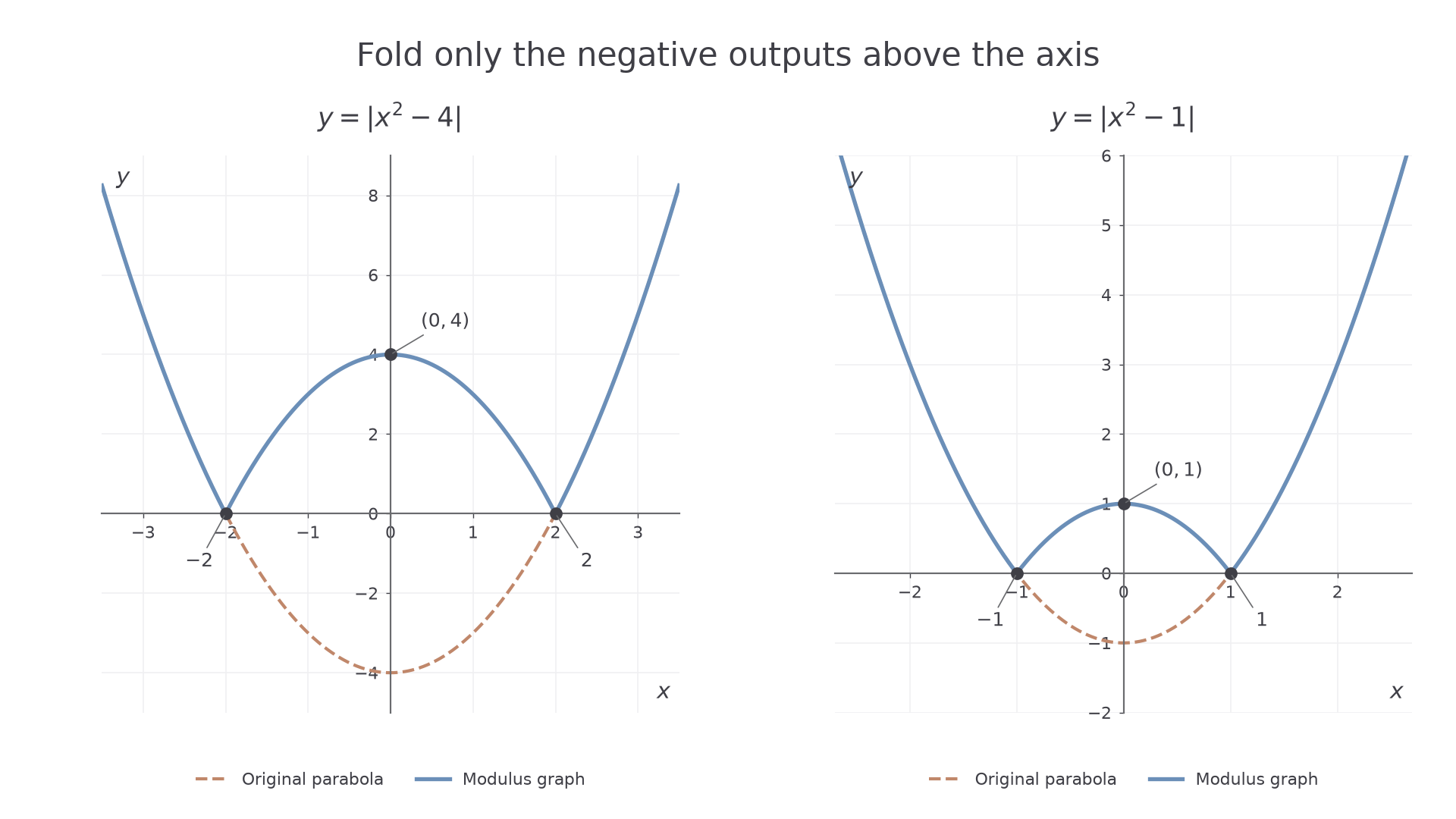
Unlike a smooth minimum of a parabola, the joins at these simple roots form corners. Reflecting the whole parabola would incorrectly turn its positive outer sections negative.
Key idea
For , keep every non-negative output and change the sign of every negative output. The graph can touch zero, but cannot go below it.
Describe a new quadratic modulus graph without needing a drawing tool.
Solving inequalities by distance or cases
The inequality asks for numbers less than distance 2 from 3, so . A greater-than sign selects the two outside regions instead. For a positive bound , the same reasoning applies to any real expression .
Modulus bounds
For real and ,
For or , include the equality boundaries. Not in the formula booklet: learn it.
For example, gives , hence . An upper bound of zero allows only when equality is permitted; an upper bound below zero gives no solutions. A comparison with is true for every input on which is defined.
With a quadratic inside the bars, solve the two quadratic comparisons and combine their interval sets. This can produce more than two allowed intervals.
Worked example 5: three solution intervals
Question. Solve , giving an exact answer.
Plan. Split the comparison into or , then solve each quadratic inequality.
Each implication uses the positive quadratic's outside-positive, inside-negative signs. The original comparison asks for either case, so take their union.
Answer.
Check. At , the modulus is , confirming the central interval. At , it is 0, so the nearby gap is correctly excluded. At and 4, it is 4, confirming both outer intervals. Every listed boundary has modulus exactly 2 and is excluded.
Change just the comparison to . The four boundaries now belong, while the open-interval signs stay unchanged.
Worked example 6: including every equality boundary
Question. Solve , giving an exact answer.
Plan. Solve or .
Answer.
Check. At the two surd boundaries, ; at 1 and 2, it equals . All four give modulus 2, so every closed bracket is justified directly in the original inequality.
This gives a surprising connection to graph folding: one horizontal line can meet a folded quadratic four times, producing three separate regions above that line. “Modulus means two solutions” is not a general rule.
Watch out
Wrong: requires and . Those cases are alternatives, so join them with “or”. By contrast, requires both bounds .
Use the same two-case method with a new quadratic.
Keeping sign and domain restrictions
Taking a modulus does not make an undefined expression defined. Nor does it make a negative expression on the other side of an inequality positive. These are separate restrictions to preserve throughout a solution.
For example, can hold only for . On , it becomes , giving ; on , it becomes , which is always true. The union is .
If you square both sides instead, you obtain , hence again, but the justification needs both sides to be non-negative. Squaring arbitrary signed quantities does not preserve their order: , whereas . For , use as well as . For , all inputs with already work; squaring them may lose solutions.
The following pair focuses on the other restriction: an excluded input that survives cancellation.
Worked example 7: a modulus with an excluded input
Question. Solve .
Plan. Record the original domain before cancelling, then solve the simpler distance inequality on that domain.
Remove the forbidden input 1 from that interval.
Answer. .
Check. At , the original modulus is 1 and works; at , it is and works. At , the original expression is , which has no value even though the cancelled formula would give 2.
Change only to . Equality adds the two distance boundaries, but still cannot restore the undefined input.
Worked example 8: equality does not fill a hole
Question. Solve .
Plan. Solve with the inherited restriction .
Answer. .
Check. In the original fraction, gives and gives 3, so their moduli equal 3 and both endpoints belong. The denominator is still zero at 1, so the two brackets facing that hole remain round.
Whenever a domain is specified, the final operation is intersection with that domain. Modulus changes values, while the domain determines which values exist in the first place.
Watch out
Wrong: cancelling a factor makes its zero admissible. Cancellation is valid only where the cancelled factor is nonzero. Retain the original exclusion before applying distance rules or squaring.
Now combine the sign check with a quadratic modulus and a straight line. Both are defined for every real input, so there are no denominator exclusions. The line's sign still determines which comparisons are valid. With a negative right side, a non-negative modulus is automatically greater, but can never be less.
Worked example 9: a quadratic modulus above a line
Question. Solve , giving an exact answer.
Plan. Deal with negative right-hand values first, then split the remaining comparison into two quadratic inequalities.
For , the right side is negative, so every such input works. For , the right side is non-negative and the two alternatives are
Intersect these case results with , then unite them with . Since , the first allowed interval joins across ; the line's zero is not itself an equality boundary here.
Answer.
Check. Directly in the original inequality, gives , confirming the automatically allowed negative-right-side region. At , confirms the middle interval; at and 4, the comparisons and are false. The four equality boundaries give equal original outputs and are excluded.
Change only to , keeping the same quadratic and line. The alternatives become simultaneous bounds, and a non-positive right side is now impossible.
Worked example 10: the same modulus below the line
Question. Solve , giving an exact answer.
Plan. Require , then solve both sides of .
The right-side condition gives . On that domain,
Here both bounds must hold, so intersect their solution sets with each other and with . The latter restriction removes no further inputs because the first interval starts above .
Answer.
Check. At , , and at , , so both selected intervals contain a valid point. At , the comparison is impossible. At , is false, confirming the central gap. At each of the four boundary inputs, the two original outputs are equal, so all four endpoints remain excluded.
The graph interpretation is the same as the algebra: the first comparison selects where the folded quadratic lies above the line; the second selects where it lies below. Locate equality boundaries, check the line's sign, and combine the allowed intervals. Do not square a comparison until the signs justify it.
Try a fresh quadratic and line using the final example's simultaneous-bound method.
Quick Recap
- Modulus keeps non-negative values and reverses negative values.
- Reflect only the portions of a graph below the horizontal axis.
- Positive upper bounds give a two-sided condition; positive lower bounds give two alternative cases.
- Keep original domains and check the signs before squaring a comparison.
The opening graph becomes non-negative by reflecting its negative outputs upwards, with every input left in place.