MD6 - Vertical circles
Combine the radial equation of motion with conservation of energy to follow a particle around a vertical circle. Decide whether a string stays taut or a surface stays in contact, and explain why a rod can complete some circles that a string cannot.
Radial equations at different positions
A particle launched from the bottom has enough energy to reach the top of a vertical circle. Is that enough to guarantee that a string will keep it on the circle? First separate two questions: how fast is it moving, and can the available forces produce the required inward acceleration?
At the bottom, the inward direction is upwards: tension pulls inwards and weight acts outwards. At the top, inwards is downwards: both tension and weight act inwards. Write the radial equation afresh at each position, rather than carrying the bottom's signs around the circle.
For a taut string of fixed length , measure from the downward vertical to the outward radius. Thus at the bottom and at the top. Weight has inward component . It is negative at the bottom and positive at the top.
[DIAGRAM: asset_name: Angle and height in a vertical circle; asset_slug: aqa7367-vertical-angle; caption: Measure theta from the downward vertical, then resolve forces towards the centre; description: A vertical circle centred at O with a particle P in its upper-right quadrant. Its outward radius makes an angle theta with the downward vertical. Tension points from P towards O and weight points vertically down. The height h above the bottom is marked and equals R times one minus cosine theta.]
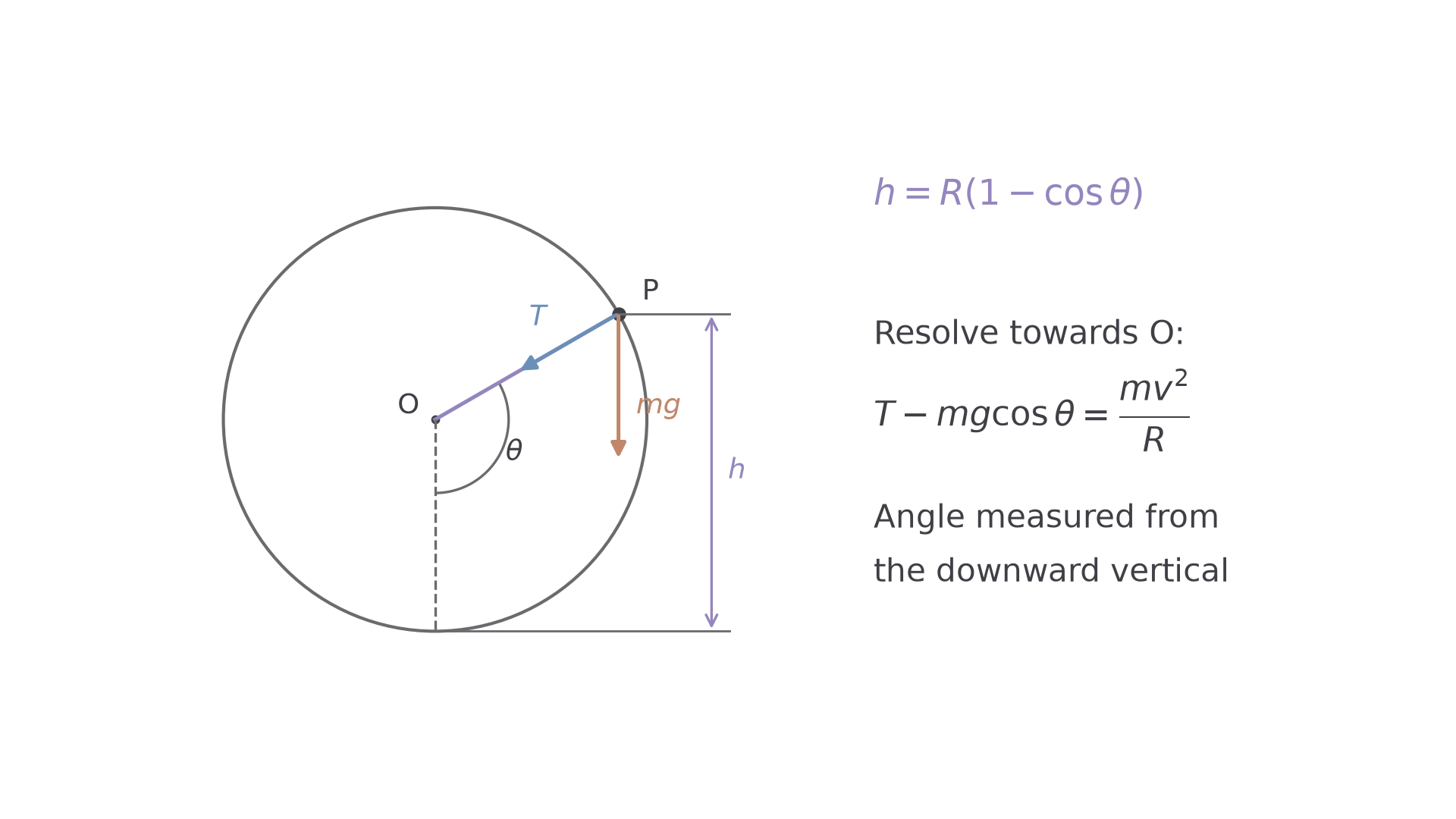
Radial equation for a taut string
For a particle of mass constrained to a vertical circle of radius , with only tension and weight acting,
Here is the speed at that position. At the bottom, ; at the top, . These radial equations are not in the formula booklet: obtain them by resolving inwards.
Gravity also has a tangential component except at the top and bottom. The particle normally slows as it rises and speeds up as it falls. The inward component of acceleration is , but the total acceleration can also have a tangential component. Do not assume that vertical circular motion has constant speed, or use with a single constant acceleration around the arc.
Worked example 1: tension at the bottom
Question. A particle on a light inextensible string of length has speed at the bottom of its vertical circle. Find the tension, using .
Plan. Take the inward direction upwards, then subtract weight from tension.
Answer. The tension is .
Check. , matching . Tension must exceed weight to produce upward acceleration.
Change only the position in the local force calculation. The next example specifies the same instantaneous speed at the top; it does not claim that the preceding launch keeps that speed during its ascent.
Worked example 2: tension at the top
Question. A particle on a light inextensible string of length has speed at the top of its vertical circle. Find the tension, using .
Plan. Take the inward direction downwards, so tension and weight now add.
Answer. The tension is , which is positive and therefore locally possible for a taut string.
Check. The required resultant is still . Weight now supplies of it, leaving for tension. At the same speed and radius, bottom tension exceeds top tension by .
Watch out
Wrong: “At the top, tension balances weight.” Both forces point downwards there. Correct: . The particle is accelerating towards the centre even at the instant when its tangential acceleration is zero.
Linking speed and height using energy
A taut inextensible string's tension is perpendicular to the instantaneous motion, so it does no work. With air resistance neglected, kinetic energy plus gravitational potential energy is conserved. The same applies to an ideal light rod with a frictionless pivot, or a particle sliding on a fixed smooth circular track while contact is maintained: the constraint force is normal to the path.
Take the bottom as zero height and let the bottom speed be . At angle from the downward vertical, the height is . This is a vertical height, not the arc length .
Energy and radial force along a vertical circle
While the fixed-radius constraint holds, with no dissipative work,
For a taut string, substituting into the radial equation gives
These energy and tension relationships are not in the formula booklet: form the energy balance and resolve the forces.
Check both and . A negative calculated means that height is not reachable with the assumed energy. A negative calculated tension means the string constraint fails before that position. Once the string goes slack, the particle no longer follows that circle; continuing these circular formulae past that point describes a required but unavailable constraint force.
Worked example 3: speed and tension at a higher point
Question. A particle of mass is launched from the bottom on a light string of length with . Find its speed squared and tension when . Verify that it can reach this point with the string taut.
Plan. Use the height in an energy equation, then find the tension and check the ascent up to the point.
On the ascent from to , decreases, so both and decrease. Their values at the endpoint are positive, so both conditions held throughout this interval.
Answer. and ; the point is reachable with positive tension.
Check. Per unit mass, the kinetic-energy decrease is , exactly . The inward force is .
Reduce only the launch speed, keeping the same target angle and string. The point can remain reachable even when a full circle is impossible.
Worked example 4: reaching a point is not completing a circle
Question. For the same type of particle and string, let . Find the speed squared and tension at , and verify that the particle reaches this point while the string is taut.
Plan. Reuse the same height, then check energy and tension separately.
Both values are positive. As in Worked example 3, they decrease continuously during the ascent to this angle, so no earlier failure occurs. However, extending the candidate formula to the top would give . The string cannot complete that proposed circular journey.
Answer. and , with the string taut up to . This does not establish a complete circle.
Check. At the target point, . Energy per unit mass is , the initial .
Watch out
Wrong: “The string goes slack when .” Slackening occurs at . Above the centre, gravity can supply the entire inward resultant at a nonzero speed. Solve the radial equation as well as the energy equation.
Continue this lesson.
You’re previewing NovaLearn without an account. Create a free account to read the rest.
Create free account