B4 - Points on the Argand diagram
What does adding a complex number look like? You will represent complex numbers as points, interpret their sums as movements, and see conjugation and sign changes as reflections and turns. The geometry gives you a second way to check the algebra.
Plot and interpret complex numbers
How can a number such as have a position? Use one direction for its real part and a perpendicular direction for its imaginary part: move 3 units right and 2 units up.
Argand diagram
An Argand diagram represents by the point with Cartesian coordinates . The horizontal axis is the real axis, labelled Re; the vertical axis is the imaginary axis, labelled Im. Both coordinate values are real numbers.
Positive imaginary parts go upwards and negative imaginary parts downwards. Real numbers lie on the horizontal axis because their imaginary part is zero. Purely imaginary numbers lie on the vertical axis because their real part is zero. The number zero is at the origin . Use equal unit lengths on the two axes when interpreting lengths and angles.
[DIAGRAM: asset_name: Complex numbers as signed coordinates; asset_slug: aqa7367-argand-points; caption: The real and imaginary coefficients give horizontal and vertical coordinates; description: An equal-scale Argand diagram shows A at (3,2) representing 3 plus 2i, B at (minus 3,2) representing minus 3 plus 2i, C at (0,minus 3) representing minus 3i, and D at (minus 4,0) representing minus 4. Dashed coordinate guides connect A and B to the axes. The origin represents zero.]
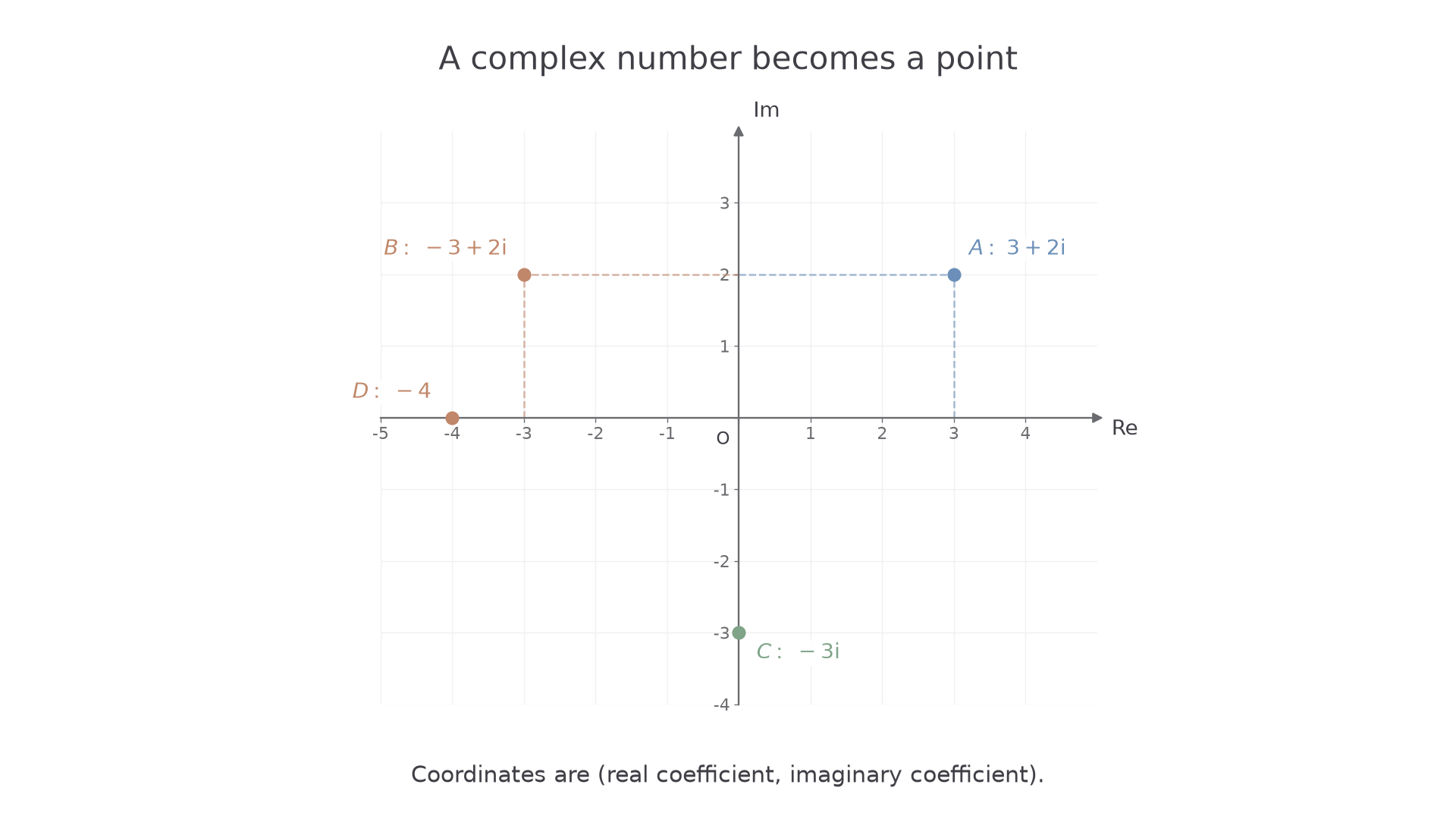
Worked example 1: two positive coordinates
Question. State the coordinates of the point representing , and describe its position relative to the origin.
Plan. Read the real coefficient first and the imaginary coefficient second.
Answer. : 3 units right and 2 units up.
Check. Reconstruct the number from the coordinates: .
Change only the sign of the real part. The horizontal movement reverses; the height stays fixed.
Worked example 2: a negative real coordinate
Question. State the coordinates of the point representing , and describe its position relative to the origin.
Plan. Keep each coefficient's sign when reading the coordinates.
Answer. : 3 units left and 2 units up.
Check. Reconstructing gives . Its positive imaginary part agrees with a point above the real axis.
The axis label Im does not turn a coordinate into a multiple of .
Watch out
The point for is , not . Its imaginary part is the real coefficient 2.
Use the same coordinate reading with a new sign pattern.
Sums as vectors
Adding moves any starting point 1 unit left and 2 units up. This movement does not depend on where you start.
A complex number can represent a point or a displacement vector. The arrow from the origin to is the position vector for . To add and , draw the arrow for starting at the endpoint of the arrow for . The final endpoint represents . Translating an arrow preserves both its length and direction.
The algebra and the picture agree because horizontal movements add separately from vertical ones:
[DIAGRAM: asset_name: Head-to-tail complex addition; asset_slug: aqa7367-argand-sum; caption: Translating the second arrow gives the point representing the sum; description: An equal-scale Argand diagram shows a blue arrow from O to U at (3,1), a sage arrow from O to V at (minus 1,2), and a translated sage arrow from U to S at (2,3). A clay arrow from O to S represents u plus v. A dashed segment from V to S completes the parallelogram.]
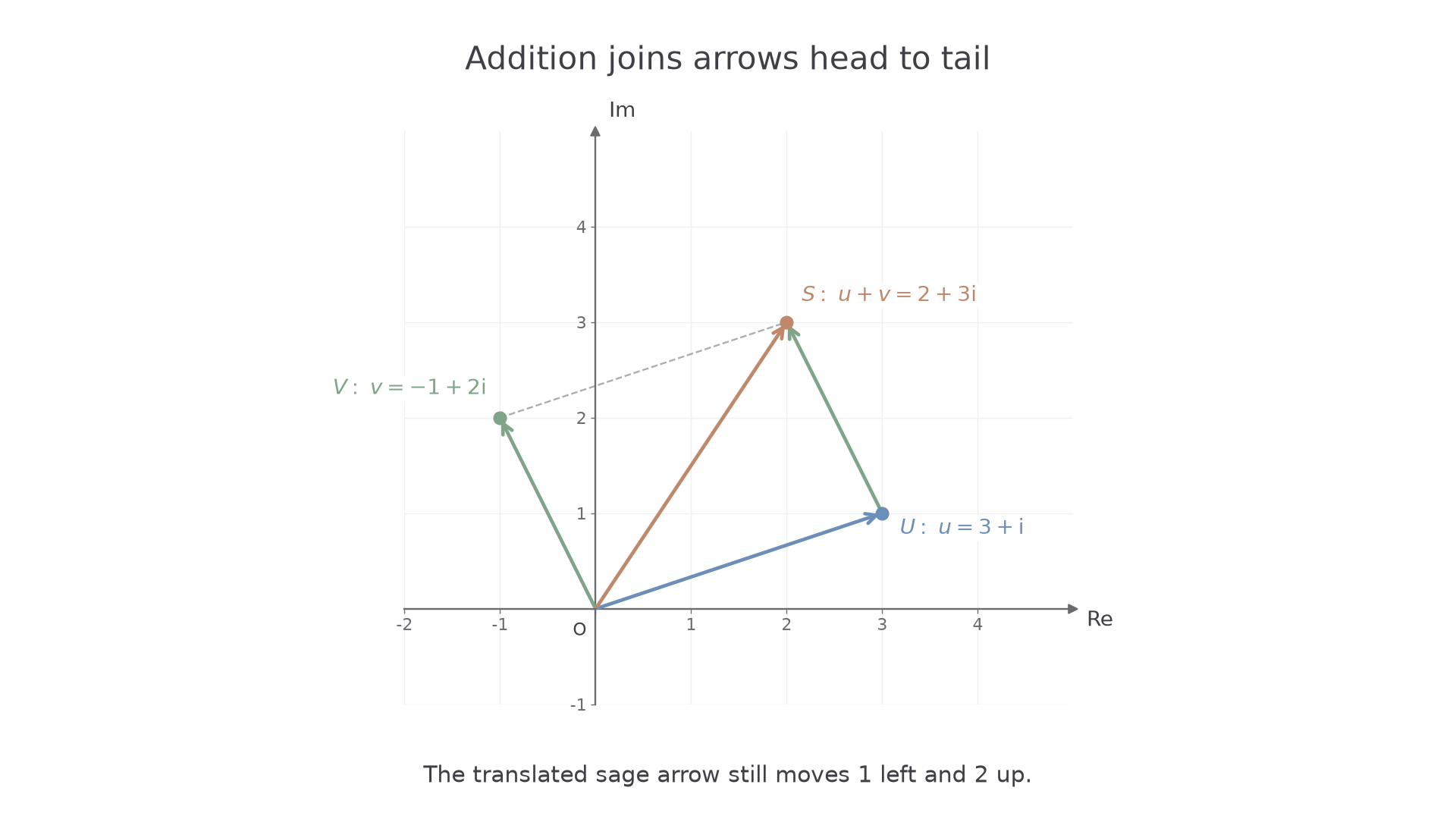
Worked example 3: an upward second movement
Question. Let and . Find and interpret the movement from the point for .
Plan. Add the two horizontal movements and the two vertical movements.
Answer. , at . From , move 1 left and 2 up.
Check. The final displacement minus the starting displacement is , exactly the vector for .
Change only the imaginary sign of the second number. Its arrow now points downwards rather than upwards.
Worked example 4: a downward second movement
Question. Let and . Find and interpret the movement from the point for .
Plan. Use the signed components of the new second arrow.
Answer. , at . From , move 1 left and 2 down.
Check. Subtract the second number from the result: .
Subtraction also has a geometric meaning. If points represent , the arrow from to represents : endpoint minus starting point. Reversing the direction gives .
Key idea
The parallelogram picture explains why : either order reaches the same opposite vertex. The arrows can change order without changing the final point.
Apply head-to-tail addition to a new starting point and displacement.
Conjugation as reflection
The numbers and have equal horizontal coordinates and opposite vertical coordinates. Their points are mirror images across the real axis.
For , the conjugate changes into . When , the segment joining the points is vertical and has its midpoint on the real axis. This is exactly reflection in that axis; when , the point stays fixed.
[DIAGRAM: asset_name: Conjugation and other sign changes; asset_slug: aqa7367-argand-reflections; caption: Conjugation reflects in the real axis while negation changes both coordinates; description: An equal-scale Argand diagram shows z at (2,3), z conjugate at (2,minus 3), minus z at (minus 2,minus 3), and minus z conjugate at (minus 2,3). Dashed horizontal and vertical lines connect the four vertices of the rectangle. The real-axis reflection pair z and z conjugate is blue, with the two left-hand points in clay.]
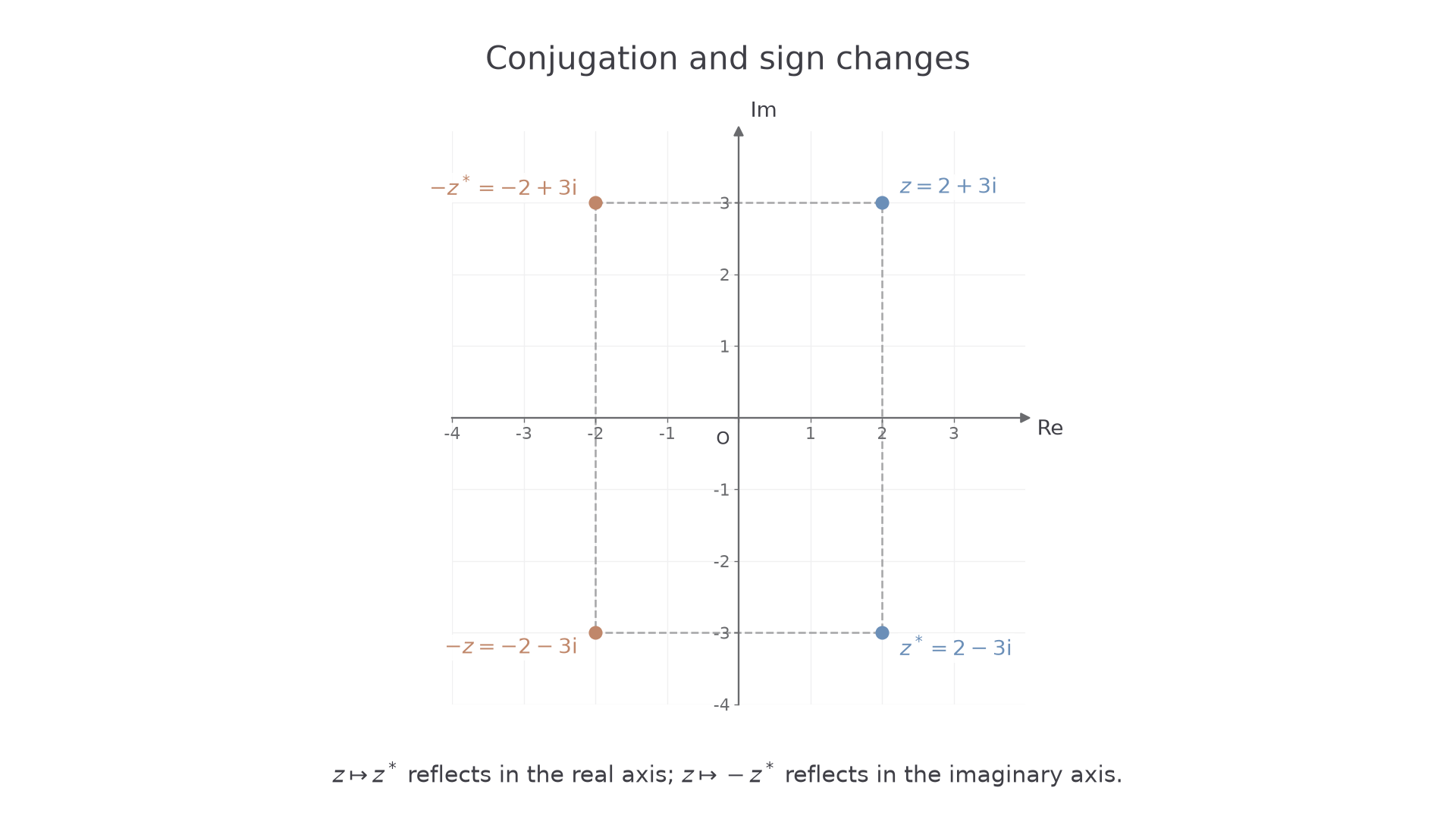
Worked example 5: reflecting an upper point
Question. A point represents . Find the number represented by its reflection in the real axis.
Plan. Keep the horizontal coordinate and reverse the vertical coordinate.
Answer. .
Check. The midpoint of the two points is , and each lies 3 units from the real axis on opposite sides.
Change only the sign of the original imaginary part. A reflection works in both directions.
Worked example 6: reflecting a lower point
Question. A point represents . Find the number represented by its reflection in the real axis.
Plan. Change the signed vertical coordinate to .
Answer. .
Check. Reflecting again restores . Algebraically, .
Real numbers are the fixed points of this reflection: their vertical coordinate is zero. A nonzero purely imaginary number moves to the opposite point on the imaginary axis; it is not fixed just because it lies on an axis.
Watch out
Conjugation reflects in the real axis. The imaginary coefficient changes sign; the axis whose points remain fixed is the real axis.
Use the reflection rule without relying on a picture.
Signed coordinates and transformations
Changing both coordinate signs sends a point to the opposite side of the origin. Changing only the real sign reflects it in the imaginary axis. These are different transformations from conjugation.
Start with . Ordinary algebra gives the complete coordinate rules:
| Resulting number | Coordinates | Geometric transformation |
|---|---|---|
| Reflection in the real axis | ||
| Half-turn about the origin | ||
| Reflection in the imaginary axis |
For the last row, the outer minus acts on both terms of . Thus , not . The reflection diagram shows all three images of .
Worked example 7: changing both signs
Question. Let . Find and describe its position relative to the point representing .
Plan. Multiply both coefficients by .
Answer. , at . It is the image under a half-turn about the origin.
Check. The midpoint of and is , so the points are opposite about the origin.
Keep the same input, but conjugate before negating. Now only the original real coordinate changes sign.
Worked example 8: changing the real sign
Question. Let . Find and describe its position relative to the point representing .
Plan. Write the conjugate, then apply the outer minus to both terms.
Answer. , at : reflection in the imaginary axis.
Check. Both points have height 5, and their horizontal coordinates are opposites. Their joining segment has midpoint on the imaginary axis.
This also works for points on the axes. Reflection in the imaginary axis fixes every point with real coordinate zero, including the origin; a half-turn fixes only the origin.
Watch out
Identify which coordinates change sign before naming the transformation. The expression changes the original real sign only, whereas changes both signs.
Try the same distinction with a point below the real axis.
Quick Recap
- Represent by the point .
- Addition joins arrows head to tail; an arrow from to represents .
- Conjugation reflects in the real axis.
- Negation gives a half-turn; negation after conjugation reflects in the imaginary axis.
Adding a complex number looks like a translation: its two signed coefficients tell you the horizontal and vertical movements.